Salmon price
Salmon currently trades at US$7.87 per kg (≈ €7.03 · £5.96) — close to the 12-month high. Over the past 12 months the price has gained 10.80%, with the annual range running from US$6.48 to US$8.46. 24-hour movement is minimal (±0.02%).

Invest in commodity ETFs from just $50
Gold, oil and even whole commodity sectors through ETFs, all in one account, kept simple.
eToro is a multi-asset investment platform. The value of your investments may go up or down. Your capital is at risk.
Salmon chart
Interactive chart and 30-day overview
The Salmon chart shows how the salmon price has moved over time. The interactive view lets you switch the timeframe (from 7 days up to MAX), the currency (USD / EUR / GBP) and overlay moving averages. Click any two points to measure the percentage change between those dates.
How is salmon priced?
What drives the price of salmon?
Supply is led above all by Norwegian production, which accounts for about 50% of the global farmed Atlantic salmon market, or roughly 1.6 million tonnes a year, according to the Norwegian Directorate of Fisheries. Norway’s growth is constrained by a biological ceiling: sea lice pressure, periodic algal blooms, low dissolved-oxygen levels during warm summers and the regulator-set maximum allowed biomass (MAB) together prevent production from responding flexibly to demand. That makes salmon a structurally tight commodity.
The Norwegian resource rent tax is another major market factor. Norway’s parliament imposed a 25%, profit-based additional tax on sea-cage salmon farming, using a similar rationale to hydropower and oil: part of the rent from a natural resource is captured by the state. The tax directly affects operating margins at the three largest Norwegian producers — Mowi, the world’s largest salmon producer, SalMar and Lerøy Seafood — and also feeds into longer-term supply through investment decisions. Chilean diseases repeatedly create supply shocks. Chile is the second-largest producer, at about 750 kt, but dense stocking and the hydrology of the southern fjords make fish particularly vulnerable to the ISA virus and SRS bacterial septicaemia. A serious outbreak can curb Chilean output for months. As Chile is the other major global supplier alongside Norway, such events are reflected directly in the Fish Pool index.
On the demand side, US, European and Asian retail are the main drivers. Fresh salmon fillet is a staple for European supermarket chains and the Japanese and Korean sushi industry, while smoked salmon and portioned fillets are regular products in the western premium segment. Scottish production at about 200 kt, Canadian output at about 120 kt and Faroese output at about 95 kt add to this global supply base. The Faroese producer Bakkafrost, for example, sells at a premium because of colder waters and integrated feed production. Low demand elasticity, as consumers do not easily switch to other proteins, supports higher price levels.
How to get exposure to the salmon market
Salmon as a commodity is not available as a CFD from the regulated retail brokers covered here — neither XTB nor eToro offers a product linked to Fish Pool contracts. The cleanest listed-market exposure is through aquaculture shares: Norway’s Mowi (MOWI.OL, the world’s largest producer), SalMar (SALM.OL), Lerøy Seafood (LSG.OL), Grieg Seafood (GSF.OL) and the Faroese Bakkafrost (BAKKA.OL). Two regulated brokers offering access to salmon producers listed in Oslo are:
30-day price history
Chart and daily closing prices
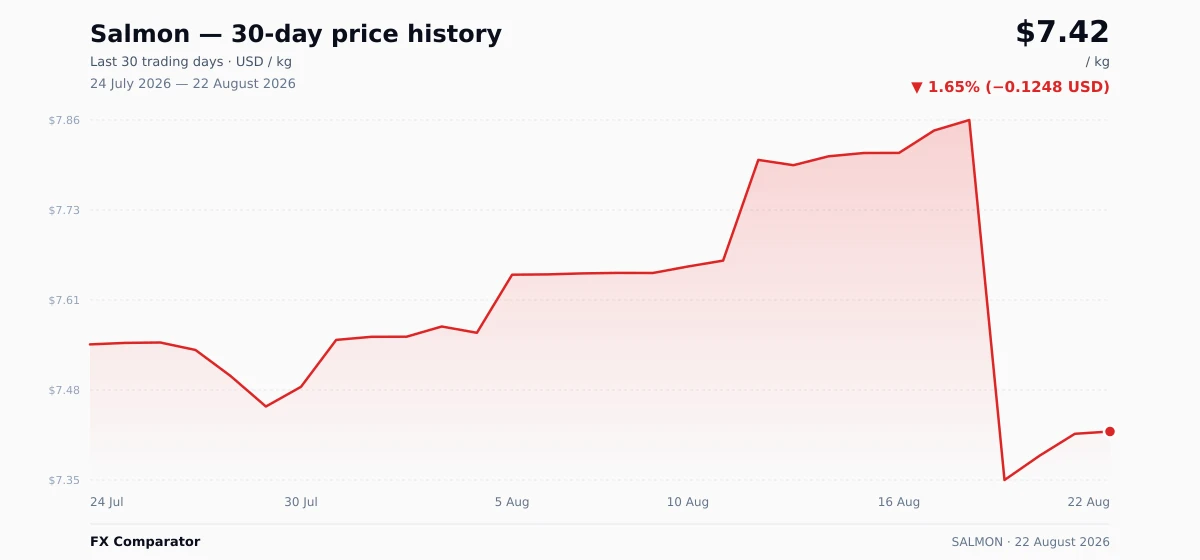
Download chart: WebP
Daily close
29 trading days
| Date | Price (USD) | Price (EUR) | Price (GBP) | Daily change |
|---|---|---|---|---|
| 8 Oct 2026 | US$7.87 | €7.03 | £5.96 | ▲ +0.02% |
| 7 Oct 2026 | US$7.86 | €7.03 | £5.95 | ▲ +1.03% |
| 6 Oct 2026 | US$7.78 | €6.96 | £5.89 | ▲ +0.32% |
| 5 Oct 2026 | US$7.76 | €6.94 | £5.87 | ▲ +0.09% |
| 3 Oct 2026 | US$7.75 | €6.93 | £5.87 | ▼ −0.03% |
| 2 Oct 2026 | US$7.75 | €6.93 | £5.87 | ▼ −0.18% |
| 1 Oct 2026 | US$7.77 | €6.94 | £5.88 | ▼ −0.27% |
| 30 Sept 2026 | US$7.79 | €6.96 | £5.90 | ▲ +1.68% |
| 29 Sept 2026 | US$7.66 | €6.85 | £5.80 | ▼ −0.40% |
| 28 Sept 2026 | US$7.69 | €6.87 | £5.82 | ▼ −0.03% |
| 27 Sept 2026 | US$7.69 | €6.88 | £5.82 | ▼ −0.01% |
| 26 Sept 2026 | US$7.69 | €6.88 | £5.83 | ▼ −0.04% |
| 25 Sept 2026 | US$7.70 | €6.88 | £5.83 | ▼ −0.20% |
| 24 Sept 2026 | US$7.71 | €6.89 | £5.84 | ▼ −0.28% |
| 23 Sept 2026 | US$7.73 | €6.91 | £5.86 | ▲ +4.50% |
| 22 Sept 2026 | US$7.40 | €6.62 | £5.60 | ▼ −0.07% |
| 21 Sept 2026 | US$7.41 | €6.62 | £5.61 | ▲ +0.02% |
| 20 Sept 2026 | US$7.40 | €6.62 | £5.61 | ▼ −0.02% |
| 19 Sept 2026 | US$7.41 | €6.62 | £5.61 | ▼ −0.02% |
| 18 Sept 2026 | US$7.41 | €6.62 | £5.61 | ▼ −0.34% |
| 17 Sept 2026 | US$7.43 | €6.64 | £5.63 | ▼ −0.45% |
| 16 Sept 2026 | US$7.47 | €6.67 | £5.65 | ▲ +2.34% |
| 15 Sept 2026 | US$7.30 | €6.52 | £5.52 | ▼ −0.27% |
| 14 Sept 2026 | US$7.31 | €6.54 | £5.54 | ▼ −0.31% |
| 13 Sept 2026 | US$7.34 | €6.56 | £5.56 | ▼ −0.05% |
| 12 Sept 2026 | US$7.34 | €6.56 | £5.56 | ▼ −0.11% |
| 11 Sept 2026 | US$7.35 | €6.57 | £5.56 | ▼ −0.39% |
| 10 Sept 2026 | US$7.38 | €6.60 | £5.59 | ▲ +0.01% |
| 9 Sept 2026 | US$7.38 | €6.60 | £5.59 | — |