Milk price
Milk currently trades at US$15.00 per Cwt (≈ €13.41 · £11.36) — 15.59% below the 12-month high. Over the past 12 months the price has lost 12.74%, with the annual range running from US$14.61 to US$17.77. In the past 24 hours the price has fallen by 0.13%.


Invest in commodity ETFs from just $50
Gold, oil and even whole commodity sectors through ETFs, all in one account, kept simple.
eToro is a multi-asset investment platform. The value of your investments may go up or down. Your capital is at risk.
Milk chart
Interactive chart and 30-day overview
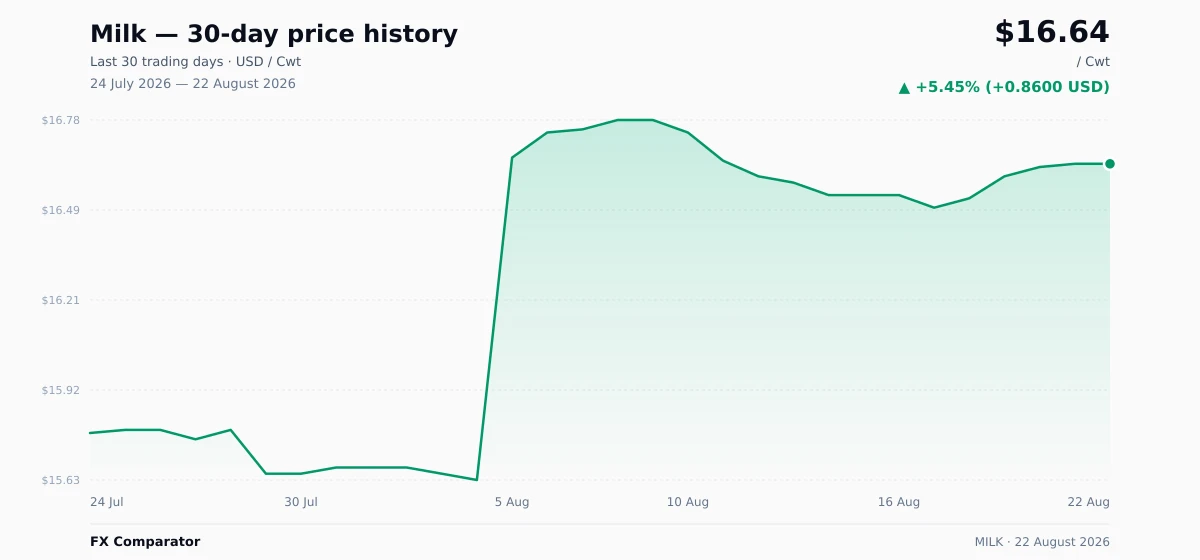
The Milk chart shows how the milk price has moved over time. The interactive view lets you switch the timeframe (from 7 days up to MAX), the currency (USD / EUR / GBP) and overlay moving averages. Click any two points to measure the percentage change between those dates.
How is milk priced?
What drives the price of milk?
The supply side of the milk market is shaped by US production data for the CME benchmark. In the United States, USDA Economic Research Service data show about 9.4 million dairy cows producing roughly 103 million tonnes of milk a year. Global milk production is about 930 million tonnes a year across all categories. The largest contributors are India at about 225 Mt a year, including buffalo milk and mostly for domestic consumption; the European Union at about 145 Mt; the United States at about 103 Mt; China at about 37 Mt; and New Zealand at about 22 Mt. A structural feature of developed markets is that dairy herds are shrinking slowly, while yield per cow has been rising for years, helped by genetics, feed optimisation and automated milking systems. Total output is therefore broadly stable or growing slowly.
The main gauge of producer margins is the milk-feed price ratio — the relationship between the selling price of milk and feed costs. Milk production relies on three main feed inputs: corn silage as an energy source, alfalfa hay for protein and fibre, and soybean meal as a concentrated protein supplement. If corn or soybean prices rise — for example because of US drought, a South American La Niña or disruption to Black Sea exports — dairy farmers’ margins narrow. Over the medium to longer term, that can restrict supply through forced culling or herd liquidation. The USDA’s monthly Milk Production and Dairy Products reports, together with Chicago corn and soybean prices, help drive the CME Class III price.
On the demand side, Chinese milk powder imports are the main external impulse for the global dairy market. China’s domestic milk production, at about 37 Mt a year, is not enough to meet rising consumption, so it imports large volumes of whole milk powder (WMP) and skim milk powder (SMP), mainly from New Zealand. Global milk powder trade is dominated by Fonterra, the New Zealand dairy co-operative, which sets a key reference price through the fortnightly Global Dairy Trade (GDT) auction. A weak GDT auction, often linked to softer Chinese buying, can push part of the global milk powder surplus back towards the US market through arbitrage. That can show up in both Class III and Class IV contracts. Demand for butter and cheese, especially European cheese consumption and mozzarella demand from the US pizza sector, directly supports the Class III price.
How to invest in milk
Holding physical raw milk is not a practical retail investment. Milk is perishable, depends on a cold chain and is traded largely through business-to-business transactions linked to processors. A European retail investor can gain exposure to the milk market in three main ways: milk CFDs linked to the CME Class III Milk (DC) price, available at some brokers but with thinner liquidity than cocoa or corn; shares in diversified dairy processors and food companies, including Saputo — SAP.TO, the Canadian cheese producer, Nestlé — NESN.SW, Danone — BN.PA and Glanbia — GLB.IR, the Irish ingredients group; and shares in New Zealand’s Fonterra — FCG.NZ dairy co-operative, which is directly exposed to GDT auction pricing. Two regulated brokers offering access to some of these instruments are:
30-day price history
Chart and daily closing prices
Download chart: WebP
Daily close
22 trading days
| Date | Price (USD) | Price (EUR) | Price (GBP) | Daily change |
|---|---|---|---|---|
| 8 Oct 2026 | US$15.00 | €13.41 | £11.36 | ▼ −0.13% |
| 7 Oct 2026 | US$15.02 | €13.43 | £11.37 | ▼ −0.27% |
| 6 Oct 2026 | US$15.06 | €13.46 | £11.40 | ▲ +0.60% |
| 5 Oct 2026 | US$14.97 | €13.38 | £11.33 | ▲ +0.20% |
| 3 Oct 2026 | US$14.94 | €13.36 | £11.31 | ▼ −0.13% |
| 2 Oct 2026 | US$14.96 | €13.37 | £11.33 | ▼ −0.93% |
| 1 Oct 2026 | US$15.10 | €13.50 | £11.43 | ▲ +1.48% |
| 30 Sept 2026 | US$14.88 | €13.30 | £11.27 | ▼ −7.58% |
| 28 Sept 2026 | US$16.10 | €14.39 | £12.19 | ▼ −0.12% |
| 25 Sept 2026 | US$16.12 | €14.41 | £12.21 | ▼ −0.06% |
| 24 Sept 2026 | US$16.13 | €14.42 | £12.21 | ▲ +0.06% |
| 23 Sept 2026 | US$16.12 | €14.41 | £12.21 | ▼ −0.12% |
| 22 Sept 2026 | US$16.14 | €14.43 | £12.22 | ▼ −0.06% |
| 21 Sept 2026 | US$16.15 | €14.44 | £12.23 | ▼ −0.06% |
| 18 Sept 2026 | US$16.16 | €14.45 | £12.24 | ▲ +0.06% |
| 17 Sept 2026 | US$16.15 | €14.44 | £12.23 | ▲ +0.12% |
| 16 Sept 2026 | US$16.13 | €14.42 | £12.21 | ▲ +0.12% |
| 15 Sept 2026 | US$16.11 | €14.40 | £12.20 | ▼ −0.06% |
| 14 Sept 2026 | US$16.12 | €14.41 | £12.21 | ▼ −0.19% |
| 11 Sept 2026 | US$16.15 | €14.44 | £12.23 | ▲ +0.12% |
| 10 Sept 2026 | US$16.13 | €14.42 | £12.21 | ▼ −0.31% |
| 9 Sept 2026 | US$16.18 | €14.46 | £12.25 | — |