Palm oil price
Palm oil currently trades at US$1,123 per tonne (≈ €1,002 · £849.73) — close to the 12-month high. Over the past 12 months the price has gained 0.82%, with the annual range running from US$954.19 to US$1,241. 24-hour movement is minimal (±0.00%).

Invest in commodity ETFs from just $50
Gold, oil and even whole commodity sectors through ETFs, all in one account, kept simple.
eToro is a multi-asset investment platform. The value of your investments may go up or down. Your capital is at risk.
Palm oil chart
Interactive chart and 30-day overview
The Palm oil chart shows how the palm oil price has moved over time. The interactive view lets you switch the timeframe (from 7 days up to MAX), the currency (USD / EUR / GBP) and overlay moving averages. Click any two points to measure the percentage change between those dates.
How is palm oil priced?
Palm oil is priced per metric tonne (1 t = 1,000 kg) — the standard unit for industrial and bulk commodities on the London Metal Exchange (LME), CME and major European exchanges. Wholesale shipments move in containers or bulk vessels, typically in 25-tonne or 100-tonne lots.
At US$1,123 per tonne, one kilogram is worth US$1.12. End-user pricing for processed goods includes refining margins, transport and tariffs on top of the wholesale benchmark.
What drives the price of palm oil?
The main structural force in the palm oil market is Indonesian state export policy. Indonesia accounts for ~58% of global palm oil production, at about ~47 million tonnes a year, and the government actively regulates how much stays in the domestic market and how much is exported. The most important tool is the Indonesian biodiesel mandate: the compulsory blending of palm oil-based biodiesel into domestic diesel absorbs roughly 13 million tonnes of palm oil a year. Indonesia also uses the DMO (Domestic Market Obligation) and DPO (Domestic Price Obligation) from time to time. In one earlier episode, the government imposed a full export ban for several weeks to curb domestic cooking-oil prices, immediately disrupting FCPO prices. Market participants track data from GAPKI (Gabungan Pengusaha Kelapa Sawit Indonesia, the Indonesian Palm Oil Association) and Indonesian finance ministry export releases.
On the demand side, the key variable is Indian and Chinese cooking-oil demand. India is the world’s largest palm oil importer, at about ~8 million tonnes a year. Palm oil supplies much of its domestic cooking-oil consumption and is a major input for processed foods such as instant noodles, biscuits and snacks. India’s monthly import data are published by the Solvent Extractors' Association of India (SEA). China is the second-largest buyer, at about ~7 Mt a year, with demand concentrated in processed foods and oleochemicals. Together, the two countries absorb a large share of global palm oil exports, so changes in Indian import duties or weaker Chinese demand are quickly reflected in FCPO prices. Relative prices for competing vegetable oils — soybean, sunflower and rapeseed oil — also matter. When palm oil trades at a premium, buyers switch to substitutes and the spread widens.
The third structural factor is EU sustainability regulation, which adds compliance costs to the palm oil market. The RED III renewable energy directive gradually removes palm oil from EU biofuel-renewable accounting, citing deforestation and high ILUC risk (indirect land use change). The EUDR (EU Deforestation Regulation) requires geolocation traceability and deforestation-free proof for every palm oil cargo entering the EU market. Suppliers must show that the producing plantation was not established through deforestation after the cut-off date set by the regulation. A fourth factor is the Malaysian and Indonesian harvest cycle. Oil-palm fruit maturity depends on El Niño / La Niña cycles, rainfall and fertiliser intensity. Monthly production, inventory and export reports from the MPOB (Malaysian Palm Oil Board), together with global supply estimates from Oil World, are among the market’s most important data points.
How to invest in palm oil
Holding physical palm oil is not practical for retail investors. It is an industrial commodity that requires climate-controlled storage and a B2B logistics chain. A European retail investor has three main routes to palm oil exposure: palm oil CFDs that track the Bursa Malaysia FCPO price directly, listed on some platforms under the PALM or FCPO ticker; individual plantation-owner shares, such as Malaysia’s Sime Darby Plantation — SDPL.KL and IOI Corporation — IOI.KL, Singapore-listed Wilmar International — F34.SI and Golden Agri-Resources — E5H.SI; and exposure through the processing and trading chain, with Wilmar as an integrated crusher, refiner and trader. Examples of regulated brokers that may offer these instruments include:
30-day price history
Chart and daily closing prices
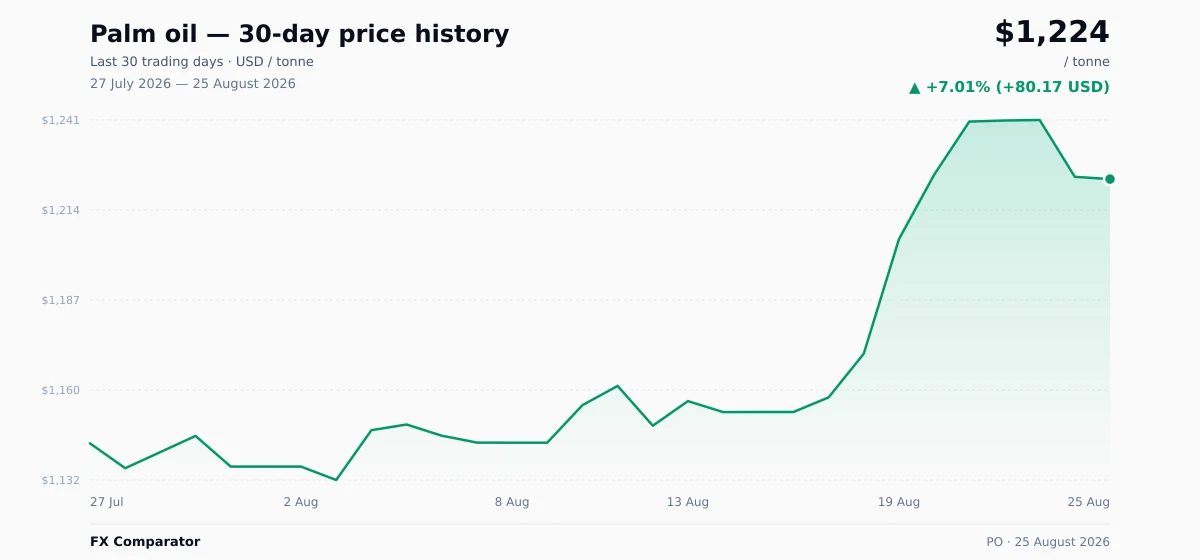
Download chart: WebP
Daily close
27 trading days
| Date | Price (USD) | Price (EUR) | Price (GBP) | Daily change |
|---|---|---|---|---|
| 9 Oct 2026 | US$1,123 | €1,002 | £849.73 | ▼ −1.49% |
| 8 Oct 2026 | US$1,140 | €1,018 | £862.54 | ▲ +2.98% |
| 7 Oct 2026 | US$1,107 | €988.11 | £837.56 | ▼ −0.81% |
| 6 Oct 2026 | US$1,116 | €996.15 | £844.37 | ▼ −0.40% |
| 5 Oct 2026 | US$1,121 | €1,000 | £847.76 | ▲ +0.93% |
| 2 Oct 2026 | US$1,111 | €991.00 | £840.00 | ▼ −0.46% |
| 1 Oct 2026 | US$1,116 | €995.59 | £843.90 | ▼ −1.38% |
| 30 Sept 2026 | US$1,131 | €1,010 | £855.74 | ▼ −0.14% |
| 29 Sept 2026 | US$1,133 | €1,011 | £856.97 | ▼ −0.95% |
| 28 Sept 2026 | US$1,144 | €1,021 | £865.14 | ▼ −0.20% |
| 27 Sept 2026 | US$1,146 | €1,023 | £866.88 | ▲ +0.01% |
| 26 Sept 2026 | US$1,146 | €1,023 | £866.80 | ▲ +0.05% |
| 25 Sept 2026 | US$1,145 | €1,022 | £866.33 | ▼ −2.04% |
| 24 Sept 2026 | US$1,169 | €1,043 | £884.40 | ▼ −0.06% |
| 23 Sept 2026 | US$1,170 | €1,044 | £884.96 | ▼ −0.86% |
| 22 Sept 2026 | US$1,180 | €1,053 | £892.60 | ▼ −0.90% |
| 21 Sept 2026 | US$1,191 | €1,063 | £900.70 | ▼ −0.65% |
| 20 Sept 2026 | US$1,199 | €1,070 | £906.60 | ▲ +0.02% |
| 19 Sept 2026 | US$1,198 | €1,069 | £906.44 | ▲ +0.03% |
| 18 Sept 2026 | US$1,198 | €1,069 | £906.19 | ▲ +1.79% |
| 17 Sept 2026 | US$1,177 | €1,050 | £890.24 | ▼ −1.59% |
| 16 Sept 2026 | US$1,196 | €1,067 | £904.67 | ▼ −0.12% |
| 15 Sept 2026 | US$1,197 | €1,069 | £905.78 | ▲ +0.55% |
| 14 Sept 2026 | US$1,191 | €1,063 | £900.82 | ▲ +0.66% |
| 13 Sept 2026 | US$1,183 | €1,056 | £894.95 | ▼ −0.01% |
| 12 Sept 2026 | US$1,183 | €1,056 | £895.06 | ▼ −0.02% |
| 11 Sept 2026 | US$1,184 | €1,056 | £895.23 | — |