Pulp price
Pulp currently trades at US$4,788 per tonne (≈ €4,280 · £3,625) — 13.85% below the 12-month high. In the past 24 hours the price has fallen by 0.21%.

Invest in commodity ETFs from just $50
Gold, oil and even whole commodity sectors through ETFs, all in one account, kept simple.
eToro is a multi-asset investment platform. The value of your investments may go up or down. Your capital is at risk.
Pulp chart
Interactive chart and 30-day overview
The Pulp chart shows how the pulp price has moved over time. The interactive view lets you switch the timeframe (from 7 days up to MAX), the currency (USD / EUR / GBP) and overlay moving averages. Click any two points to measure the percentage change between those dates.
How is pulp priced?
Pulp is priced per metric tonne (1 t = 1,000 kg) — the standard unit for industrial and bulk commodities on the London Metal Exchange (LME), CME and major European exchanges. Wholesale shipments move in containers or bulk vessels, typically in 25-tonne or 100-tonne lots.
At US$4,788 per tonne, one kilogram is worth US$4.79. End-user pricing for processed goods includes refining margins, transport and tariffs on top of the wholesale benchmark.
What drives the price of pulp?
The main demand factor in the pulp market is Chinese consumption. China accounts for roughly 40% of global market-pulp imports. A domestic fibre deficit — China does not have enough softwood plantations to meet its own needs — is covered by seaborne imports of NBSK and BEK (Bleached Eucalyptus Kraft, eucalyptus-based hardwood pulp). Chinese demand is especially strong in two segments: tissue paper and packaging paper (kraftliner, fluting). Growth in tissue consumption is driven by the expansion of the middle class and higher per-capita use of household paper towels, tissues and toilet paper. Per-capita tissue consumption in China remains well below North American and western European levels, leaving room for structural catch-up. Packaging-paper demand is tied to volumes in e-commerce logistics (Alibaba, JD.com, Pinduoduo) and also correlates with global container-shipping traffic. The market is tracked through weekly USD-per-tonne CIF China assessments from Fastmarkets RISI and Argus, as well as the yuan-denominated SP contract on the Shanghai Futures Exchange (SHFE).
On the supply side, the market is shaped by access to Canadian and Scandinavian softwood logs. Global market-pulp output is roughly 70 million tonnes a year. Within that, Brazil is the largest producer, at about 25 million tonnes a year, mostly eucalyptus-based BEK rather than NBSK. Canada, at about 10 million tonnes a year, is the benchmark producer in the NBSK segment. Finland and Sweden, each at around 5–5 million tonnes, are the main sources of European NBSK supply. Among North American companies, Canfor Pulp Products, West Fraser and Domtar are the most significant. On the Scandinavian side, UPM-Kymmene (UPM.HE), Stora Enso (STERV.HE) and Metsä Fibre dominate. The market is often sensitive to wildfires in British Columbia and to pulp-mill closures in the province, which have structurally tightened NBSK supply.
The third structural factor is the competition between virgin fibre and recovered fibre. A large share of global paper production is now made from recovered paper — Old Corrugated Containers (OCC), Old Newsprint (ONP) and Mixed Office Waste — bought by paper mills in China, Europe and North America. When OCC prices rise, for example because of stricter Chinese waste-import rules or lower recovered-paper collection, fresh NBSK pulp becomes more competitive in relative terms, and tissue and kraftliner producers increase the share of virgin fibre in their fibre mix. In the tissue segment (toilet paper, paper towels), virgin fibre dominates. Tissue made with recycled fibre tends to have lower softness and bulk than tissue made from virgin fibre. The market is followed through Pöyry — now AFRY — Pulp Market reports and annual statistics from the EU Confederation of European Paper Industries (CEPI). Core industry data points are published quarterly.
How to invest in pulp
Holding physical pulp is not practical for retail investors. Market NBSK is an industrial raw material that needs climate-controlled storage and a B2B logistics chain. A European retail investor can get pulp exposure in three main ways: through pulp CFDs, which on some platforms track the SHFE Pulp contract directly under the PULP ticker, although this CFD is not available at every retail broker; through integrated pulp and paper companies, including Brazil’s Suzano — SUZ, the world’s largest market-pulp producer, Europe’s UPM-Kymmene — UPM.HE and Stora Enso — STERV.HE, and North America’s Mercer International and Canfor Pulp; and indirectly through shares in packaging and tissue-product manufacturers such as Kimberly-Clark, Essity and Mondi. Two regulated brokers with English-language platforms where pulp and paper industry shares are available are:
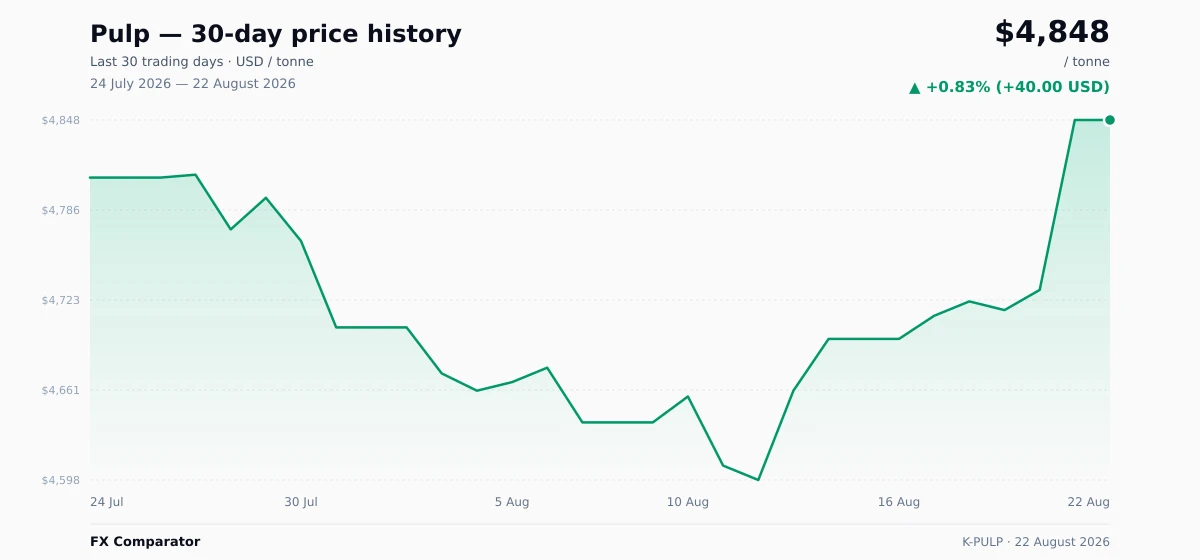
30-day price history
Chart and daily closing prices
Download chart: WebP
Daily close
15 trading days
| Date | Price (USD) | Price (EUR) | Price (GBP) | Daily change |
|---|---|---|---|---|
| 8 Oct 2026 | US$4,788 | €4,280 | £3,625 | ▼ −0.21% |
| 30 Sept 2026 | US$4,798 | €4,289 | £3,633 | ▼ −0.46% |
| 28 Sept 2026 | US$4,820 | €4,309 | £3,650 | ▼ −1.55% |
| 24 Sept 2026 | US$4,896 | €4,377 | £3,707 | ▼ −0.41% |
| 23 Sept 2026 | US$4,916 | €4,395 | £3,722 | ▼ −0.93% |
| 22 Sept 2026 | US$4,962 | €4,436 | £3,757 | ▲ +0.49% |
| 21 Sept 2026 | US$4,938 | €4,414 | £3,739 | ▲ +3.05% |
| 18 Sept 2026 | US$4,792 | €4,284 | £3,628 | ▲ +0.76% |
| 17 Sept 2026 | US$4,756 | €4,252 | £3,601 | ▼ −1.33% |
| 16 Sept 2026 | US$4,820 | €4,309 | £3,650 | ▲ +1.64% |
| 15 Sept 2026 | US$4,742 | €4,239 | £3,591 | ▼ −1.04% |
| 14 Sept 2026 | US$4,792 | €4,284 | £3,628 | ▼ −0.17% |
| 11 Sept 2026 | US$4,800 | €4,291 | £3,634 | ▼ −0.37% |
| 10 Sept 2026 | US$4,818 | €4,307 | £3,648 | ▼ −1.19% |
| 9 Sept 2026 | US$4,876 | €4,359 | £3,692 | — |