Soybean meal price
Soybean meal currently trades at US$361.77 per bushel (≈ €323.56 · £273.34) — close to the 12-month high. Over the past 12 months the price has gained 30.61%, with the annual range running from US$275.61 to US$371.49. In the past 24 hours the price has fallen by 1.23%.

Invest in commodity ETFs from just $50
Gold, oil and even whole commodity sectors through ETFs, all in one account, kept simple.
eToro is a multi-asset investment platform. The value of your investments may go up or down. Your capital is at risk.
Soybean meal chart
Interactive chart and 30-day overview
The Soybean meal chart shows how the soybean meal price has moved over time. The interactive view lets you switch the timeframe (from 7 days up to MAX), the currency (USD / EUR / GBP) and overlay moving averages. Click any two points to measure the percentage change between those dates.
How is soybean meal priced?
Soybean meal is priced per bushel — the historical US grain measure (1 bushel ≈ 27.2 kg of wheat or soybean, ≈ 25.4 kg of corn). The bushel remains the standard on the Chicago Board of Trade (CBOT) grain futures.
At US$361.77 per bushel, one tonne is worth around US$13,277. Global grain trade increasingly references the tonne, but the bushel persists as the price-discovery unit on the CBOT — where USDA WASDE supply-and-demand reports drive most short-term moves.
What drives the price of soybean meal?
The price of soybean meal is not set as a standalone supply-and-demand product. It is a by-product of soybean-crush economics. A processor, or crusher, turns soybeans into roughly 80% soybean meal and 20% soybean oil by weight through industrial pressing and solvent extraction. The prices of the two products together determine the crusher’s margin. The "board crush" indicator is the dollar-denominated processing spread calculated from CBOT soybean (ZS), soybean meal (ZM) and soybean oil (ZL) futures. If it improves, processors such as Bunge, ADM, Cargill and Cofco crush more soybeans. Meal supply rises and downward pressure builds on meal prices. If the crush margin deteriorates, usually because meal or oil prices weaken, crush capacity utilisation falls and supply tightens.
Demand is dominated by global livestock protein demand. About 98% of soybean meal produced is used in feed, mainly as a core protein ingredient for poultry, pigs, dairy and aquaculture. The single most important factor is the Chinese pig herd. China consumes about 75 Mt of soybean meal a year, much of it in feed for a herd numbering in the hundreds of millions. Waves of African swine fever (ASF) have repeatedly reshaped Chinese demand since the major outbreak in China. Large herd losses have been followed by sharp weakness in ZM, while herd rebuilding has had a price-supportive effect of similar scale. The market therefore follows quarterly pig-herd data from China’s National Bureau of Statistics (NBS) and port soybean-import statistics closely.
International trade is dominated by Argentine and Brazilian crusher output. Argentina is the world’s largest soybean meal exporter, shipping about 32 Mt a year, or roughly 40% of global exports. Soy processing is deeply embedded in the Argentine economy, with exports moving through the Rosario port cluster on the Paraná River. Weekly output and loading data from CIARA (Cámara de la Industria Aceitera) and CEC (Centro Exportador de Cereales) are among the main reference points for the global ZM market. Periodic Argentine oilseed-processing and port strikes are a market risk for Chicago prices. Brazil, with about 42 Mt of production, and the United States, with about 50 Mt, are the other two major players. Global soybean meal production is about 260 Mt a year, most of which is absorbed by domestic use.
How to invest in soybean meal
Physical ownership of soybean meal is not practical for retail investors. The product trades in industrial volumes, mainly through B2B channels between feed mills and large crushers such as ADM, Bunge, Cargill and Cofco International. For a European retail investor, market exposure is available in three main forms: soybean meal CFDs linked to the CBOT ZM futures contract, which is less liquid than soybeans or corn; futures contracts traded directly on CBOT; and shares in soybean processors and agribusiness groups, including Archer Daniels Midland (ADM) and Bunge (BG). Cargill and Cofco International are not listed. Two regulated brokers where soybean meal CFDs and agribusiness shares may be available are:
30-day price history
Chart and daily closing prices
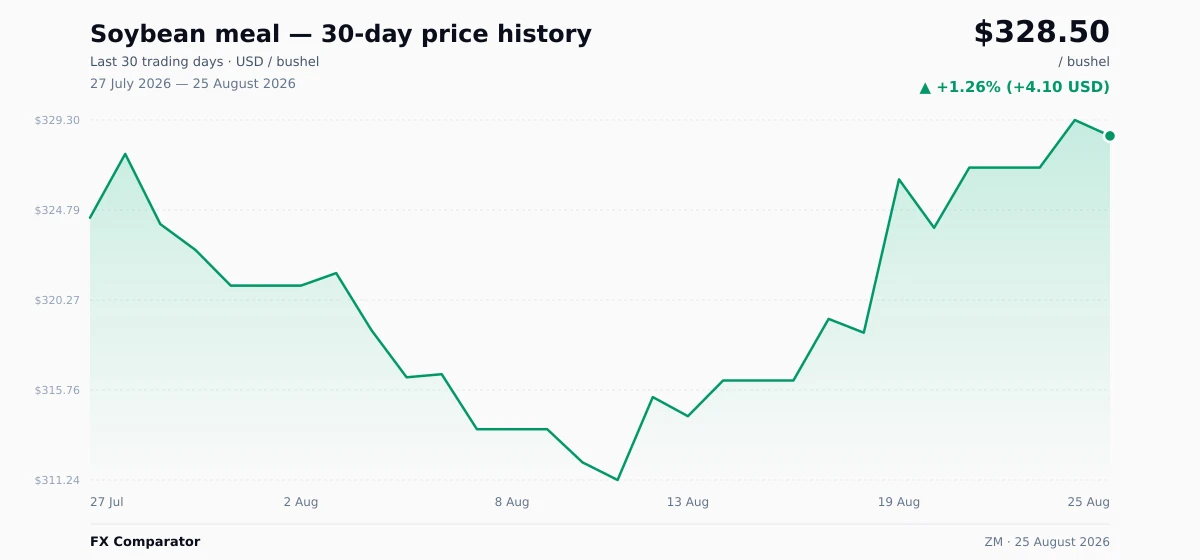
Download chart: WebP
Daily close
22 trading days
| Date | Price (USD) | Price (EUR) | Price (GBP) | Daily change |
|---|---|---|---|---|
| 13 Oct 2026 | US$361.77 | €323.56 | £273.34 | ▼ −1.23% |
| 12 Oct 2026 | US$366.27 | €327.58 | £276.74 | ▲ +0.50% |
| 9 Oct 2026 | US$364.44 | €325.94 | £275.35 | ▲ +2.04% |
| 8 Oct 2026 | US$357.14 | €319.42 | £269.84 | ▼ −2.13% |
| 7 Oct 2026 | US$364.91 | €326.36 | £275.71 | ▲ +2.54% |
| 6 Oct 2026 | US$355.88 | €318.29 | £268.89 | ▲ +2.33% |
| 5 Oct 2026 | US$347.78 | €311.04 | £262.77 | ▲ +0.18% |
| 2 Oct 2026 | US$347.17 | €310.50 | £262.30 | ▼ −1.62% |
| 1 Oct 2026 | US$352.90 | €315.62 | £266.63 | ▼ −1.08% |
| 30 Sept 2026 | US$356.75 | €319.07 | £269.54 | ▼ −0.70% |
| 29 Sept 2026 | US$359.25 | €321.30 | £271.43 | ▼ −0.06% |
| 28 Sept 2026 | US$359.46 | €321.49 | £271.59 | ▼ −2.86% |
| 25 Sept 2026 | US$370.05 | €330.96 | £279.59 | ▼ −0.16% |
| 24 Sept 2026 | US$370.65 | €331.50 | £280.04 | ▲ +0.11% |
| 23 Sept 2026 | US$370.26 | €331.15 | £279.75 | ▼ −0.25% |
| 22 Sept 2026 | US$371.18 | €331.97 | £280.45 | ▲ +0.87% |
| 21 Sept 2026 | US$367.99 | €329.12 | £278.03 | ▲ +2.42% |
| 18 Sept 2026 | US$359.30 | €321.35 | £271.47 | ▼ −3.28% |
| 17 Sept 2026 | US$371.49 | €332.25 | £280.68 | ▲ +1.10% |
| 16 Sept 2026 | US$367.44 | €328.63 | £277.62 | ▲ +0.38% |
| 15 Sept 2026 | US$366.04 | €327.38 | £276.56 | ▲ +2.52% |
| 14 Sept 2026 | US$357.03 | €319.32 | £269.75 | — |