Sugar UK No 5 price
Sugar UK No 5 currently trades at US$552.87 per tonne (≈ €494.25 · £418.62) — close to the 12-month high. Over the past 12 months the price has gained 22.61%, with the annual range running from US$394.30 to US$564.67. In the past 24 hours the price has fallen by 1.76%.


Invest in commodity ETFs from just $50
Gold, oil and even whole commodity sectors through ETFs, all in one account, kept simple.
eToro is a multi-asset investment platform. The value of your investments may go up or down. Your capital is at risk.
Sugar UK No 5 chart
Interactive chart and 30-day overview
The Sugar UK No 5 chart shows how the sugar UK No 5 price has moved over time. The interactive view lets you switch the timeframe (from 7 days up to MAX), the currency (USD / EUR / GBP) and overlay moving averages. Click any two points to measure the percentage change between those dates.
How is sugar UK No 5 priced?
Sugar UK No 5 is priced per metric tonne (1 t = 1,000 kg) — the standard unit for industrial and bulk commodities on the London Metal Exchange (LME), CME and major European exchanges. Wholesale shipments move in containers or bulk vessels, typically in 25-tonne or 100-tonne lots.
At US$552.87 per tonne, one kilogram is worth US$0.5529. End-user pricing for processed goods includes refining margins, transport and tariffs on top of the wholesale benchmark.
What drives the price of white sugar (Sugar No. 5)?
The refining margin — the gap between London Sugar No. 5, the white refined sugar contract, and New York Sugar No. 11, the raw cane sugar contract, known in the market as the white-raw spread — is the most direct pricing factor in the Sugar No. 5 market. The spread reflects the per-tonne margin of large refiners such as Tate & Lyle, ED&F Man, Südzucker and Cosan. When the spread is narrow, refining is loss-making, refiners draw down inventories and cut capacity utilisation, which directly tightens white sugar supply. When the spread is wide, refiners compete for raw sugar, which can also push up the New York Sugar No. 11 price. Czarnikow publishes a monthly estimate of global refining margins.
Indian and Thai export policy is the second major factor. India is the world’s second-largest sugar producer and has about 6 million tonnes of annual white sugar export capacity. The government, however, imposes export licences or quotas depending on monsoon rainfall and domestic stock levels. The announcement of tighter curbs can move the London contract within minutes. Thailand produces about 10 million tonnes of sugar a year, roughly 10% of global exports, so weather during the cane harvest and droughts have a direct effect on global refined sugar supply. The USDA Foreign Agricultural Service publishes monthly crop and export estimates.
The EU sugar reform is a longer-term structural factor. The EU abolished sugar beet production quotas and has since periodically been a net exporter of beet sugar, with annual output of about 17 million tonnes, mainly from France, Germany and Poland. EU beet sugar is closely aligned with the London Sugar No. 5 benchmark, which European refiners such as Südzucker, Tereos and Cristal Union use as a pricing reference. Global trade in refined white sugar is about 30 million tonnes a year. Brazil’s roughly 30 million tonnes of raw sugar exports and the regional refining role of Mauritius, Algeria and Indonesia shape the flow map. Higher oil prices can tighten raw sugar availability through Brazil’s sugar-ethanol production switch, and the white sugar price tends to reflect that.
How to invest in white sugar
Investors can access the white sugar market without taking physical delivery through exchange-traded futures, notably ICE Futures Europe White Sugar No. 5, SUGAR CFD products, where most brokers track the ICE US Sugar No. 11 raw sugar contract but some platforms also offer No. 5 white sugar, the CANE (Teucrium Sugar Fund) ETF, and shares of large companies in the sugar value chain. These include Tate & Lyle (TATE.L), the UK industrial sweeteners group, Südzucker (SZU.DE), Europe’s largest beet sugar refiner, and Cosan (CSAN3.SA), the large integrated Brazilian sugar and ethanol producer. Futures contracts and SUGAR CFDs offer the closest commodity exposure. Shares add company-specific business-model risk. Two EU-regulated brokers with English-language platforms where sugar CFDs and sugar-related shares are available:
30-day price history
Chart and daily closing prices
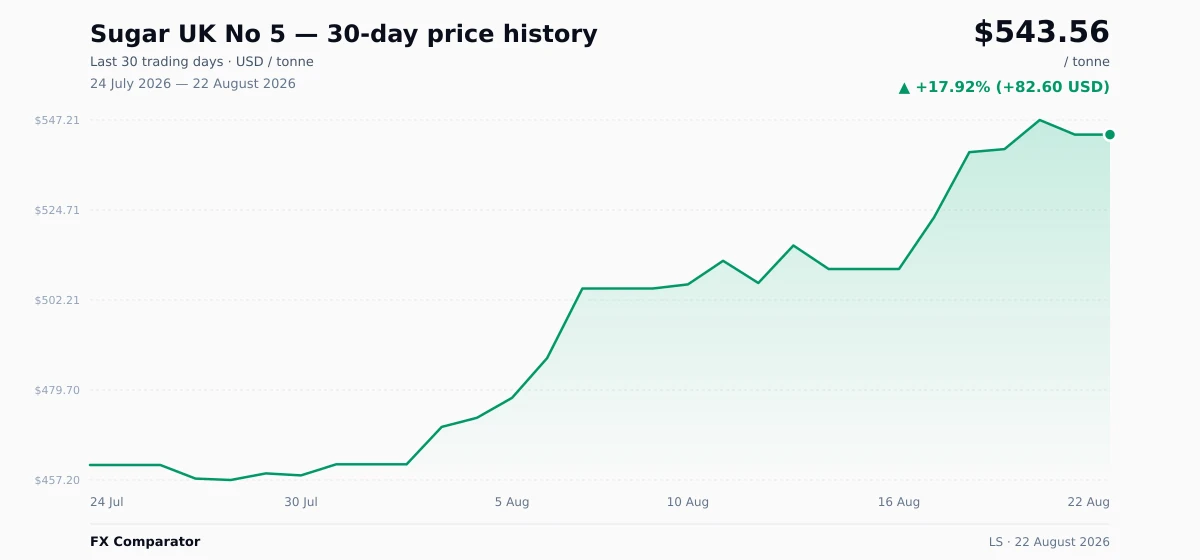
Download chart: WebP
Daily close
22 trading days
| Date | Price (USD) | Price (EUR) | Price (GBP) | Daily change |
|---|---|---|---|---|
| 8 Oct 2026 | US$552.87 | €494.25 | £418.62 | ▼ −1.76% |
| 7 Oct 2026 | US$562.77 | €503.10 | £426.12 | ▼ −0.34% |
| 6 Oct 2026 | US$564.67 | €504.80 | £427.56 | ▲ +1.85% |
| 5 Oct 2026 | US$554.42 | €495.63 | £419.80 | ▲ +3.29% |
| 2 Oct 2026 | US$536.75 | €479.84 | £406.42 | ▲ +4.70% |
| 1 Oct 2026 | US$512.67 | €458.31 | £388.18 | ▲ +0.40% |
| 30 Sept 2026 | US$510.61 | €456.47 | £386.62 | ▼ −0.56% |
| 29 Sept 2026 | US$513.48 | €459.04 | £388.80 | ▲ +1.12% |
| 28 Sept 2026 | US$507.77 | €453.93 | £384.47 | ▲ +0.48% |
| 25 Sept 2026 | US$505.32 | €451.74 | £382.62 | ▼ −1.38% |
| 24 Sept 2026 | US$512.38 | €458.05 | £387.96 | ▲ +0.66% |
| 23 Sept 2026 | US$509.03 | €455.06 | £385.43 | ▼ −0.15% |
| 22 Sept 2026 | US$509.79 | €455.74 | £386.00 | ▲ +0.33% |
| 21 Sept 2026 | US$508.13 | €454.25 | £384.75 | ▼ −0.53% |
| 18 Sept 2026 | US$510.84 | €456.68 | £386.80 | ▲ +0.43% |
| 17 Sept 2026 | US$508.67 | €454.74 | £385.15 | ▼ −2.97% |
| 16 Sept 2026 | US$524.23 | €468.65 | £396.94 | ▼ −0.48% |
| 15 Sept 2026 | US$526.77 | €470.92 | £398.86 | ▼ −0.22% |
| 14 Sept 2026 | US$527.91 | €471.94 | £399.72 | ▲ +0.28% |
| 11 Sept 2026 | US$526.41 | €470.59 | £398.59 | ▼ −2.60% |
| 10 Sept 2026 | US$540.46 | €483.16 | £409.23 | ▲ +0.45% |
| 9 Sept 2026 | US$538.06 | €481.01 | £407.41 | — |