Fund vs ETF fee calculator
A €20,000 investment into an active fund at 2 % annual TER costs more than €40,000 extra over 25 years compared with an ETF at 0.2 %. Run the numbers yourself below.
FX Editorial Team Updated: May 26, 2026 How to use it?
Fees are the long-term investor's hidden enemy. A 1–2 % gap looks trivial; over 20–30 years it adds up to tens of thousands of euros. The calculator below puts two scenarios side by side — typically an active fund against a low-cost ETF at 0.2 % TER — and shows the real impact of the fee on the ending balance.
Scenario A — more expensive
€221,061
- Total fees paid
- €47,820
Scenario B — cheaper
€323,827
- Total fees paid
- €6,252
Difference — what the higher fee costs
€102,766
46 % less than Scenario AInvestment horizon: 25 yrs
Portfolio value over time
- Scenario A (2.0 %)
- Scenario B (0.2 %)
- Difference
Year-by-year breakdown
| Year | Scenario A | Scenario B | Difference | Cumul. fees A | Cumul. fees B |
|---|---|---|---|---|---|
| 1 | €22,990 | €24,105 | €1,115 | €421 | €44 |
| 2 | €26,801 | €28,541 | €1,741 | €915 | €96 |
| 3 | €30,847 | €33,336 | €2,490 | €1,488 | €157 |
| 4 | €35,142 | €38,519 | €3,377 | €2,143 | €229 |
| 5 | €39,703 | €44,121 | €4,418 | €2,888 | €311 |
| 6 | €44,545 | €50,176 | €5,631 | €3,726 | €405 |
| 7 | €49,686 | €56,721 | €7,035 | €4,663 | €511 |
| 8 | €55,143 | €63,794 | €8,651 | €5,706 | €631 |
| 9 | €60,937 | €71,440 | €10,502 | €6,862 | €765 |
| 10 | €67,089 | €79,703 | €12,614 | €8,136 | €915 |
This calculator is for guidance only. Actual returns and fees may differ.
Important disclaimer
This calculator is for educational and informational purposes only — it does not constitute investment advice. Calculations are approximations; despite careful work, rounding errors or technical bugs may occur. Real-world returns, fees, inflation and taxes can diverge from the values entered, and past or projected returns do not guarantee future results. Consult a qualified financial adviser before making any investment decision.
How to use the calculator in 3 steps
-
Enter the shared parameters
Set the starting deposit, monthly contribution, time horizon and expected gross return. These are identical across both scenarios so the only variable being compared is the fee.
-
Set the fees for both scenarios
In Scenario A, enter the fees of your current fund (annual TER + entry load). In Scenario B, enter the fees of the alternative you're considering.
-
Read the result
The red box in the middle shows the difference — the concrete amount the higher fees cost you. The table shows the year-by-year breakdown.
€40,000+ lost to fees — how it happens
Imagine two investors. Both put €20,000 down as a lump sum and add €200 a month for 25 years. Both earn the same 8 % gross annual return. The only difference: the first pays a 2 % annual fee inside a fund, the second 0.2 % inside an ETF. The result — a gap of more than €40,000.
This isn't hypothetical — those are the calculator's default settings above. The reason is mechanical: the fee is charged on the entire portfolio, not on the contributions. By year 15, the 2 % is no longer being applied to €20,000; it is being applied to a six-figure pot, including all accumulated returns. The drag accelerates each year.
What "annual fee" really means and where to find it
On the fund factsheet, look for the TER (Total Expense Ratio) or "ongoing charges". It bundles fund management, administration and every recurring cost — a single number telling you what share of your portfolio leaks out in fees each year.
Typical European ranges: actively managed mutual funds usually charge 1.5–2.5 % a year. Index-tracking ETFs sit between 0.05–0.30 %. Robo-advisers (Trade Republic Pension, Scalable Capital, Vanguard LifeStrategy and similar) generally land at 0.5–1.2 % all-in.
Entry fees: a hidden tax on every contribution
The entry fee (also called "front-end load" or "subscription fee") is deducted from every euro you put in — the lump sum and every monthly contribution. For funds sold through banks or advisers it tends to sit at 1–5 %. That means a €200 monthly contribution with a 3 % entry load only puts €194 into the fund. Over 25 years, the entry fees alone on recurring contributions add up to a four-figure leak.
ETFs bought through an online broker normally carry no entry fee — only the broker's transaction fee per trade, often a few euros or even zero on no-commission platforms.
Inflation: what the result is really worth
The calculator can optionally convert the result into real purchasing power. Just set the inflation parameter above zero — a new column appears in the table with the inflation-adjusted value for both scenarios. With an 8 % nominal return and 3 % inflation, the real return is roughly 5 %. Over 25 years the gap between nominal and real value is large, and worth keeping in mind.
Real-world example: bank fund vs online broker
| Fund via bank | ETF via broker | |
|---|---|---|
| Annual fee (TER) | 2.0 % | 0.2 % |
| Entry fee | 3.0 % | 0 % |
| Starting deposit | €20,000 | |
| Monthly contribution | €200 | |
| Horizon | 25 years | |
| Gross return | 8 % p.a. | |
Verify the result in the calculator above — these are the default inputs. The gap exceeds €40,000, and that's the real price of staying in the more expensive product. Both scenarios assume the same gross return; in practice, the majority of actively managed funds fail to beat the index over the long run, so the real-world difference is usually even larger.
What the calculator does not model
The model assumes a constant annual return, which doesn't reflect real-world volatility — in practice there are positive and negative years. It does not include taxes (rules differ by country — capital-gains tax, dividend tax and shelter accounts such as ISAs in the UK or PEAs in France change the picture), exit loads, fund-switching fees, or currency risk on foreign-domiciled ETFs. It's an illustrative model that isolates the impact of one variable — fees — for a clean comparison.
Calculators
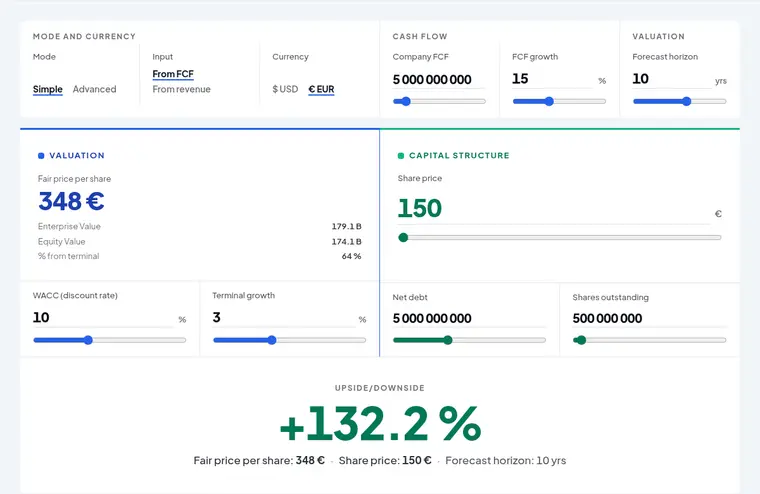 DCF calculator — stock's intrinsic value
 This DCF calculator estimates a stock's intrinsic (fair) value using the discounted-cash-flow method. Works for US equities (NYSE, NASDAQ), European exchanges and other international markets.
-
 FIRE calculator — financial independence
Financial independence
-
 Compound interest calculator — investment growth
Investment planning
-
 Pip value calculator
Forex