Moving Averages in Forex: SMA vs EMA, Key Periods, and Trading Strategies
The 200-day moving average is the single most watched technical level in forex. When EUR/USD broke below its 200-day SMA at 1.0875 in late 2024, the pair slid another 300 pips within two weeks. That one line on a chart moved billions in institutional order flow.
Moving averages strip noise from price data and show you the underlying trend direction. They are among the oldest technical tools still in active daily use, and for good reason: they work across all timeframes, all currency pairs, and all market conditions.
Simple Moving Average (SMA) vs Exponential Moving Average (EMA)
There are two core types of moving averages, and the difference between them matters more than most traders realise.
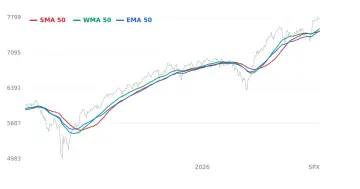
Simple Moving Average (SMA) adds up closing prices over a set number of periods and divides by that number. A 20-day SMA on EUR/USD takes the last 20 daily closing prices, sums them, and divides by 20. Every day carries equal weight, which makes the SMA smooth but slower to react to sudden price changes.
Exponential Moving Average (EMA) applies more weight to recent prices. The calculation uses a multiplier (2 / (period + 1)) that emphasises the latest data. A 20-day EMA responds roughly 10% faster to price changes than its SMA equivalent.
In our experience, the practical difference shows up most during volatile breakouts. When GBP/USD gapped up 150 pips on a Bank of England surprise hold in early 2025, the 20-EMA caught the move within two candles. The 20-SMA took four candles to reflect the same shift.
When to use which:
- SMA works better on daily and weekly charts where you want a smoother, less reactive line. It reduces whipsaws on longer timeframes.
- EMA suits intraday and 4-hour traders who need faster signals. Scalpers on the 15-minute chart almost always prefer the EMA.
Neither is objectively "better." They answer different questions. The SMA asks, "Where has price been on average?" The EMA asks, "Where is price heading right now?"
The Key Periods: 20, 50, 100, and 200
Not all moving average periods are equal. Four specific periods dominate institutional and retail trading alike.
20-Period MA
The 20-period MA tracks roughly one month of trading data on a daily chart. It is the go-to measure for short-term trend direction. If price is above the 20 MA and the line is sloping up, you are in a short-term uptrend. Full stop.
We've observed that the 20 EMA on the 4-hour chart is one of the most reliable dynamic support levels for trending pairs. During the EUR/USD rally from 1.0520 to 1.0950 in Q1 2025, price pulled back to the 4H 20-EMA seven times and bounced each time before the trend finally exhausted.
50-Period MA
The 50-day MA represents roughly one quarter of trading activity. It is the medium-term trend filter. Many swing traders will only take long trades when price is above the 50-day MA and short trades when below.
100-Period MA
The 100-day MA sits between the 50 and 200 and acts as an intermediate filter. It is less commonly cited in trading books, but institutional desks watch it closely. We've seen multiple instances where EUR/USD stalled within 10-15 pips of the 100-day SMA before reversing.
200-Period MA
The 200-day MA is the gold standard for defining the long-term trend. Hedge funds, pension funds, and central bank reserve managers all reference it. A currency pair trading above its 200-day SMA is broadly considered to be in a bullish trend; below it, bearish.
On USD/JPY, the 200-day SMA acted as resistance at 149.50 for nearly three weeks in mid-2025 before the pair finally broke through. Once it cleared, price rallied another 400 pips. That is the power of a widely watched level.
Golden Cross and Death Cross
These two signals are the most well-known moving average events in all of technical analysis.
Golden Cross: The 50-day MA crosses above the 200-day MA. This signals a potential shift from a long-term downtrend to an uptrend. On EUR/USD, the golden cross in April 2024 preceded a 500+ pip rally over the following three months.
Death Cross: The 50-day MA crosses below the 200-day MA. This warns of a shift to bearish momentum. GBP/USD's death cross in September 2024 arrived just before a 600-pip decline through year-end.
A critical caveat: both signals are lagging by definition. By the time the 50-day crosses the 200-day, a significant portion of the move has already happened. In our experience, these crosses work best as confirmation tools rather than entry triggers. You use them to confirm the trend direction, then find entries on shorter timeframe pullbacks.
Using Moving Averages as Dynamic Support and Resistance
Static support and resistance are horizontal lines. Moving averages give you dynamic levels that move with price, and they are remarkably effective.
Here is how it works in practice:
In an uptrend, price pulls back to a key MA (20, 50, or 200) and bounces. The MA acts as a floor. You look for bullish candlestick patterns like pin bars or engulfing candles at the MA level to time your entry.
In a downtrend, price rallies up to a key MA and gets rejected. The MA acts as a ceiling. You look for bearish rejection signals at the MA to enter short.
MA confluence zones form when two or more MAs cluster near the same price level. If the 50-day SMA and the 100-day EMA both sit near 1.0800 on EUR/USD, that level becomes significantly stronger than either MA alone.
During the AUD/USD downtrend in late 2024, the pair tested the 50-day SMA from below five times and was rejected every single time. Each rejection produced a move of at least 80-100 pips to the downside. Traders who sold at the 50-day SMA with a stop 30 pips above had a reward-to-risk ratio of nearly 3:1 on every trade.
Practical Moving Average Strategies
Strategy 1: EMA Pullback in Trend
- Identify the trend using the 200-day SMA (price above = long only, price below = short only).
- Wait for price to pull back to the 20-EMA on the 4-hour chart.
- Enter when a bullish (or bearish) candle closes at the EMA.
- Stop loss: 20-30 pips beyond the EMA.
- Target: previous swing high/low, or 1.5x your stop distance.
Strategy 2: Triple MA Crossover
Use three EMAs: 10, 25, and 50. When the 10 crosses above the 25 and both are above the 50, you go long. When the 10 crosses below the 25 and both are below the 50, you go short. This filters out many false signals that dual-MA systems produce.
Strategy 3: 200 SMA Bounce on Daily
This is a lower-frequency strategy. Wait for a major pair to pull back to its 200-day SMA after an extended trend. Look for a clear rejection candle (long wick, strong close away from the MA). Enter in the direction of the bounce with a stop below the 200-day SMA. Target a return to the recent swing.
Common Mistakes to Avoid
Using too many MAs at once. If your chart has six moving averages, you have noise, not clarity. Two or three is the practical maximum.
Ignoring the higher timeframe. A 20-EMA buy signal on the 15-minute chart means nothing if the daily 200-SMA trend is pointing down. Always check the bigger picture.
Treating crosses as automatic trades. A golden cross is not a buy order. It is a directional filter. You still need entry timing, stop placement, and risk management.
Using MAs in ranging markets. Moving averages are trend-following tools. In a sideways market, they will whipsaw you repeatedly. If price is chopping around the MA with no clear slope, step aside.
Combining Moving Averages with Other Tools
Moving averages become significantly more powerful when combined with other analysis methods. Pairing a 200-day SMA level with a harmonic pattern completion point gives you two independent reasons to take a trade. That kind of confluence is what separates consistent traders from gamblers.
RSI divergence at a key moving average level is another high-probability setup. If price pulls back to the 50-day SMA and RSI shows bullish divergence at the same time, you have a strong case for a bounce.
Volume confirmation matters too. A bounce off the 200-day SMA on above-average volume carries more weight than one on thin liquidity.
Key Takeaways
Moving averages remain one of the most reliable tools in forex technical analysis because they are simple, objective, and widely followed. The 200-day SMA defines the long-term trend. The 50-day SMA tracks medium-term momentum. The 20-EMA captures short-term moves.
Golden and death crosses confirm trend shifts. MAs act as dynamic support and resistance. And the best results come from combining MAs with price action, other indicators, and sound risk management.
Start with one MA on one timeframe. Master it before adding complexity. That approach, in our experience, produces better results than any indicator-stacking strategy ever will.