Compound interest calculator
Use the calculator to see how a portfolio grows under compound interest. Enter a starting deposit, a regular contribution, the expected annual return and the time horizon — the chart and the year-by-year table update as you move the sliders.
FX Editorial Team Updated: May 25, 2026 How to use it?
Inputs
Total contributions
€53,000
- Contributions share
- 37.2 %
- Starting deposit
- €5,000
- Recurring contribution
- €200
Interest earned
€89,438
- Interest share
- 62.8 %
- Expected annual return (p.a.)
- 8.0 %
Future portfolio value
€142,438
in 20 yearsAverage annual return: 8.0 %
Portfolio composition
- Deposited
- Interest
- Value
Scenario comparison
- Conservative (5.0 %)
- €95,770
- Your input (8.0 %)your settings
- €142,438
- Optimistic (12.0 %)
- €252,314
Year-by-year breakdown
| Year | Deposited | Interest | Value | Interest share |
|---|---|---|---|---|
| 1 | €7,400 | €505 | €7,905 | 6.4 % |
| 2 | €9,800 | €1,251 | €11,051 | 11.3 % |
| 3 | €12,200 | €2,258 | €14,458 | 15.6 % |
| 4 | €14,600 | €3,548 | €18,148 | 19.6 % |
| 5 | €17,000 | €5,145 | €22,145 | 23.2 % |
| 6 | €19,400 | €7,073 | €26,473 | 26.7 % |
| 7 | €21,800 | €9,360 | €31,160 | 30.0 % |
| 8 | €24,200 | €12,036 | €36,236 | 33.2 % |
| 9 | €26,600 | €15,134 | €41,734 | 36.3 % |
| 10 | €29,000 | €18,687 | €47,687 | 39.2 % |
Important disclaimer
This calculator is for educational and informational purposes only — it does not constitute investment advice or a recommendation to buy or sell any specific instrument. Calculations are approximations; despite careful work, rounding errors or technical bugs may occur. Real-world returns, fees, inflation and taxes can diverge from the values entered, and past or projected returns do not guarantee future results. Consult a qualified financial adviser before making any investment decision.
How to use the compound interest calculator
In three steps you can model how much your investment could grow under compound interest — starting from a one-off deposit, adding regular contributions over a horizon of your choosing.
-
Enter the basics
Fill in your starting deposit, the recurring monthly or quarterly contribution, the expected annual return and the investment horizon. The sliders update the result instantly.
-
Open the advanced settings (optional)
Switch on Advanced settings to factor in the annual fund fee (TER) and inflation. The calculator then shows the real, inflation-adjusted value alongside the nominal one.
-
Read the result
The future portfolio value, total contributions, interest earned, CAGR and three scenarios (conservative / your input / optimistic) appear immediately.
What is compound interest?
Compound interest is the principle by which interest is calculated not only on the original deposit but also on the interest accumulated in previous periods. Unlike simple interest, where the same base is used every year, the compounding base keeps growing. The longer the horizon, the wider the gap between the two methods.
It is often called the eighth wonder of the world precisely because the growth is exponential. In the early years the effect is barely visible; over decades it dominates the outcome.
How compound interest works in practice
Picture a single deposit of €5,000 at a 7 % annual return. After the first year, €350 in interest is added — €5,350 in total. In the second year the interest is calculated on €5,350, adding €374.50. Each subsequent year the base grows and the increments get larger.
Add a regular contribution of €200 a month on top of the lump sum and the effect compounds. Over twenty years at 7 %, total contributions reach roughly €53,000 — but the ending balance crosses €120,000. The gap is the compound-interest effect.
The compound interest formula
The basic formula for a single deposit:
- FV — future value of the investment
- PV — present value (initial deposit)
- r — interest rate per period
- n — number of periods
For regular contributions the annuity formula is added: FV = PMT × ((1 + r)n − 1) / r, where PMT is the recurring contribution. The calculator above works in the contribution frequency you pick — monthly, quarterly or yearly — and compounds at the same cadence.
What the calculator does
Beyond the headline number, a few practical features bring the result closer to a real-world portfolio:
- Three scenarios at once — alongside your chosen return, the chart plots a conservative path (5 %) and an optimistic path (12 %) so you can see how sensitive the outcome is to the rate assumption.
- Interactive chart — hovering (or tapping) on the time axis displays the value of all three scenarios in the year you selected.
- Advanced settings — optional inputs for the annual fund fee (TER) and inflation. Fees drag down the net return; inflation reduces the purchasing power of the end value.
- CAGR (compound annual growth rate) — the after-fee effective annual return, expressed as a percentage.
- Portfolio composition — a stacked bar shows what share of the final balance comes from contributions and what share comes from compounded interest.
- Export and share — download the year-by-year data as CSV, copy a link that encodes the current inputs, or print the page to PDF.
The Rule of 72
A quick way to estimate how many years an investment takes to double: divide 72 by the annual rate. At a 6 % annual return, the money doubles in roughly 12 years (72 ÷ 6 = 12). At 8 % it is about 9 years. The estimate is approximate but useful for a back-of-the-envelope check before reaching for the calculator.
Compounding frequency
The final value also depends on how often the interest is credited. The more frequent the compounding (annual, quarterly, monthly, daily), the higher the end result for the same nominal rate. In the calculator the compounding frequency is set via the Contribution frequency control — monthly, quarterly or yearly. Monthly compounding is the most common default and matches how most ETFs, mutual funds and bond funds report and reinvest income.
The biggest factors that shape the outcome
The single largest driver of the final balance is the length of the horizon. In compounding, time matters more than the size of any individual contribution. After that come contribution discipline, the return rate and the compounding frequency.
It is also worth separating nominal and real returns. The nominal return is the headline number on the product fact sheet. The real return adjusts for inflation — at a 7 % nominal return with 3 % inflation, the real return is roughly 4 %. With the Advanced settings Annual inflation input turned on, the calculator shows both: the nominal end balance and, next to it, the inflation-adjusted real value.
Fund fees (TER) can also erode long-run returns more than most savers expect. Out of an 8 % gross return, even a 1 % annual fee takes a sizable bite over 20–30 years. The Advanced settings let you enter the fund's annual cost; the calculator then folds it into the CAGR and the future value.
What the calculator does not model
The Advanced settings handle inflation and fees, but a few other factors are left out by design. They are worth thinking through separately:
- Taxes — investment returns are usually subject to capital-gains tax (rules and rates differ by country, and some accounts such as ISAs in the UK or PEAs in France offer shelters). The calculator shows pre-tax results.
- Market volatility — real-world returns are not constant; individual years can be sharply higher or negative. The three scenarios (conservative / your input / optimistic) give a sense of how the return assumption changes the outcome, but they do not replace a proper volatility model.
- Sequence-of-returns risk — poor years early in the withdrawal phase can hurt the end result disproportionately, even if the average return is unchanged.
- Currency risk — for portfolios held in a foreign currency (USD-denominated ETFs from a euro perspective, for instance), exchange-rate moves change the result in your home currency.
- Transaction and platform costs — beyond the TER, there can be entry/exit loads, broker commissions, FX spreads or platform fees that the calculator does not include.
For a plan tailored to your situation, it is worth talking to a qualified financial adviser.
Calculators
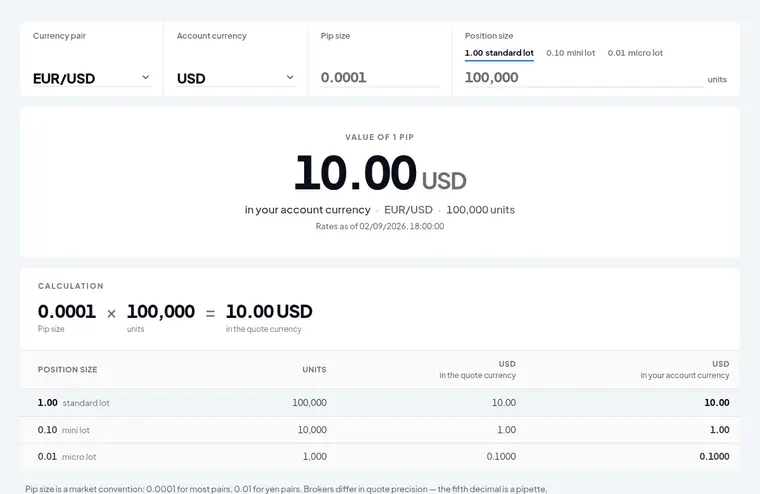 Pip value calculator
 Pick a currency pair, a position size and your account currency. The calculator works out what a one-pip move is worth to you — in the quote currency and converted into your account currency at the current rate.
-
 Fund vs ETF fee calculator
Cost comparison
-
 DCF calculator — stock's intrinsic value
Stock valuation
-
 FIRE calculator — financial independence
Financial independence