Canola price
Canola currently trades at US$573.24 per tonne (≈ €512.46 · £434.05) — close to the 12-month high. Over the past 12 months the price has gained 32.67%, with the annual range running from US$407.08 to US$608.73. In the past 24 hours the price has risen by 0.69%.


Invest in commodity ETFs from just $50
Gold, oil and even whole commodity sectors through ETFs, all in one account, kept simple.
eToro is a multi-asset investment platform. The value of your investments may go up or down. Your capital is at risk.
Canola chart
Interactive chart and 30-day overview
The Canola chart shows how the canola price has moved over time. The interactive view lets you switch the timeframe (from 7 days up to MAX), the currency (USD / EUR / GBP) and overlay moving averages. Click any two points to measure the percentage change between those dates.
How is canola priced?
Canola is priced per metric tonne (1 t = 1,000 kg) — the standard unit for industrial and bulk commodities on the London Metal Exchange (LME), CME and major European exchanges. Wholesale shipments move in containers or bulk vessels, typically in 25-tonne or 100-tonne lots.
At US$573.24 per tonne, one kilogram is worth US$0.5732. End-user pricing for processed goods includes refining margins, transport and tariffs on top of the wholesale benchmark.
What drives the price of canola?
The Canadian Prairie crop is the market’s main driver. A large share of global canola supply comes from Canada. The country produces about ~18-20 million tonnes a year, of which ~10 Mt is exported, roughly 70% of global canola trade. More than 90% of the planted area is concentrated in three Prairie provinces: Saskatchewan, Alberta and Manitoba. Planting takes place in May, with harvest in late August and September. A severe Prairie drought showed how sensitive the market can be: Canadian canola output fell by almost 35% in one year, and the ICE Canada contract rose to record levels. Early autumn frost, July heat or rain during harvest can therefore trigger direct and material price moves in ICE Futures Canada canola futures. Market participants closely follow Statistics Canada Field Crop Production reports and the monthly USDA FAS Oilseeds outlook.
Chinese import policy is the second major factor, and its political character makes it hard to model. China is the largest foreign buyer of Canadian canola, purchasing an average of ~5 million tonnes a year, close to half of Canadian canola exports. Diplomatic tensions between the two countries have periodically led to import bans. Beijing has suspended licences for several large Canadian canola exporters, officially citing quality issues such as fungal contamination or foreign material. The market has often read these moves as diplomatic retaliation. An announcement of this kind can immediately push down the Winnipeg contract and redirect Canadian cargoes, typically towards Japan, Mexico, the United Arab Emirates and the European Union, often at a lower average price. Canola is therefore one of the few physical agricultural commodities whose price is regularly moved by bilateral foreign-policy news.
The third major group of drivers is demand for North American biomass-based diesel. Under US renewable fuel rules, the Renewable Fuel Standard, RFS — D4 category, producers of biomass-based diesel and renewable diesel are using larger volumes of Canadian canola oil as feedstock. Canola oil’s low saturated-fat content and favourable cold-flow properties make it competitive with soya and palm oil, while US LCFS rules, mainly in California and Oregon, also give it a favourable carbon-intensity score. This structural demand diverts part of canola-oil supply away from the traditional food market and supports both oil and seed prices. A fourth factor to watch is the spread between ICE Canada canola and Euronext rapeseed in Paris, quoted in EUR/tonne. When it widens, it points to stress between North American and European supply conditions and can prompt arbitrage cargoes across the Atlantic.
How to invest in canola
There are several ways to access the canola market without taking physical delivery. The ICE Futures Canada canola futures contract is the global benchmark, quoted in CAD/tonne, and some European regulated brokers, including XTB and eToro in certain platform configurations, offer canola CFDs linked to the Winnipeg price. On the equity side, global oilseed processors and agribusiness groups provide indirect exposure: Bunge (BG), Nutrien (NTR), the Canadian fertiliser and agribusiness company, Viterra, the grain trader owned by Glencore, giving indirect Glencore exposure, and Richardson International, a privately held Canadian company. Cargill is privately owned and its shares are not publicly traded. Two regulated brokers where canola-related products may be available are:
30-day price history
Chart and daily closing prices
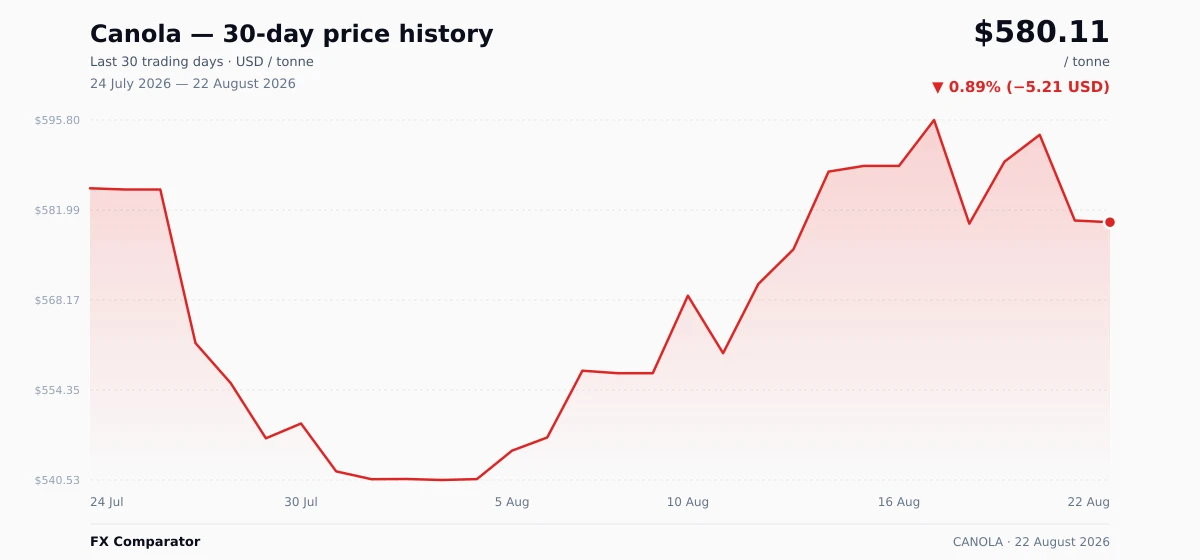
Download chart: WebP
Daily close
30 trading days
| Date | Price (USD) | Price (EUR) | Price (GBP) | Daily change |
|---|---|---|---|---|
| 8 Oct 2026 | US$573.24 | €512.46 | £434.05 | ▲ +0.69% |
| 7 Oct 2026 | US$569.29 | €508.93 | £431.06 | ▼ −1.89% |
| 6 Oct 2026 | US$580.25 | €518.73 | £439.35 | ▲ +0.88% |
| 5 Oct 2026 | US$575.21 | €514.22 | £435.54 | ▲ +0.35% |
| 4 Oct 2026 | US$573.21 | €512.43 | £434.02 | ▼ −0.01% |
| 3 Oct 2026 | US$573.25 | €512.46 | £434.05 | ▲ +0.20% |
| 2 Oct 2026 | US$572.09 | €511.43 | £433.18 | ▲ +0.19% |
| 1 Oct 2026 | US$571.02 | €510.48 | £432.37 | ▼ −1.59% |
| 30 Sept 2026 | US$580.24 | €518.72 | £439.35 | ▼ −0.04% |
| 29 Sept 2026 | US$580.47 | €518.93 | £439.52 | ▲ +1.48% |
| 28 Sept 2026 | US$572.04 | €511.38 | £433.13 | ▼ −2.51% |
| 27 Sept 2026 | US$586.79 | €524.57 | £444.30 | ▲ +0.01% |
| 26 Sept 2026 | US$586.74 | €524.53 | £444.27 | ▲ +0.07% |
| 25 Sept 2026 | US$586.31 | €524.15 | £443.95 | ▼ −0.18% |
| 24 Sept 2026 | US$587.35 | €525.07 | £444.73 | ▲ +0.12% |
| 23 Sept 2026 | US$586.65 | €524.45 | £444.20 | ▼ −0.25% |
| 22 Sept 2026 | US$588.10 | €525.74 | £445.30 | ▼ −1.60% |
| 21 Sept 2026 | US$597.64 | €534.27 | £452.52 | ▲ +1.61% |
| 20 Sept 2026 | US$588.16 | €525.79 | £445.34 | ▼ −0.01% |
| 19 Sept 2026 | US$588.24 | €525.87 | £445.40 | ▲ +0.12% |
| 18 Sept 2026 | US$587.54 | €525.24 | £444.87 | ▼ −1.59% |
| 17 Sept 2026 | US$597.02 | €533.72 | £452.05 | ▲ +0.45% |
| 16 Sept 2026 | US$594.35 | €531.33 | £450.03 | ▼ −0.40% |
| 15 Sept 2026 | US$596.72 | €533.45 | £451.82 | ▲ +0.58% |
| 14 Sept 2026 | US$593.27 | €530.36 | £449.21 | ▲ +0.43% |
| 13 Sept 2026 | US$590.72 | €528.09 | £447.28 | ▼ −0.02% |
| 12 Sept 2026 | US$590.85 | €528.20 | £447.38 | ▼ −0.14% |
| 11 Sept 2026 | US$591.67 | €528.93 | £448.00 | ▼ −2.78% |
| 10 Sept 2026 | US$608.58 | €544.05 | £460.80 | ▲ +0.85% |
| 9 Sept 2026 | US$603.44 | €539.45 | £456.91 | — |