Livestock & dairy · CHE

Cheese price

Cheese currently trades at US$1.62 per pound (≈ €1.38 · £1.21) — 20.98% below the 12-month high. Over the past 12 months it has lost 18.59%, with the annual range running from US$1.40 to US$2.05. 24-hour movement is minimal (±0.00%).

US$1.62 / pound
≈ €1.38 ≈ £1.21 Unchanged 24h 34% within the 52-week range
FX Editorial Team · Data updated: · Editorially verified
Cheese (CHE) price today US$1.62 / pound, ↑ +0.00% (24h)

Cheese chart

Interactive chart and 30-day overview

7 days
▼ −2.41%
−US$0.0400
30 days
▼ −4.14%
−US$0.0700
1 year
▼ −18.59%
−US$0.3700
52-week range
US$1.40 34% US$2.05
Cheese (CHE) 30-day price chart — USD, EUR, GBP

The Cheese chart shows how the cheese price has moved over time. The interactive view lets you switch the timeframe (from 7 days up to MAX), the currency (USD / EUR / GBP) and overlay moving averages. Click any two points to measure the percentage change between those dates.

How is cheese priced?

Cheese is quoted per pound (1 lb = 0.4536 kg) on the major US futures exchanges, including the COMEX, CME and ICE. The pound is the legacy commercial unit for North American agricultural and metals contracts.

At US$1.62 per pound, one kilogram costs about US$3.57. Industrial buyers usually negotiate in tonnes, while retail or specialty trade still references the pound — particularly for soft commodities and base-metal cathodes.

What drives the price of cheese?

The main input behind the cheese price is the raw milk price. Cheese is the most valuable end product in the Class III Milk category used in the US Federal Milk Marketing Order system. Class III Milk covers raw milk used to make cheese. The official monthly Class III Milk price is calculated by the US Department of Agriculture (USDA AMS) from USDA NDPSR prices for cheese, butter and whey: higher cheese prices lift the Class III Milk price, and vice versa. Producing one kilogram of cheddar requires about 10 kg of raw milk, and raw milk accounts for 50–60% of a processor’s cost base. The two benchmarks are therefore closely correlated. Dairy farm profitability — a major part of milk-producer revenue — is directly linked to the CME cheese quotation.

Demand is dominated by the foodservice segment. The structural driver of US cheese consumption is the pizza industry: combined mozzarella demand from Domino's, Pizza Hut, Papa John's, Little Caesars and independent pizzerias is one of the most important monthly drivers. About 35–40% of total US cheese production is mozzarella, and foodservice is the dominant channel within that category. Sales data from pizza chains, US restaurant traffic indices, Black Box Intelligence and the Restaurant Performance Index are therefore early indicators for cheese prices. The retail dairy shelf — cheddar, monterey jack and Swiss cheese — is a slower-moving and more stable segment. Foodservice is more sensitive to the economic cycle: in recessions, hospitality demand weakens and cheese prices come under pressure. USDA Foreign Agricultural Service dairy reports, together with monthly export data and domestic use, provide the broader demand picture.

Export demand is the third major driver of cheese prices. US cheese exports have been on a growth path in recent years and account for about 5% of total US cheese production — roughly 0.4 million tonnes a year. The main buyers are Mexico, the largest single market, followed by South Korea and Japan. Global cheese production is about 24 million tonnes a year. The EU produces about 10 million tonnes of that total, led by the Netherlands, Germany, France, Italy and Ireland. The United States produces 6.5 million tonnes, Brazil 0.8 million tonnes and New Zealand 0.4 million tonnes. New Zealand is a key player in global dairy exports despite its small production base. Dutch, Irish and French exporters are the main competitors to US suppliers in the Mexican, Japanese and Korean markets. Monthly price signals and export statistics from the EU Milk Market Observatory are among the best indicators of the global balance.

How to invest in cheese?

Cheese is usually not available as a direct CFD through retail brokers. Liquidity in CME Cheese Futures and cheese options is relatively low, and neither XTB nor eToro offers cheese as a standalone contract. Retail exposure is therefore usually built through listed companies in the global dairy-processing industry. Toronto-listed Saputo (SAP.TO) is one of the world’s largest cheese and dairy companies, with a significant US business through Saputo Cheese USA and a European presence. Ireland’s Glanbia (GLB.IR) is an important player in the US cheddar and mozzarella markets through its US subsidiaries. France’s Savencia (SAVE.PA) is focused on branded cheeses, while the US-listed Kraft Heinz (KHC) is linked to the CME benchmark through processed cheddar and Kraft Singles. France’s Lactalis is the world’s largest dairy company, but it is privately held and not available on public markets. Two regulated brokers where dairy-processing shares are available:

30-day price history

Chart and daily closing prices
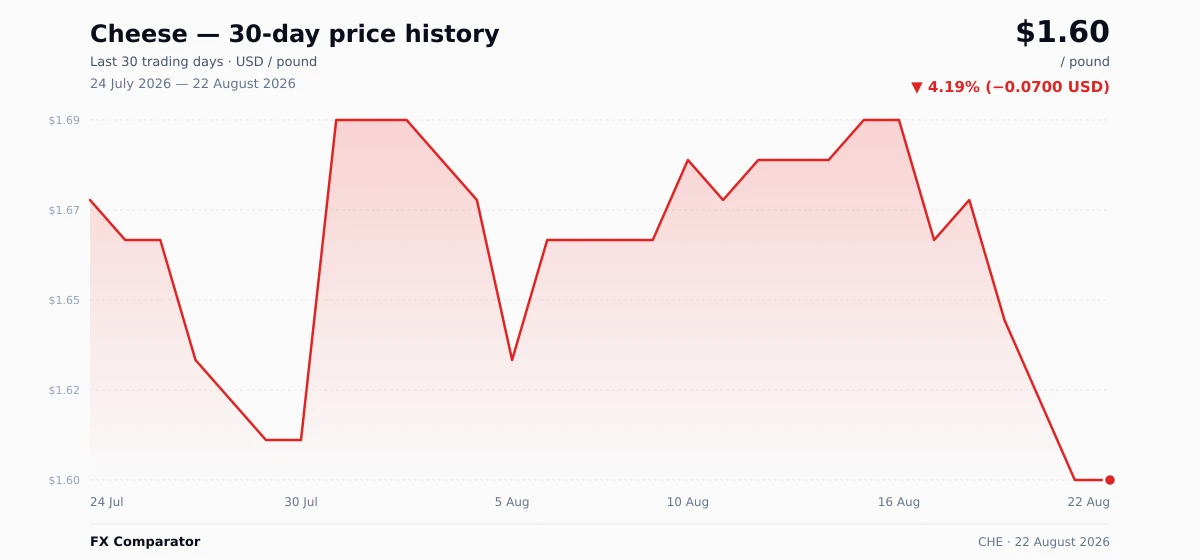
Cheese (CHE) 30-day price chart — USD, EUR, GBP

Daily close

30 trading days

Date Price (USD) Price (EUR) Price (GBP) Daily change
22 May 2026 US$1.62 €1.38 £1.21 ▼ −0.61%
19 May 2026 US$1.63 €1.39 £1.21 ▼ −1.21%
18 May 2026 US$1.65 €1.40 £1.23 ▼ −0.60%
16 May 2026 US$1.66 €1.41 £1.24 ▼ −0.60%
15 May 2026 US$1.67 €1.42 £1.24 ▼ −1.18%
13 May 2026 US$1.69 €1.44 £1.26 ▲ +1.20%
11 May 2026 US$1.67 €1.42 £1.24 ▼ −0.60%
10 May 2026 US$1.68 €1.43 £1.25 ▼ −1.75%
6 May 2026 US$1.71 €1.45 £1.27 ▲ +1.79%
30 Apr 2026 US$1.68 €1.43 £1.25 ▼ −1.18%
29 Apr 2026 US$1.70 €1.45 £1.27 ▼ −1.16%
27 Apr 2026 US$1.72 €1.46 £1.28 ▲ +1.18%
25 Apr 2026 US$1.70 €1.45 £1.27 ▲ +0.59%
22 Apr 2026 US$1.69 €1.44 £1.26 ▲ +2.42%
20 Apr 2026 US$1.65 €1.40 £1.23

Cheese FAQ

Why is the cheese price quoted in pounds (lb), not kilograms? +
The global cheese reference is the CME Group Cheese (Cheddar Blocks) Futures contract, which follows US processing-industry convention: the quotation is in US cents per pound (pound, symbol lb). 1 pound = 0.4536 kilogram, or 1 kg ≈ 2.2046 pounds. The contract refers to the quality specification for 40-pound cheddar blocks, the standard size in the US cheese industry. In European wholesale markets, prices are more often quoted in EUR per tonne or EUR per kg. Conversion uses the pound-to-kilogram rate and the current EUR/USD exchange rate.
What is the CME Spot Cheese Auction and why does it matter? +
The CME Spot Cheese Auction is the Chicago exchange’s daily spot-market auction for 40-pound cheddar blocks and 500-pound cheddar barrels. In the Class III pricing formula, the USDA Federal Milk Marketing Order system does not use the CME spot auction. It uses the USDA NDPSR weekly weighted average prices to calculate the official formula for Class III Milk, or raw milk used for cheese. The USDA NDPSR cheese price is therefore built directly into the formula that determines revenue for US dairy farms producing milk for cheese. It is a key indicator for pricing across the US dairy industry.
What does the “block-barrel spread” mean? +
The block-barrel spread is the price difference between the two main products in the CME Spot Cheese Auction: 40-pound cheddar blocks and 500-pound cheddar barrels. Block cheddar typically goes to retail and foodservice channels. Barrel cheddar is more commonly used as an input for processed cheese, including process cheese and Kraft Singles. The normal spread is a few cents per pound. A persistent shift in the spread points to a change in the balance of demand between the two segments. Industry analysts see the block-barrel spread as one of the main indicators of processing demand and the health of the cheese segment.
How much raw milk is needed to make one kilogram of cheddar cheese? +
As an industry rule of thumb, producing 1 kg of cheddar cheese requires about 10 kg of raw milk. Yield depends on the type of cheese. Fresh cheeses with high water content, such as mozzarella and ricotta, have better yields at about 7–8 kg of milk per kg of cheese. Mature, lower-moisture cheeses, such as parmesan and aged cheddar, have lower yields, sometimes 12–13 kg of milk per kg of cheese. Raw milk accounts for 50–60% of the cost structure in cheese production. The rest comes from processing, packaging, maturation, logistics and margin. This is why cheese prices track raw milk prices so closely, and why the USDA officially describes cheese as the most valuable end product of Class III Milk.
How large is global cheese production and which countries are the main producers? +
Global cheese production is about 24 million tonnes a year. The largest producer is the European Union, with about 10 million tonnes. The Netherlands, Germany, France, Italy and Ireland are the leading players. The United States follows with about 6.5 million tonnes, produced mainly in Wisconsin, California, Idaho and New York. Other significant producers include Brazil, at about 0.8 million tonnes, New Zealand, at about 0.4 million tonnes, Argentina and Australia. New Zealand produces relatively small volumes, but a large share goes to export. That is one reason the global dairy trade closely follows Fonterra’s Global Dairy Trade auctions.
Where does the US cheese industry export? +
US cheese exports are about 0.4 million tonnes a year, or roughly 5% of total US cheese production, and have been structurally growing. The three most important buyers are Mexico, by far the largest single market because of cultural proximity, favourable NAFTA/USMCA tariffs and foodservice growth, followed by South Korea and Japan. The main competitors to US suppliers are EU exporters from the Netherlands, Ireland, France and Germany, as well as New Zealand’s Fonterra co-operative. Monthly export data from the USDA Foreign Agricultural Service Dairy and reports from the EU Milk Market Observatory are the main reference sources for global cheese trade.
How does the pizza industry affect cheese prices? +
The structural driver of US cheese consumption is the pizza industry. About 35–40% of total US cheese production is mozzarella, and foodservice is the largest buyer within that category, mainly through pizza chains such as Domino's, Pizza Hut, Papa John's, Little Caesars and independent pizzerias. Monthly sales data from large chains, same-store sales, hospitality traffic indices such as Black Box Intelligence, NPD Group and the Restaurant Performance Index, and growth rates at delivery platforms such as DoorDash and Uber Eats are early indicators of mozzarella demand. In recessions, hospitality consumption weakens, but pizza is a relatively recession-resistant segment: it is cheaper, suitable for delivery and works for family meals.
How can a European retail investor access the cheese market? +
Direct cheese CFDs are usually not available through retail brokers. Liquidity in CME Cheese Futures is low compared with major industrial benchmarks, and neither XTB nor eToro offers cheese as a standalone contract. For European retail investors, the practical route is through global dairy-processing shares: Saputo (SAP.TO) in Toronto, Glanbia (GLB.IR) in Dublin, Savencia (SAVE.PA) in Paris and Kraft Heinz (KHC) in New York. The world’s largest dairy company, France’s Lactalis, is privately held and not listed. Tax treatment varies by jurisdiction; consult a local tax adviser.