Lead price
Lead currently trades at US$1,897 per tonne (≈ €1,693 · £1,435) — close to the 12-month high. Over the past 12 months the price has lost 5.30%, with the annual range running from US$1,855 to US$2,099. 24-hour movement is minimal (±0.00%).


Invest in commodity ETFs from just $50
Gold, oil and even whole commodity sectors through ETFs, all in one account, kept simple.
eToro is a multi-asset investment platform. The value of your investments may go up or down. Your capital is at risk.
Lead chart
Interactive chart and 30-day overview
The Lead chart shows how the lead price has moved over time. The interactive view lets you switch the timeframe (from 7 days up to MAX), the currency (USD / EUR / GBP) and overlay moving averages. Click any two points to measure the percentage change between those dates.
How is lead priced?
Lead is priced per metric tonne (1 t = 1,000 kg) — the standard unit for industrial and bulk commodities on the London Metal Exchange (LME), CME and major European exchanges. Wholesale shipments move in containers or bulk vessels, typically in 25-tonne or 100-tonne lots.
At US$1,897 per tonne, one kilogram is worth US$1.90. End-user pricing for processed goods includes refining margins, transport and tariffs on top of the wholesale benchmark.
What drives the price of lead?
The lead-acid battery segment dominates global lead demand, accounting for about 85% of use. Within that, the split is roughly as follows: replacement batteries for vehicles already on the road account for ~70% (a typical SLI battery lasts 4–6 years, so fleet size directly drives demand), factory original equipment is ~15%, industrial UPS, telecoms backup and forklift batteries are ~10%, and the rest comes from the e-bike and e-rickshaw segment, especially in India, Vietnam and China’s inland regions. Lead-acid chemistry remains competitive on cost and energy density for starter batteries and stationary industrial backup systems.
The EV transition has a mixed effect on the market. Battery-electric vehicles (BEVs) use lithium-ion, not lead-acid, in the powertrain. A smaller internal-combustion fleet is therefore one long-term risk for lead demand. At the same time, every vehicle, including fully electric models, still uses a 12-volt auxiliary battery to power onboard electronics, lighting and control units. These batteries are still mainly lead-acid. Because lead-acid chemistry is cheap, reliable in extreme temperatures and easy to recycle, replacement of 12 V auxiliary batteries remains an important aftermarket factor.
Supply is structurally dominated by secondary (recycled) lead. Of global annual output of about 12 million tonnes, only around 4.5 million tonnes comes from mined production, mainly in China at ~2 Mt, Australia, Peru, Mexico and the US. The remaining ~7.5 million tonnes comes from processing used batteries. The lead-acid battery is one of the world’s most efficiently recycled products: collection rates in OECD countries are above 95%, and 99% of the lead can be recovered. China is the largest refined lead producer at about 5 million tonnes. The United States produces around 1.1 million tonnes, also mainly from secondary sources. Major market participants include Glencore, Doe Run, Boliden and Teck Resources.
How can investors get exposure to lead?
European retail investors can access lead exposure in several ways. A lead CFD is the most direct form: a leveraged product linked to the LME Lead price, allowing long or short positions, but with high risk. Pure lead ETFs are uncommon; lead ETCs or ETNs may be available in some markets. Equity exposure is usually through diversified base-metals miners: Glencore (GLEN.L) is one of the world’s largest diversified lead-related producers, Teck Resources (TECK) is a Canadian base-metals miner with significant lead and zinc operations, and Doe Run is a major integrated US lead producer but is privately held and not directly listed. Physical lead is not widely used as a retail investment because of its low value per unit of weight, toxicity, and storage and handling risks.
30-day price history
Chart and daily closing prices
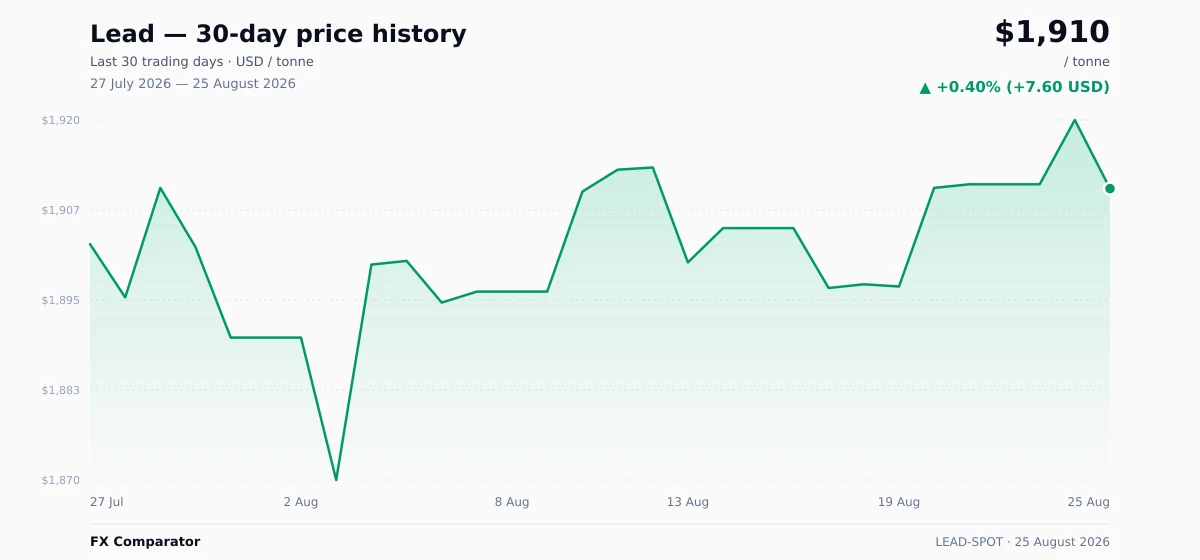
Download chart: WebP
Daily close
21 trading days
| Date | Price (USD) | Price (EUR) | Price (GBP) | Daily change |
|---|---|---|---|---|
| 9 Oct 2026 | US$1,897 | €1,693 | £1,435 | ▲ +1.57% |
| 8 Oct 2026 | US$1,868 | €1,667 | £1,413 | ▼ −1.91% |
| 7 Oct 2026 | US$1,904 | €1,699 | £1,440 | ▲ +1.21% |
| 6 Oct 2026 | US$1,881 | €1,679 | £1,423 | ▲ +0.43% |
| 5 Oct 2026 | US$1,873 | €1,672 | £1,417 | ▲ +0.87% |
| 2 Oct 2026 | US$1,857 | €1,657 | £1,405 | ▼ −0.41% |
| 1 Oct 2026 | US$1,865 | €1,664 | £1,411 | ▼ −0.92% |
| 30 Sept 2026 | US$1,882 | €1,680 | £1,424 | ▼ −1.46% |
| 29 Sept 2026 | US$1,910 | €1,704 | £1,445 | ▼ −0.22% |
| 28 Sept 2026 | US$1,914 | €1,708 | £1,448 | ▼ −1.33% |
| 25 Sept 2026 | US$1,940 | €1,731 | £1,467 | ▼ −0.16% |
| 24 Sept 2026 | US$1,943 | €1,734 | £1,470 | ▲ +0.55% |
| 23 Sept 2026 | US$1,933 | €1,725 | £1,462 | ▼ −0.55% |
| 22 Sept 2026 | US$1,943 | €1,734 | £1,470 | ▼ −0.15% |
| 21 Sept 2026 | US$1,946 | €1,737 | £1,472 | ▲ +0.80% |
| 18 Sept 2026 | US$1,931 | €1,723 | £1,460 | ▲ +0.55% |
| 17 Sept 2026 | US$1,920 | €1,714 | £1,452 | ▲ +1.35% |
| 16 Sept 2026 | US$1,895 | €1,691 | £1,433 | ▲ +0.48% |
| 15 Sept 2026 | US$1,886 | €1,683 | £1,426 | ▼ −0.21% |
| 14 Sept 2026 | US$1,890 | €1,686 | £1,429 | ▼ −0.67% |
| 11 Sept 2026 | US$1,903 | €1,698 | £1,439 | — |