Methanol price
Methanol currently trades at US$3,863 per tonne (≈ €3,453 · £2,925) — close to the 12-month high. Over the past 12 months the price has gained 74.80%, with the annual range running from US$1,949 to US$4,181. In the past 24 hours the price has risen by 0.34%.


Invest in commodity ETFs from just $50
Gold, oil and even whole commodity sectors through ETFs, all in one account, kept simple.
eToro is a multi-asset investment platform. The value of your investments may go up or down. Your capital is at risk.
Methanol chart
Interactive chart and 30-day overview
The Methanol chart shows how the methanol price has moved over time. The interactive view lets you switch the timeframe (from 7 days up to MAX), the currency (USD / EUR / GBP) and overlay moving averages. Click any two points to measure the percentage change between those dates.
How is methanol priced?
Methanol is priced per metric tonne (1 t = 1,000 kg) — the standard unit for industrial and bulk commodities on the London Metal Exchange (LME), CME and major European exchanges. Wholesale shipments move in containers or bulk vessels, typically in 25-tonne or 100-tonne lots.
At US$3,863 per tonne, one kilogram is worth US$3.86. End-user pricing for processed goods includes refining margins, transport and tariffs on top of the wholesale benchmark.
What moves the price of methanol?
The main driver of methanol prices is the feedstock cost, which varies by region. Producers on the US Gulf Coast, in the Middle East (Saudi Arabia, Oman, Iran) and in Trinidad make methanol from natural gas through steam methane reforming, so Henry Hub and regional gas benchmarks directly shape margins. China, by contrast, produces about 80% of its domestic methanol from coal, mainly through gasification in the mining regions of Inner Mongolia and Shanxi. Chinese methanol costs therefore move with Qinhuangdao coal prices and Chinese power prices. The different carbon footprints of the two production routes are becoming a more relevant cost factor because of European customs rules, including CBAM, and IMO shipping regulations.
The second key factor is Chinese MTO economics. The methanol-to-olefins process converts methanol into ethylene and propylene, the two basic monomers used in polymer production. It accounts for about 70% of domestic methanol consumption in China. The market prices the process against the cost of olefins produced through conventional oil-based naphtha cracking, which is why methanol and naphtha prices tend to move closely together. If naphtha rises because of higher crude oil prices, MTO plants run at higher utilisation and Chinese methanol demand strengthens. If naphtha is cheap, many MTO plants temporarily shut down or operate at lower rates. Chinese MTO plants have nominal capacity of about 30 Mt/year of olefin output, equivalent to about 90 Mt/year of methanol use.
The third longer-term driver is the marine fuel transition. As the International Maritime Organization (IMO) tightens CO₂ and pollutant rules, the shipping industry is looking at lower-carbon fuels. Methanol, especially renewable “green methanol”, is one of the main candidates. Maersk has ordered and deployed dozens of large dual-fuel methanol container ships. MSC and CMA CGM have also announced methanol-capable capacity, while X-Press Feeders operates methanol-powered vessels in the regional feeder segment. In Methanol Institute scenarios, maritime methanol demand is a significant long-term demand item and a visible share of current global demand. This demand factor matters for both Methanex MX and CFR China pricing.
How to invest in the methanol industry
Methanol is a specialised chemicals market. Retail CFD brokers in the US, UK and Europe, including XTB and eToro, do not offer direct methanol CFDs. The Dalian MA contract is regulated in China, while global spot references such as Methanex MX and CFR China are benchmark prices, not exchange-traded products. A European retail investor therefore tends to access methanol exposure through companies in the industry: a pure-play North American methanol producer (Methanex — MEOH, the NASDAQ-listed Canadian company and the world’s largest pure-play methanol producer with about 9 Mt/year of capacity), a Norwegian nitrogen and methanol producer (Yara International — YAR.OL), a Dutch nitrogen and methanol producer (OCI N.V.), and a South African integrated energy and chemicals group (Sasol — SOL.JO / SSL ADR, a pioneer in Fischer-Tropsch coal and gas processing). International shares may be eligible for tax-efficient accounts, such as a UK ISA or similar EU wrappers, depending on the investor’s jurisdiction and account provider.
30-day price history
Chart and daily closing prices
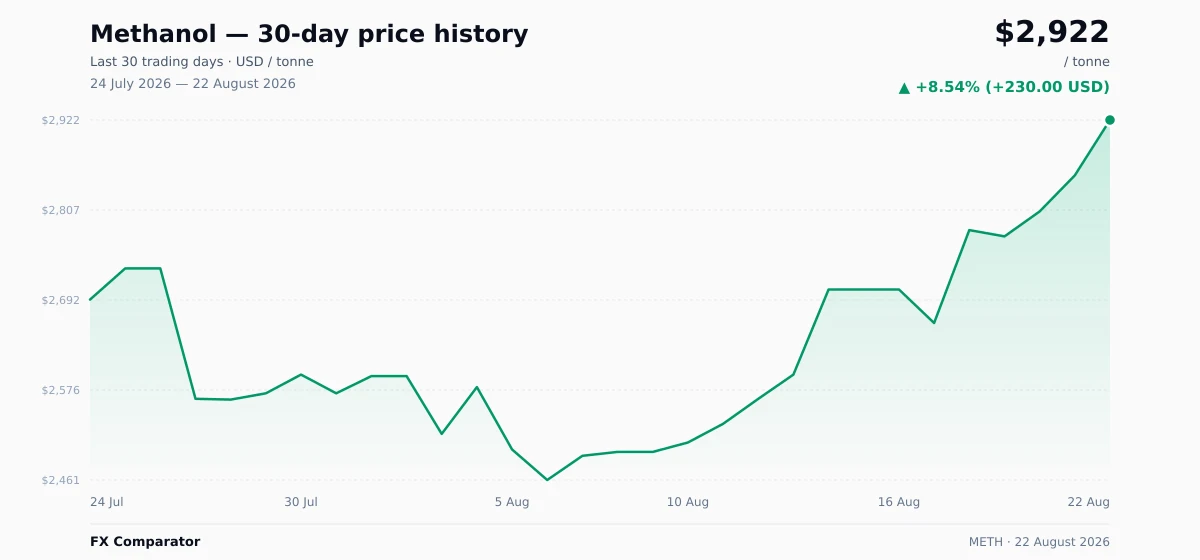
Download chart: WebP
Daily close
20 trading days
| Date | Price (USD) | Price (EUR) | Price (GBP) | Daily change |
|---|---|---|---|---|
| 8 Oct 2026 | US$3,863 | €3,453 | £2,925 | ▲ +0.34% |
| 1 Oct 2026 | US$3,850 | €3,442 | £2,915 | ▲ +6.06% |
| 30 Sept 2026 | US$3,630 | €3,245 | £2,749 | ▲ +2.83% |
| 29 Sept 2026 | US$3,530 | €3,156 | £2,673 | ▲ +2.11% |
| 28 Sept 2026 | US$3,457 | €3,090 | £2,618 | ▼ −1.59% |
| 25 Sept 2026 | US$3,513 | €3,141 | £2,660 | ▲ +4.37% |
| 24 Sept 2026 | US$3,366 | €3,009 | £2,549 | ▲ +0.78% |
| 23 Sept 2026 | US$3,340 | €2,986 | £2,529 | ▼ −1.56% |
| 22 Sept 2026 | US$3,393 | €3,033 | £2,569 | ▲ +0.18% |
| 21 Sept 2026 | US$3,387 | €3,028 | £2,565 | ▼ −1.34% |
| 19 Sept 2026 | US$3,433 | €3,069 | £2,599 | ▲ +1.12% |
| 18 Sept 2026 | US$3,395 | €3,035 | £2,571 | ▼ −1.48% |
| 17 Sept 2026 | US$3,446 | €3,081 | £2,609 | ▲ +2.77% |
| 16 Sept 2026 | US$3,353 | €2,997 | £2,539 | ▼ −0.24% |
| 15 Sept 2026 | US$3,361 | €3,005 | £2,545 | ▲ +0.27% |
| 14 Sept 2026 | US$3,352 | €2,997 | £2,538 | ▼ −19.83% |
| 12 Sept 2026 | US$4,181 | €3,738 | £3,166 | ▲ +16.14% |
| 11 Sept 2026 | US$3,600 | €3,218 | £2,726 | ▼ −4.96% |
| 10 Sept 2026 | US$3,788 | €3,386 | £2,868 | ▲ +13.38% |
| 9 Sept 2026 | US$3,341 | €2,987 | £2,530 | — |