Polypropylene price
Polypropylene currently trades at US$1,387 per tonne (≈ €1,238 · £1,049) — effectively at the 12-month high. Over the past 12 months the price has gained 41.34%, with the annual range running from US$894.05 to US$1,398. 24-hour movement is minimal (±0.01%).


Invest in commodity ETFs from just $50
Gold, oil and even whole commodity sectors through ETFs, all in one account, kept simple.
eToro is a multi-asset investment platform. The value of your investments may go up or down. Your capital is at risk.
Polypropylene chart
Interactive chart and 30-day overview
The Polypropylene chart shows how the polypropylene price has moved over time. The interactive view lets you switch the timeframe (from 7 days up to MAX), the currency (USD / EUR / GBP) and overlay moving averages. Click any two points to measure the percentage change between those dates.
How is polypropylene priced?
Polypropylene is priced per metric tonne (1 t = 1,000 kg) — the standard unit for industrial and bulk commodities on the London Metal Exchange (LME), CME and major European exchanges. Wholesale shipments move in containers or bulk vessels, typically in 25-tonne or 100-tonne lots.
At US$1,387 per tonne, one kilogram is worth US$1.39. End-user pricing for processed goods includes refining margins, transport and tariffs on top of the wholesale benchmark.
What drives the price of polypropylene?
The cost of propylene monomer is the main pillar of polypropylene economics. Propylene has traditionally been produced as a by-product of naphtha crackers, where ethylene is the main product, so supply depends on activity in the ethylene market. Propane dehydrogenation (PDH) plants, by contrast, produce propylene directly and have become a marginal cost-setter in regions where propane is cheap because of the shale gas boom. The expansion of Chinese PDH capacity has materially changed the global propylene balance: when the propane-propylene spread, or P-P spread, narrows, PDH plant utilisation falls. That tightens the monomer market and pushes PP resin prices higher.
Chinese demand is the second major factor. China accounts for about 30 percent of global polypropylene consumption and is also the largest producer. Demand rests on three pillars: the car industry, including bumpers, interior trim and battery housings in electric vehicles; textiles and nonwovens, including hygiene products, geotextiles and surgical masks; and packaging, including food, beverage and cosmetics packaging. Beijing’s property policy, Chinese vehicle production runs and the order book of the export-oriented textile sector all feed directly into Dalian Commodity Exchange prices.
Demand for automotive lightweighting and medical nonwoven fabrics is the third structural factor. A modern passenger car typically contains 80–100 kg of plastic, much of it polypropylene. Replacing metal parts reduces weight and fuel consumption, and increases range in electric vehicles. In the medical and hygiene segment, PP nonwovens made with melt-blown technology form the filtration layer in surgical masks, FFP2/FFP3 respirators and adult incontinence products. Epidemic cycles have therefore become a direct price factor.
How to invest in polypropylene
There is no directly accessible retail CFD or ETF on polypropylene resin — neither XTB nor eToro offers PP spot or futures products. Retail investors usually build market exposure through petrochemical shares: LyondellBasell (LYB) is one of the world’s largest polypropylene producers; ExxonMobil (XOM) also has a significant PP presence through its chemicals division; Dow Inc. (DOW) has a diversified polyolefins portfolio; India’s Reliance Industries (RELIANCE.NS) operates one of the world’s largest integrated complexes at Jamnagar; and OMV offers European exposure through its majority ownership of Borealis.
30-day price history
Chart and daily closing prices
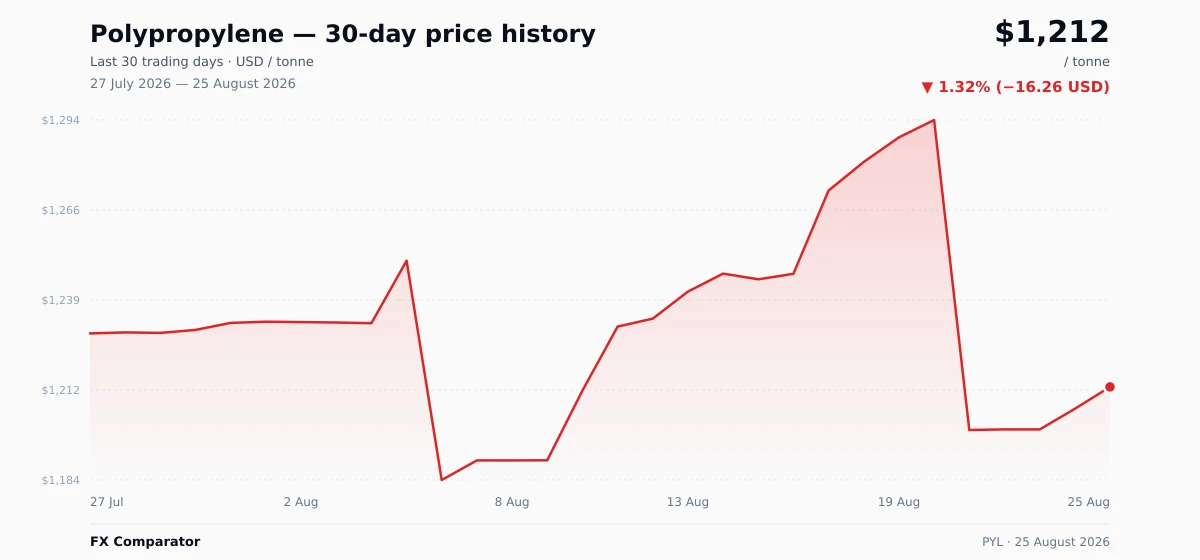
Download chart: WebP
Daily close
25 trading days
| Date | Price (USD) | Price (EUR) | Price (GBP) | Daily change |
|---|---|---|---|---|
| 10 Oct 2026 | US$1,387 | €1,238 | £1,049 | ▲ +0.01% |
| 9 Oct 2026 | US$1,387 | €1,237 | £1,049 | ▲ +2.38% |
| 8 Oct 2026 | US$1,354 | €1,209 | £1,025 | ▲ +5.87% |
| 7 Oct 2026 | US$1,279 | €1,142 | £967.75 | ▼ −0.22% |
| 5 Oct 2026 | US$1,282 | €1,144 | £969.79 | ▼ −0.01% |
| 2 Oct 2026 | US$1,282 | €1,144 | £969.85 | ▲ +0.21% |
| 1 Oct 2026 | US$1,279 | €1,142 | £967.81 | ▼ −0.01% |
| 30 Sept 2026 | US$1,280 | €1,142 | £967.88 | ▼ −0.22% |
| 29 Sept 2026 | US$1,282 | €1,144 | £970.06 | ▲ +1.20% |
| 28 Sept 2026 | US$1,267 | €1,131 | £958.58 | ▲ +0.09% |
| 27 Sept 2026 | US$1,266 | €1,130 | £957.75 | ▲ +0.04% |
| 26 Sept 2026 | US$1,266 | €1,129 | £957.34 | ▼ −0.01% |
| 25 Sept 2026 | US$1,266 | €1,130 | £957.42 | ▼ −0.03% |
| 24 Sept 2026 | US$1,266 | €1,130 | £957.72 | ▲ +0.97% |
| 23 Sept 2026 | US$1,254 | €1,119 | £948.53 | ▼ −1.43% |
| 22 Sept 2026 | US$1,272 | €1,135 | £962.27 | ▼ −1.40% |
| 21 Sept 2026 | US$1,290 | €1,151 | £975.97 | ▼ −2.59% |
| 20 Sept 2026 | US$1,325 | €1,182 | £1,002 | ▲ +0.01% |
| 18 Sept 2026 | US$1,324 | €1,182 | £1,002 | ▼ −0.59% |
| 17 Sept 2026 | US$1,332 | €1,189 | £1,008 | ▲ +0.37% |
| 16 Sept 2026 | US$1,327 | €1,184 | £1,004 | ▲ +0.01% |
| 15 Sept 2026 | US$1,327 | €1,184 | £1,004 | ▼ −0.52% |
| 14 Sept 2026 | US$1,334 | €1,191 | £1,009 | ▼ −1.06% |
| 13 Sept 2026 | US$1,348 | €1,203 | £1,020 | ▲ +0.05% |
| 11 Sept 2026 | US$1,348 | €1,203 | £1,019 | — |