RBOB gasoline price
RBOB gasoline currently trades at US$3.33 per gallon (≈ €2.98 · £2.52) — 10.24% below the 12-month high. Over the past 12 months the price has gained 77.13%, with the annual range running from US$1.68 to US$3.71. In the past 24 hours the price has sharply, risen by 4.39%.


Invest in commodity ETFs from just $50
Gold, oil and even whole commodity sectors through ETFs, all in one account, kept simple.
eToro is a multi-asset investment platform. The value of your investments may go up or down. Your capital is at risk.
RBOB gasoline chart
Interactive chart and 30-day overview
The RBOB gasoline chart shows how the RBOB gasoline price has moved over time. The interactive view lets you switch the timeframe (from 7 days up to MAX), the currency (USD / EUR / GBP) and overlay moving averages. Click any two points to measure the percentage change between those dates.
How is RBOB gasoline priced?
What drives the price of RBOB gasoline?
The most important gauge is the crack spread: the price difference between RBOB and crude oil, usually Brent or WTI. It directly reflects the refining margin. Traders typically watch the 3:2:1 crack ratio: three barrels of crude oil are assumed to yield two barrels of gasoline and one barrel of diesel. The dollar result shows whether refiners have an incentive to raise output. If the crack spread narrows, refiners cut capacity, tightening gasoline supply and putting upward pressure on RBOB prices.
The driving season creates a strong calendar pattern. Demand peaks between Memorial Day, the last Monday in May, and Labor Day, the first Monday in September, when US households take longer road trips. The summer-to-winter blend switch adds a technical cost. Summer-grade gasoline has lower vapour pressure, or RVP, and requires more expensive components. That alone adds about $0.10–$0.15 per gallon to refinery costs. US gasoline consumption is around 9 million barrels per day.
Refining capacity and hurricane risk are the two main supply-side factors. Total US refining capacity is about 18 million barrels per day, and almost half of it is concentrated on the Gulf Coast, in Texas and Louisiana, directly in the path of the Atlantic hurricane season from June to November. A major storm-related outage can lift RBOB prices within days. The Brent-WTI spread also matters, because coastal refineries process imported crude, so Brent-linked feedstock costs feed directly into the final gasoline price.
How to invest in gasoline
For a retail investor, gasoline exposure is almost entirely obtained through derivatives. The NYMEX RBOB futures contract is too large for most private accounts at 42,000 gallons, so brokers in Europe and the UK typically offer it as a CFD, often under the name GASOLINE or RBOB. Exchange-traded gasoline products such as UGA — United States Gasoline Fund — and shares in US refiners provide direct or indirect exposure.
30-day price history
Chart and daily closing prices
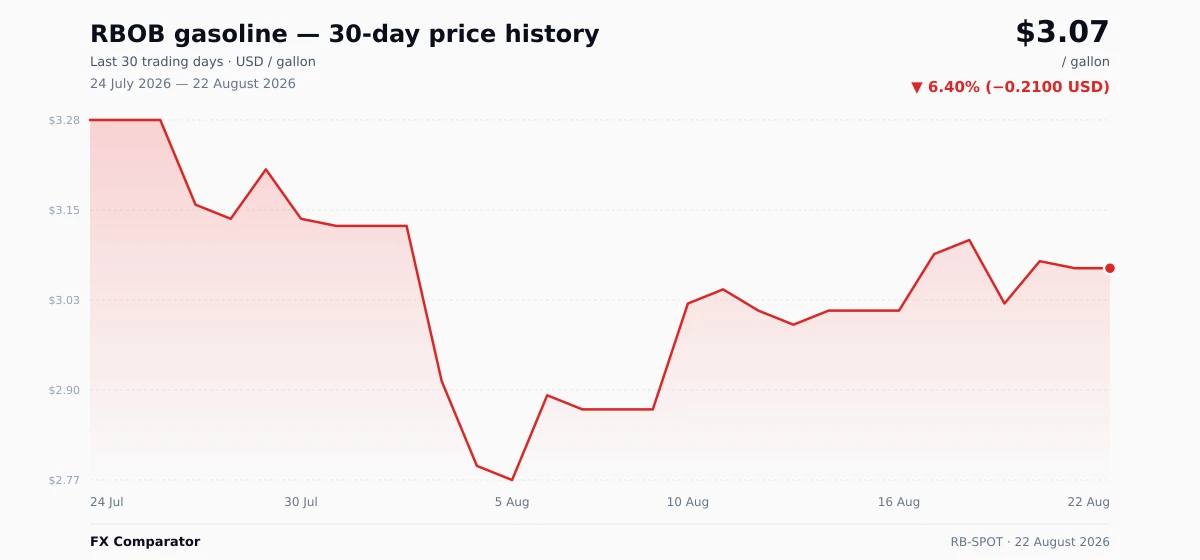
Download chart: WebP
Daily close
22 trading days
| Date | Price (USD) | Price (EUR) | Price (GBP) | Daily change |
|---|---|---|---|---|
| 8 Oct 2026 | US$3.33 | €2.98 | £2.52 | ▲ +4.39% |
| 7 Oct 2026 | US$3.19 | €2.85 | £2.42 | ▼ −2.15% |
| 6 Oct 2026 | US$3.26 | €2.91 | £2.47 | ▲ +2.19% |
| 5 Oct 2026 | US$3.19 | €2.85 | £2.42 | ▼ −2.45% |
| 3 Oct 2026 | US$3.27 | €2.92 | £2.48 | ▼ −0.30% |
| 2 Oct 2026 | US$3.28 | €2.93 | £2.48 | ▼ −2.67% |
| 1 Oct 2026 | US$3.37 | €3.01 | £2.55 | ▲ +3.69% |
| 30 Sept 2026 | US$3.25 | €2.91 | £2.46 | ▲ +4.84% |
| 29 Sept 2026 | US$3.10 | €2.77 | £2.35 | ▼ −2.21% |
| 28 Sept 2026 | US$3.17 | €2.83 | £2.40 | ▼ −1.25% |
| 25 Sept 2026 | US$3.21 | €2.87 | £2.43 | ▼ −3.89% |
| 24 Sept 2026 | US$3.34 | €2.99 | £2.53 | ▼ −1.47% |
| 23 Sept 2026 | US$3.39 | €3.03 | £2.57 | ▲ +4.31% |
| 22 Sept 2026 | US$3.25 | €2.91 | £2.46 | ▲ +0.62% |
| 21 Sept 2026 | US$3.23 | €2.89 | £2.45 | ▼ −2.42% |
| 18 Sept 2026 | US$3.31 | €2.96 | £2.51 | ▲ +0.91% |
| 17 Sept 2026 | US$3.28 | €2.93 | £2.48 | ▼ −1.80% |
| 15 Sept 2026 | US$3.34 | €2.99 | £2.53 | ▲ +2.77% |
| 14 Sept 2026 | US$3.25 | €2.91 | £2.46 | ▲ +0.93% |
| 11 Sept 2026 | US$3.22 | €2.88 | £2.44 | ▼ −4.17% |
| 10 Sept 2026 | US$3.36 | €3.00 | £2.54 | ▲ +5.99% |
| 9 Sept 2026 | US$3.17 | €2.83 | £2.40 | — |