TTF natural gas (EU) price
TTF natural gas (EU) currently trades at US$88.62 per MWh (≈ €79.23 · £67.10) — close to the 12-month high. Over the past 12 months the price has gained 137.17%, with the annual range running from US$30.33 to US$95.79. In the past 24 hours the price has fallen by 0.62%.


Invest in commodity ETFs from just $50
Gold, oil and even whole commodity sectors through ETFs, all in one account, kept simple.
eToro is a multi-asset investment platform. The value of your investments may go up or down. Your capital is at risk.
TTF natural gas (EU) chart
Interactive chart and 30-day overview
The TTF natural gas (EU) chart shows how the TTF natural gas (EU) price has moved over time. The interactive view lets you switch the timeframe (from 7 days up to MAX), the currency (USD / EUR / GBP) and overlay moving averages. Click any two points to measure the percentage change between those dates.
How is TTF natural gas (EU) priced?
TTF natural gas (EU) is priced per MWh on the Dutch TTF (Title Transfer Facility) — Europe's most-traded natural gas hub. One MWh equals 1,000 kWh, or roughly 3.41 MMBtu.
At US$88.62 per MWh, one MMBtu is worth around US$25.97 and one kWh about US$0.0886. TTF is the European gas benchmark that drives heating and electricity costs across the EU; its US counterpart is the Henry Hub price quoted in MMBtu.
What drives the Dutch TTF gas price?
Europe’s gas market has changed sharply since Russian pipeline supply fell. Russia once supplied about 40% of the EU’s roughly 350 billion m³ of annual gas consumption by pipeline. Today that share is in single digits. The gap is filled by liquefied natural gas (LNG) from the United States, Qatar and West Africa, and by higher Norwegian pipeline flows of about 85 billion m³ a year. The TTF price rose above EUR 300/MWh at the peak of the supply shock. Since then, the market has become structurally dependent on LNG imports. That links TTF more closely to the global gas market and makes it more sensitive to weather and geopolitical news.
The annual price pattern is shaped by the EU gas storage rule. Under the regulation, member states must reach a 90% storage filling level by 1 November, with flexibility between 1 October and 1 December. The EU’s combined storage capacity is about 100 billion m³. This creates a spring-summer injection cycle and an autumn-winter withdrawal cycle. Storage buying supports spot prices in summer, while withdrawals offset peak heating demand in winter. Daily GIE AGSI+ data and ENTSOG daily gas-flow statistics are quickly reflected in TTF trading.
Globally, the JKM-TTF spread helps decide where an LNG tanker goes. JKM, the Japan-Korea Marker, is the Asian LNG spot price. If the Asian premium over TTF widens, flexible US LNG cargoes without fixed destinations can move through the Suez Canal to the Far East, leaving fewer tankers for European LNG terminals such as Rotterdam, Zeebrugge, Dunkerque, Gate and Świnoujście. A hot Asian summer or a Japanese nuclear plant outage can therefore lift TTF. Chemical demand cycles, including fertiliser and ethylene, also matter. So does volatile renewable power generation, which changes the load on gas-fired power plants.
How to invest in European natural gas
There is no European natural-gas ETF built directly on TTF, so a European retail investor usually takes direct price exposure through CFDs. XTB and eToro both offer Dutch Gas or NL Gas CFDs, with leverage and high risk. TTF is a highly volatile exchange-traded energy market. Indirect exposure is available through shares of European integrated energy companies: RWE, a German power and gas producer; Engie, a French gas importer and LNG operator; Enel, an Italian multi-utility; EDF, a French power producer with a sizeable gas-fired fleet; and TotalEnergies, which has an LNG portfolio. These shares pay dividends and usually move more slowly than CFDs, but company-specific risks such as regulation, debt levels and hedging policy are added to the gas-price exposure.
30-day price history
Chart and daily closing prices
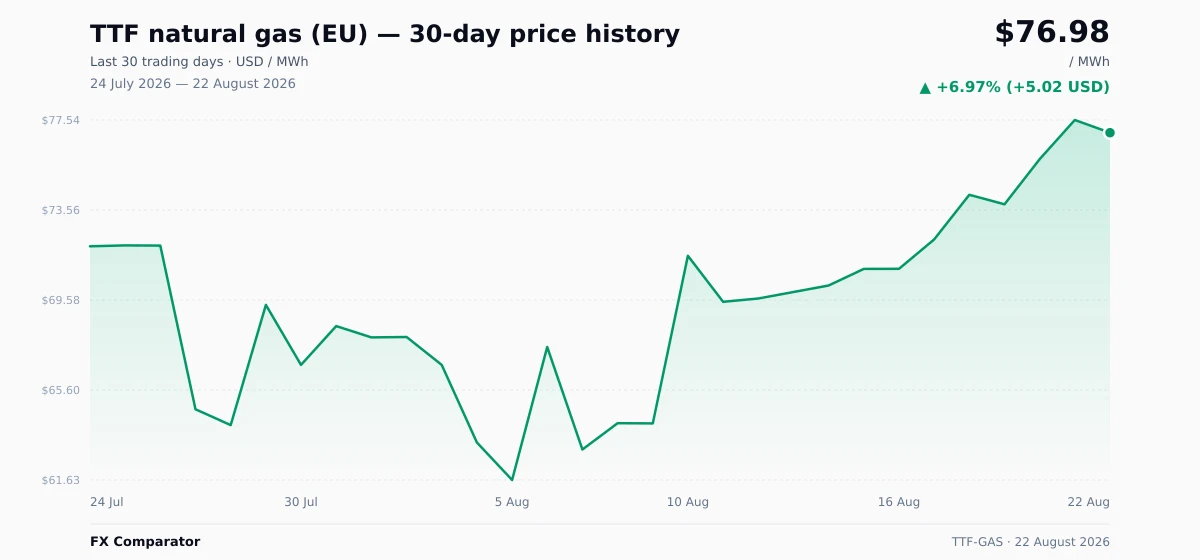
Download chart: WebP
Daily close
29 trading days
| Date | Price (USD) | Price (EUR) | Price (GBP) | Daily change |
|---|---|---|---|---|
| 8 Oct 2026 | US$88.62 | €79.23 | £67.10 | ▼ −0.62% |
| 7 Oct 2026 | US$89.17 | €79.72 | £67.52 | ▲ +3.89% |
| 6 Oct 2026 | US$85.83 | €76.73 | £64.99 | ▲ +3.60% |
| 5 Oct 2026 | US$82.85 | €74.07 | £62.74 | ▼ −1.81% |
| 4 Oct 2026 | US$84.39 | €75.44 | £63.90 | ▼ −0.03% |
| 3 Oct 2026 | US$84.41 | €75.46 | £63.92 | ▼ −2.02% |
| 2 Oct 2026 | US$86.15 | €77.02 | £65.23 | ▲ +3.85% |
| 1 Oct 2026 | US$82.96 | €74.16 | £62.82 | ▲ +1.15% |
| 30 Sept 2026 | US$82.02 | €73.32 | £62.10 | ▲ +4.57% |
| 29 Sept 2026 | US$78.43 | €70.12 | £59.39 | ▼ −3.25% |
| 28 Sept 2026 | US$81.07 | €72.47 | £61.38 | ▼ −1.06% |
| 26 Sept 2026 | US$81.94 | €73.25 | £62.05 | ▲ +1.91% |
| 25 Sept 2026 | US$80.40 | €71.88 | £60.88 | ▼ −5.90% |
| 24 Sept 2026 | US$85.44 | €76.38 | £64.70 | ▲ +0.68% |
| 23 Sept 2026 | US$84.87 | €75.87 | £64.26 | ▲ +3.82% |
| 22 Sept 2026 | US$81.75 | €73.08 | £61.90 | ▼ −3.24% |
| 21 Sept 2026 | US$84.48 | €75.53 | £63.97 | ▼ −7.56% |
| 20 Sept 2026 | US$91.39 | €81.70 | £69.20 | ▼ −0.02% |
| 19 Sept 2026 | US$91.41 | €81.72 | £69.22 | ▲ +0.57% |
| 18 Sept 2026 | US$90.90 | €81.26 | £68.83 | ▲ +0.51% |
| 17 Sept 2026 | US$90.44 | €80.85 | £68.48 | ▲ +0.70% |
| 16 Sept 2026 | US$89.81 | €80.29 | £68.00 | ▼ −3.76% |
| 15 Sept 2026 | US$93.32 | €83.42 | £70.66 | ▼ −1.69% |
| 14 Sept 2026 | US$94.93 | €84.86 | £71.88 | ▲ +2.78% |
| 13 Sept 2026 | US$92.36 | €82.56 | £69.93 | ▼ −0.01% |
| 12 Sept 2026 | US$92.37 | €82.57 | £69.94 | ▼ −1.00% |
| 11 Sept 2026 | US$93.30 | €83.41 | £70.64 | ▼ −2.60% |
| 10 Sept 2026 | US$95.79 | €85.63 | £72.53 | ▲ +3.88% |
| 9 Sept 2026 | US$92.21 | €82.44 | £69.82 | — |