Magnesium price
Magnesium currently trades at US$2,472 per tonne (≈ €2,206 · £1,870) — close to the 12-month high. Over the past 12 months the price has lost 4.06%, with the annual range running from US$2,415 to US$2,731. 24-hour movement is minimal (±0.01%).

Invest in commodity ETFs from just $50
Gold, oil and even whole commodity sectors through ETFs, all in one account, kept simple.
eToro is a multi-asset investment platform. The value of your investments may go up or down. Your capital is at risk.
Magnesium chart
Interactive chart and 30-day overview
The Magnesium chart shows how the magnesium price has moved over time. The interactive view lets you switch the timeframe (from 7 days up to MAX), the currency (USD / EUR / GBP) and overlay moving averages. Click any two points to measure the percentage change between those dates.
How is magnesium priced?
Magnesium is priced per metric tonne (1 t = 1,000 kg) — the standard unit for industrial and bulk commodities on the London Metal Exchange (LME), CME and major European exchanges. Wholesale shipments move in containers or bulk vessels, typically in 25-tonne or 100-tonne lots.
At US$2,472 per tonne, one kilogram is worth US$2.47. End-user pricing for processed goods includes refining margins, transport and tariffs on top of the wholesale benchmark.
What drives the price of magnesium?
The main feature of the magnesium market is Chinese supply concentration. Global primary magnesium production is ~1.0 million tonnes a year, of which China accounts for about ~85% — ~850,000 tonnes. The remaining sizeable producers are few: Russia (~50 kt), Israel (Dead Sea Magnesium, ~25 kt) and the United States (US Magnesium LLC near the Great Salt Lake in Utah, ~22 kt). Chinese output is also concentrated. Fugu county in Shaanxi province — China’s “magnesium capital” — alone accounts for close to ~40% of global production. A single provincial power-control measure or environmental tightening in China can therefore reset prices worldwide.
The second pillar is Chinese energy constraint. Primary magnesium production is based almost entirely on the Pidgeon process: dolomite is calcined, and the resulting magnesium oxide is reduced with ferrosilicon into magnesium vapour, which then condenses. The process is highly energy-intensive — producing one tonne of magnesium requires roughly 35–40 MWh of energy, typically coal-fired power — making Pidgeon-process metal one of the most carbon-intensive metals in the world on a per-tonne basis. A previous autumn wave of Chinese power curbs, when a large share of capacity in Shaanxi and Shanxi had to be shut, lifted the FOB China price from ~3,100 USD to ~6,400 USD / tonne in three months. The temporary shock showed how exposed Western buyers are to this single bottleneck.
The third driver is the lightweighting trend on the demand side. Magnesium alloys (AZ91, AM60) are 33% lighter than aluminium and 75% lighter than steel, so the automotive industry — especially the EV segment — uses them increasingly in transmission housings, steering-wheel frames and instrument-panel supports. The other major end-market is aluminium alloying: 5xxx and 6xxx series structural aluminium alloys typically contain 0.5–5% magnesium, so aluminium production (~70 Mt a year) alone generates magnesium demand in the hundreds of thousands of tonnes. Movements in the US Defense Logistics Agency strategic magnesium stockpile also add a seasonal effect. Magnesium is among the metals considered strategically critical for defence procurement.
How to invest in magnesium
Magnesium is a difficult commodity for retail investors to access directly. Pure magnesium CFDs are not available from large European brokers such as XTB and eToro — there is no liquid exchange-traded contract on which a CFD could be based — and there is no pure magnesium ETF, because the market is too small and too concentrated for listed products. A European retail investor therefore gets exposure indirectly. One route is through diversified mining companies such as Glencore — GLEN.L and Rio Tinto. Another is through aluminium producers such as Alcoa — AA and Norsk Hydro, where magnesium and aluminium-alloy businesses form a meaningful part of the product base. A third route is through automotive lightweighting suppliers such as Magna International — MGA, whose activity is linked to magnesium demand trends.
30-day price history
Chart and daily closing prices
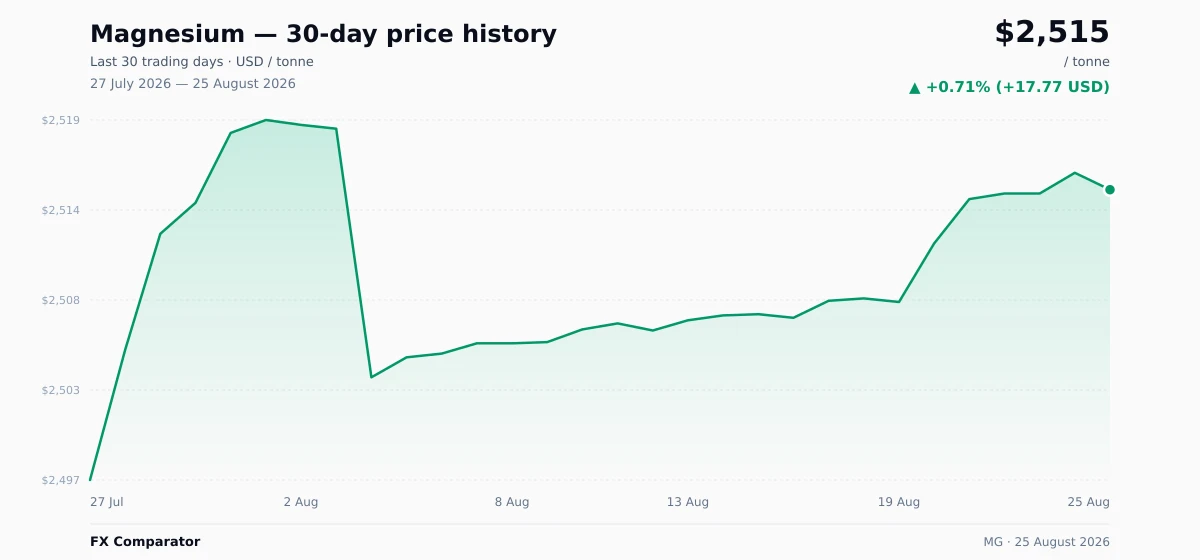
Download chart: WebP
Daily close
23 trading days
| Date | Price (USD) | Price (EUR) | Price (GBP) | Daily change |
|---|---|---|---|---|
| 10 Oct 2026 | US$2,472 | €2,206 | £1,870 | ▲ +0.01% |
| 9 Oct 2026 | US$2,472 | €2,206 | £1,870 | ▼ −1.13% |
| 8 Oct 2026 | US$2,500 | €2,231 | £1,891 | ▲ +0.02% |
| 7 Oct 2026 | US$2,500 | €2,231 | £1,891 | ▼ −0.01% |
| 5 Oct 2026 | US$2,500 | €2,231 | £1,891 | ▼ −0.01% |
| 1 Oct 2026 | US$2,500 | €2,231 | £1,891 | ▼ −0.01% |
| 30 Sept 2026 | US$2,500 | €2,231 | £1,891 | ▲ +0.06% |
| 29 Sept 2026 | US$2,499 | €2,230 | £1,890 | ▼ −0.23% |
| 28 Sept 2026 | US$2,504 | €2,235 | £1,894 | ▼ −0.01% |
| 27 Sept 2026 | US$2,505 | €2,235 | £1,895 | ▲ +0.04% |
| 26 Sept 2026 | US$2,504 | €2,234 | £1,894 | ▼ −0.01% |
| 25 Sept 2026 | US$2,504 | €2,234 | £1,894 | ▼ −0.03% |
| 24 Sept 2026 | US$2,505 | €2,235 | £1,894 | ▼ −0.10% |
| 23 Sept 2026 | US$2,507 | €2,237 | £1,896 | ▼ −0.39% |
| 21 Sept 2026 | US$2,517 | €2,246 | £1,904 | ▲ +0.09% |
| 20 Sept 2026 | US$2,515 | €2,244 | £1,902 | ▲ +0.01% |
| 18 Sept 2026 | US$2,514 | €2,244 | £1,902 | ▲ +0.07% |
| 17 Sept 2026 | US$2,513 | €2,242 | £1,901 | ▲ +0.32% |
| 16 Sept 2026 | US$2,505 | €2,235 | £1,895 | ▲ +0.01% |
| 15 Sept 2026 | US$2,505 | €2,235 | £1,894 | ▼ −0.61% |
| 14 Sept 2026 | US$2,520 | €2,249 | £1,906 | ▼ −0.65% |
| 13 Sept 2026 | US$2,536 | €2,263 | £1,919 | ▲ +0.05% |
| 11 Sept 2026 | US$2,535 | €2,262 | £1,918 | — |