Neodymium price
Neodymium currently trades at US$141,382 per tonne (≈ €126,493 · £107,070) — 17.22% below the 12-month high. Over the past 12 months the price has gained 24.70%, with the annual range running from US$98,651 to US$170,799. 24-hour movement is minimal (±0.01%).


Invest in commodity ETFs from just $50
Gold, oil and even whole commodity sectors through ETFs, all in one account, kept simple.
eToro is a multi-asset investment platform. The value of your investments may go up or down. Your capital is at risk.
Neodymium chart
Interactive chart and 30-day overview
The Neodymium chart shows how the neodymium price has moved over time. The interactive view lets you switch the timeframe (from 7 days up to MAX), the currency (USD / EUR / GBP) and overlay moving averages. Click any two points to measure the percentage change between those dates.
How is neodymium priced?
Neodymium is priced per metric tonne (1 t = 1,000 kg) — the standard unit for industrial and bulk commodities on the London Metal Exchange (LME), CME and major European exchanges. Wholesale shipments move in containers or bulk vessels, typically in 25-tonne or 100-tonne lots.
At US$141,382 per tonne, one kilogram is worth US$141.38. End-user pricing for processed goods includes refining margins, transport and tariffs on top of the wholesale benchmark.
What drives the price of neodymium?
The neodymium market is dominated by China’s concentration of supply. According to the USGS Mineral Commodity Summaries, global rare-earth mine production is around 390,000 tonnes REO (rare earth oxide) a year. China accounts for about 270,000 tonnes, the United States — essentially the Mountain Pass mine operated by MP Materials — about 45,000 tonnes, Australia — Lynas Rare Earths and Mt Weld — about 13,000 tonnes, and Myanmar about 30,000 tonnes. Neodymium and praseodymium together make up about 30% of mined REO content, making them the most commercially relevant light rare-earth elements. Concentration is even more acute in refining and separation: nearly 80% of global separation capacity is in China, so much of the concentrate mined in Myanmar, Australia and even the US is still processed in Chinese refineries.
Demand is driven mainly by two end uses. The first is permanent-magnet drive motors in electric vehicles. Estimates from Adamas Intelligence and IEA Critical Minerals suggest that about 90% of EVs sold globally use NdFeB permanent-magnet synchronous motors (PMSM), because they offer a favourable power-to-weight ratio. An average EV motor contains 1.5–2 kg of NdFeB magnets, of which about 30% by weight is Nd-Pr. The second major end use is direct-drive wind-turbine generators. Offshore and large onshore wind turbines often use direct-drive generators, with about 200 kg of NdFeB magnets per megawatt. A third, smaller but steady source of demand comes from industrial servo motors, robots, MRI scanners and consumer electronics such as speakers and hard drives.
The third set of drivers is the diversification and regulatory environment. China has long controlled rare-earth mining and separation through a quota system, while gradually tightening export controls on processing know-how and separation technology. The western response rests on three pillars: the Mountain Pass mine in California, operated by MP Materials, with a separation and magnet plant under development in Texas; Australia’s Lynas Rare Earths, which operates the Mt Weld mine and the Kuantan refinery in Malaysia and is building separation capacity in Texas with US Department of Defense support; and smaller emerging producers, including Canada’s Vital Metals, Brazil’s Serra Verde, and projects in Greenland and Africa. Recycling used NdFeB magnets, by companies such as Urban Mining Company and Solvay, is another route to reducing dependence on Chinese supply over the longer term.
How can investors get exposure to neodymium?
Direct neodymium oxide CFD or spot trading is typically not available to European retail investors. Because the market is OTC and liquidity is limited, rare-earth price exposure is generally not offered as a retail derivative. There are three main routes to rare-earth exposure. The first is a thematic ETF. The best-known is VanEck Rare Earth/Strategic Metals (ticker: REMX), which tracks a basket of global rare-earth and strategic-metals producers. The second is individual equities. California-based MP Materials (MP) operates the largest rare-earth mine in the western hemisphere. Lynas Rare Earths (LYC.AX) is the largest integrated miner-refiner outside China. Iluka Resources (ILU.AX) builds light rare-earth exposure through mineral sands and a standalone Australian refinery project. Energy Fuels (UUUU) is involved in separation linked to uranium by-product projects. The third, indirect route is through downstream users — EV makers and wind-turbine manufacturers such as Vestas and Siemens Gamesa — although neodymium is only one input among many for these companies. Two regulated brokers where REMX and the individual shares above may be available are:
30-day price history
Chart and daily closing prices
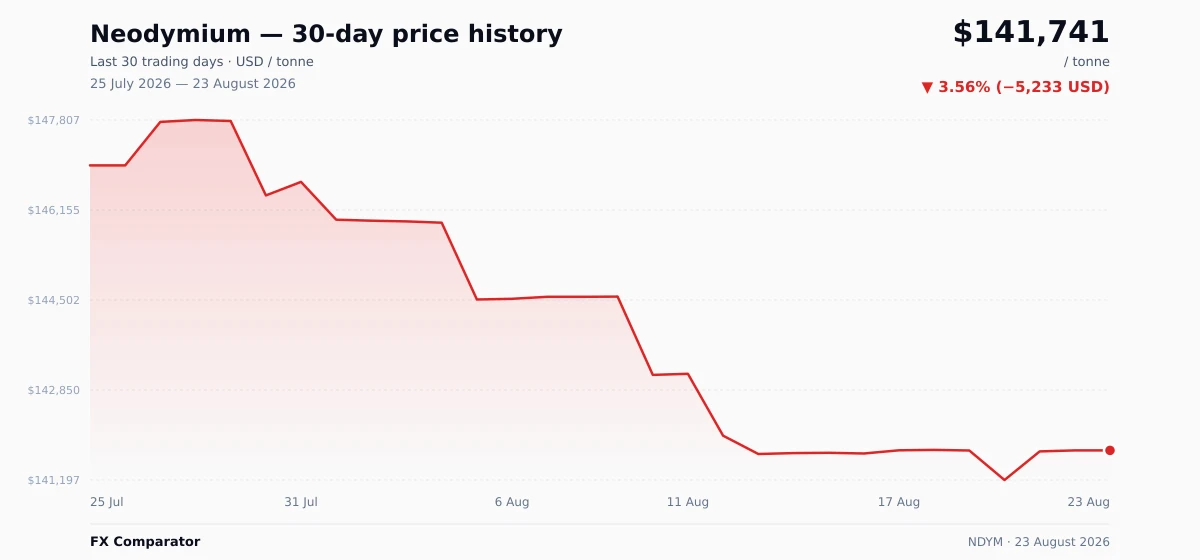
Download chart: WebP
Daily close
23 trading days
| Date | Price (USD) | Price (EUR) | Price (GBP) | Daily change |
|---|---|---|---|---|
| 8 Oct 2026 | US$141,382 | €126,493 | £107,070 | ▼ −0.01% |
| 7 Oct 2026 | US$141,401 | €126,510 | £107,084 | ▼ −0.01% |
| 5 Oct 2026 | US$141,403 | €126,512 | £107,086 | ▼ −0.01% |
| 1 Oct 2026 | US$141,409 | €126,517 | £107,090 | ▼ −0.01% |
| 30 Sept 2026 | US$141,420 | €126,527 | £107,099 | ▲ +0.06% |
| 29 Sept 2026 | US$141,342 | €126,457 | £107,040 | ▲ +0.07% |
| 28 Sept 2026 | US$141,247 | €126,372 | £106,968 | ▼ −0.01% |
| 27 Sept 2026 | US$141,258 | €126,382 | £106,976 | ▲ +0.04% |
| 26 Sept 2026 | US$141,197 | €126,328 | £106,930 | ▼ −0.01% |
| 25 Sept 2026 | US$141,209 | €126,338 | £106,939 | ▼ −0.03% |
| 24 Sept 2026 | US$141,253 | €126,378 | £106,972 | ▼ −0.10% |
| 23 Sept 2026 | US$141,397 | €126,506 | £107,081 | ▼ −0.35% |
| 21 Sept 2026 | US$141,903 | €126,959 | £107,465 | ▲ +0.08% |
| 20 Sept 2026 | US$141,783 | €126,852 | £107,374 | ▲ +0.01% |
| 18 Sept 2026 | US$141,766 | €126,837 | £107,361 | ▲ +0.07% |
| 17 Sept 2026 | US$141,662 | €126,744 | £107,282 | ▲ +0.02% |
| 16 Sept 2026 | US$141,633 | €126,718 | £107,260 | ▼ −0.52% |
| 15 Sept 2026 | US$142,369 | €127,376 | £107,817 | ▼ −0.01% |
| 14 Sept 2026 | US$142,389 | €127,394 | £107,833 | ▼ −0.07% |
| 13 Sept 2026 | US$142,484 | €127,479 | £107,905 | ▲ +0.05% |
| 11 Sept 2026 | US$142,414 | €127,416 | £107,852 | ▼ −0.03% |
| 10 Sept 2026 | US$142,459 | €127,457 | £107,886 | ▲ +0.04% |
| 9 Sept 2026 | US$142,401 | €127,405 | £107,842 | — |