Steel price
Steel currently trades at US$462.92 per tonne (≈ €413.10 · £350.16) — close to the 12-month high. Over the past 12 months the price has gained 1.88%, with the annual range running from US$437.49 to US$477.65. 24-hour movement is minimal (±0.01%).

Invest in commodity ETFs from just $50
Gold, oil and even whole commodity sectors through ETFs, all in one account, kept simple.
eToro is a multi-asset investment platform. The value of your investments may go up or down. Your capital is at risk.
Steel chart
Interactive chart and 30-day overview
The Steel chart shows how the steel price has moved over time. The interactive view lets you switch the timeframe (from 7 days up to MAX), the currency (USD / EUR / GBP) and overlay moving averages. Click any two points to measure the percentage change between those dates.
How is steel priced?
Steel is priced per metric tonne (1 t = 1,000 kg) — the standard unit for industrial and bulk commodities on the London Metal Exchange (LME), CME and major European exchanges. Wholesale shipments move in containers or bulk vessels, typically in 25-tonne or 100-tonne lots.
At US$462.92 per tonne, one kilogram is worth US$0.4629. End-user pricing for processed goods includes refining margins, transport and tariffs on top of the wholesale benchmark.
What drives rebar prices?
The main driver of the rebar market is the volume of new construction in China’s property sector. China produces about 250 million tonnes of rebar a year, more than 60% of global rebar output of roughly 400 Mt, and most of it is consumed domestically. New residential construction starts in China exceeded 1 billion m² a year at the peak. At an estimated use rate of about 85 kg/m², that alone generated roughly 85 million tonnes of rebar demand. The liquidity position of developers such as Country Garden, Evergrande and Vanke, mortgage conditions set by the People’s Bank of China and local government infrastructure programmes can feed into SHFE rebar prices within days.
The second major factor is Chinese supply discipline and environmental regulation. Beijing has used capacity quotas and output curbs for years to contain oversupply. During the winter pollution season from November to March, steel mills in the northern provinces of Hebei, Shanxi and Shandong are often forced to cut production by 20–50% to meet air-quality limits. That can move rebar prices at the start of winter. The annual crude-steel output ceiling of about 1 billion tonnes, associated with the “Common Prosperity” policy framework, also limits supply flexibility.
The third structural factor is the shift in raw-material inputs and production technology. Traditional blast furnace/basic oxygen furnace (BF/BOF) steelmaking uses iron ore and coking coal, so SGX iron ore and Australian HCC prices feed directly into rebar costs. One tonne of rebar requires about 1.6 t of iron ore and about 0.6 t of coking coal. Electric arc furnaces (EAFs), by contrast, melt scrap steel, so input costs are tied to the global scrap market, including Turkish HMS and US shredded scrap, and to electricity prices. China is seeking to raise the EAF share for emissions reasons, from about 10% now towards a target of about 20%, changing the cost structure of the steel industry.
How to invest in steel
A European retail investor usually does not have direct access to Chinese SHFE rebar CFDs. Neither XTB nor eToro offers the Chinese rebar futures contract directly. Rebar exposure is usually built through integrated steelmaker shares and sector ETFs: Luxembourg-based ArcelorMittal (MT) is the world’s second-largest steel producer, South Korea’s POSCO Holdings (PKX) is a global steel group, and US-based Nucor (NUE) is a major EAF-based rebar producer. A diversified option is the VanEck Steel ETF (SLX), which tracks a global basket of steel-industry shares. Availability varies by broker, and shares or ETFs can produce dividends as well as capital gains or losses.
30-day price history
Chart and daily closing prices
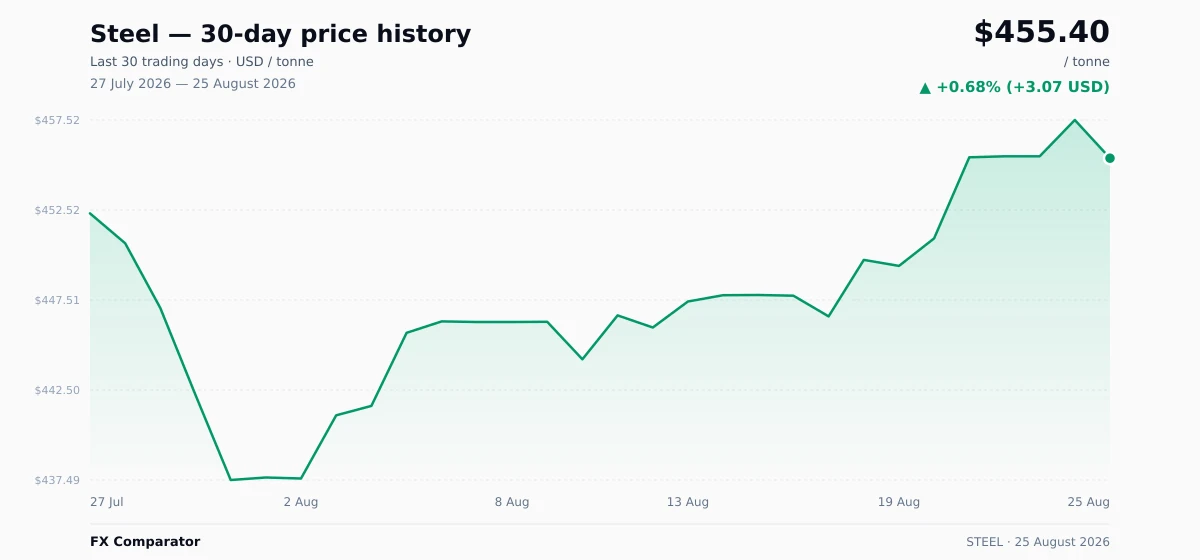
Download chart: WebP
Daily close
24 trading days
| Date | Price (USD) | Price (EUR) | Price (GBP) | Daily change |
|---|---|---|---|---|
| 10 Oct 2026 | US$462.92 | €413.10 | £350.16 | ▲ +0.01% |
| 9 Oct 2026 | US$462.88 | €413.07 | £350.13 | ▲ +0.94% |
| 8 Oct 2026 | US$458.56 | €409.21 | £346.86 | ▼ −1.17% |
| 7 Oct 2026 | US$463.97 | €414.04 | £350.95 | ▼ −0.01% |
| 5 Oct 2026 | US$463.98 | €414.05 | £350.96 | ▼ −0.01% |
| 1 Oct 2026 | US$464.00 | €414.07 | £350.98 | ▲ +0.67% |
| 30 Sept 2026 | US$460.90 | €411.30 | £348.63 | ▼ −0.33% |
| 29 Sept 2026 | US$462.44 | €412.67 | £349.79 | ▼ −0.03% |
| 28 Sept 2026 | US$462.58 | €412.79 | £349.90 | ▼ −0.14% |
| 27 Sept 2026 | US$463.21 | €413.36 | £350.37 | ▲ +0.04% |
| 26 Sept 2026 | US$463.01 | €413.18 | £350.22 | ▼ −0.01% |
| 25 Sept 2026 | US$463.05 | €413.21 | £350.25 | ▼ −0.03% |
| 24 Sept 2026 | US$463.19 | €413.34 | £350.36 | ▲ +0.19% |
| 23 Sept 2026 | US$462.32 | €412.56 | £349.70 | ▼ −0.38% |
| 22 Sept 2026 | US$464.09 | €414.14 | £351.04 | ▼ −0.26% |
| 21 Sept 2026 | US$465.29 | €415.22 | £351.95 | ▲ +0.60% |
| 20 Sept 2026 | US$462.51 | €412.73 | £349.85 | ▲ +0.01% |
| 18 Sept 2026 | US$462.45 | €412.68 | £349.80 | ▼ −0.22% |
| 17 Sept 2026 | US$463.46 | €413.58 | £350.57 | ▼ −0.68% |
| 16 Sept 2026 | US$466.64 | €416.42 | £352.97 | ▲ +0.17% |
| 15 Sept 2026 | US$465.87 | €415.73 | £352.39 | ▲ +0.57% |
| 14 Sept 2026 | US$463.25 | €413.39 | £350.40 | ▲ +1.10% |
| 13 Sept 2026 | US$458.19 | €408.88 | £346.58 | ▲ +0.05% |
| 11 Sept 2026 | US$457.96 | €408.68 | £346.41 | — |