Titanium price
Titanium currently trades at US$6.50 per kg (≈ €5.80 · £4.92) — close to the 12-month high. Over the past 12 months the price has lost 8.06%, with the annual range running from US$6.47 to US$7.14. 24-hour movement is minimal (±0.01%).

Invest in commodity ETFs from just $50
Gold, oil and even whole commodity sectors through ETFs, all in one account, kept simple.
eToro is a multi-asset investment platform. The value of your investments may go up or down. Your capital is at risk.
Titanium chart
Interactive chart and 30-day overview
The Titanium chart shows how the titanium price has moved over time. The interactive view lets you switch the timeframe (from 7 days up to MAX), the currency (USD / EUR / GBP) and overlay moving averages. Click any two points to measure the percentage change between those dates.
How is titanium priced?
What moves the price of titanium?
The titanium sponge market is driven mainly by the aerospace build rate. Boeing’s 787 and 777X programmes, and Airbus’s A350 and A320neo programmes, together generate demand running into several thousand tonnes a year. A single 787 airframe contains about 15 tonnes of titanium, including engine blades, fuselage frames and landing-gear components. OEM order books, scheduling delays and Boeing’s quality-control crises feed directly into prices in long-term supply contracts. The military segment, including the F-35, F-22, Eurofighter and jet engines, is smaller but more stable and carries higher premiums. Certified aerospace-grade sponge can cost up to ten times as much as industrial-grade material in small lots.
On the supply side, geopolitical concentration is the main risk. Of global annual titanium sponge production of about 280,000 tonnes, China accounts for roughly 150 kt, or about 54%, Japan for ~50 kt through Toho Titanium and Osaka Titanium, Russia for ~40 kt through VSMPO-AVISMA, historically a supplier of about 30% of global aerospace titanium, and Kazakhstan for ~25 kt from Ust-Kamenogorsk. The United States produces only a fraction. Since the start of the war in Ukraine, western aerospace buyers such as Boeing, Airbus and Rolls-Royce have deliberately diversified away from Russian supply towards Japanese, US and Chinese sources. VSMPO-AVISMA’s direct western exposure has narrowed sharply, embedding a persistent supply premium in index prices.
Medical and industrial demand is the third durable price driver. Titanium’s biocompatibility makes Ti-6Al-4V, or Grade 5, the standard alloy for hip, knee and dental implants. Ageing populations and rising implant demand provide structural support. Chemical equipment, including chlorine production units, hydrochloric-acid tanks and heat exchangers in seawater desalination plants, often cannot be replaced with cheaper metals because of titanium’s corrosion resistance. The Kroll process, which reduces titanium tetrachloride with magnesium at about 900 °C in an argon atmosphere, is directly exposed to electricity and gas prices. Producing one kilogram of sponge requires about 30–40 kWh of electricity, far more than aluminium on a per-kilogram basis.
How to invest in titanium
Titanium is not available as a direct exchange-traded instrument for European retail investors. There is no CFD and no pure-play ETF, because the market is too narrow and illiquid. One possible indirect route is through titanium processors and aerospace stocks. Allegheny Technologies (ATI), Howmet Aerospace (HWM, formerly part of Arconic) and Carpenter Technology (CRS) are among the main western producers of titanium semi-finished products. Boeing (BA) and Airbus (AIR.PA) serve as demand-side proxies. They are not pure titanium exposures, but they are linked to aircraft build rates. The former Russian pure play, VSMPO-AVISMA, has been delisted from the Moscow Exchange and is under sanctions. It is not available to western investors.
30-day price history
Chart and daily closing prices
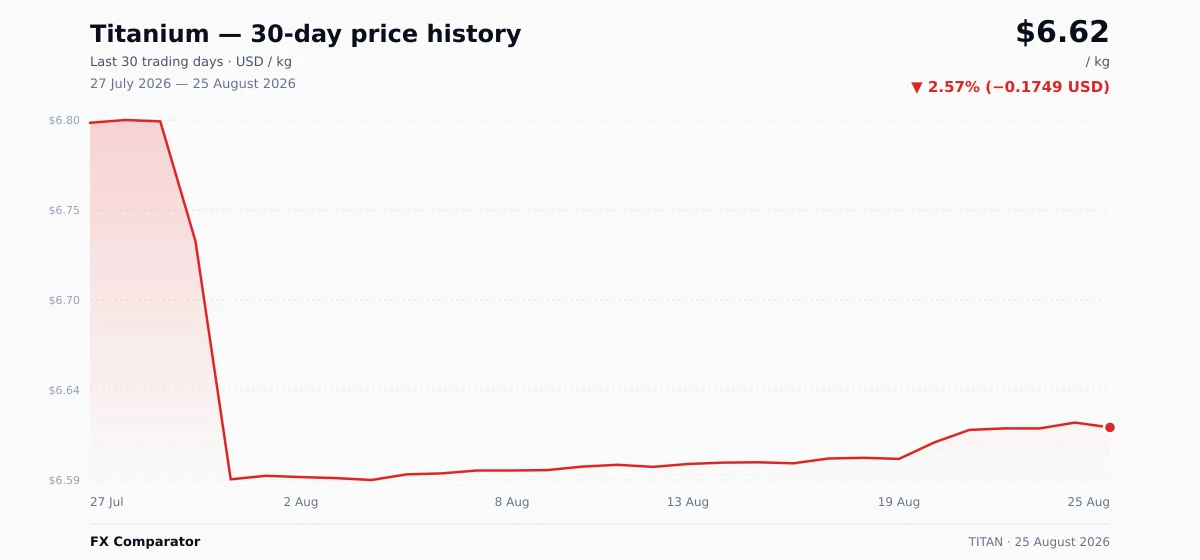
Download chart: WebP
Daily close
23 trading days
| Date | Price (USD) | Price (EUR) | Price (GBP) | Daily change |
|---|---|---|---|---|
| 10 Oct 2026 | US$6.50 | €5.80 | £4.92 | ▲ +0.01% |
| 9 Oct 2026 | US$6.50 | €5.80 | £4.91 | ▲ +0.06% |
| 8 Oct 2026 | US$6.49 | €5.79 | £4.91 | ▲ +0.02% |
| 7 Oct 2026 | US$6.49 | €5.79 | £4.91 | ▼ −0.01% |
| 5 Oct 2026 | US$6.49 | €5.79 | £4.91 | ▼ −0.01% |
| 1 Oct 2026 | US$6.49 | €5.79 | £4.91 | ▼ −0.01% |
| 30 Sept 2026 | US$6.49 | €5.79 | £4.91 | ▲ +0.06% |
| 29 Sept 2026 | US$6.49 | €5.79 | £4.91 | ▲ +0.07% |
| 28 Sept 2026 | US$6.48 | €5.79 | £4.91 | ▼ −0.01% |
| 27 Sept 2026 | US$6.49 | €5.79 | £4.91 | ▲ +0.04% |
| 26 Sept 2026 | US$6.48 | €5.78 | £4.90 | ▼ −0.01% |
| 25 Sept 2026 | US$6.48 | €5.79 | £4.90 | ▼ −0.03% |
| 24 Sept 2026 | US$6.48 | €5.79 | £4.91 | ▼ −0.10% |
| 23 Sept 2026 | US$6.49 | €5.79 | £4.91 | ▼ −0.09% |
| 21 Sept 2026 | US$6.50 | €5.80 | £4.91 | ▲ +0.09% |
| 20 Sept 2026 | US$6.49 | €5.79 | £4.91 | ▲ +0.01% |
| 18 Sept 2026 | US$6.49 | €5.79 | £4.91 | ▲ +0.07% |
| 17 Sept 2026 | US$6.49 | €5.79 | £4.91 | ▲ +0.02% |
| 16 Sept 2026 | US$6.49 | €5.79 | £4.91 | ▲ +0.01% |
| 15 Sept 2026 | US$6.48 | €5.79 | £4.91 | ▼ −0.01% |
| 14 Sept 2026 | US$6.49 | €5.79 | £4.91 | ▼ −0.07% |
| 13 Sept 2026 | US$6.49 | €5.79 | £4.91 | ▲ +0.05% |
| 11 Sept 2026 | US$6.49 | €5.79 | £4.91 | — |