Bitumen price
Bitumen currently trades at US$709.84 per tonne (≈ €633.44 · £536.93) — 12.49% below the 12-month high. Over the past 12 months the price has gained 49.30%, with the annual range running from US$420.37 to US$811.13. 24-hour movement is minimal (±0.01%).


Invest in commodity ETFs from just $50
Gold, oil and even whole commodity sectors through ETFs, all in one account, kept simple.
eToro is a multi-asset investment platform. The value of your investments may go up or down. Your capital is at risk.
Bitumen chart
Interactive chart and 30-day overview
The Bitumen chart shows how the bitumen price has moved over time. The interactive view lets you switch the timeframe (from 7 days up to MAX), the currency (USD / EUR / GBP) and overlay moving averages. Click any two points to measure the percentage change between those dates.
How is bitumen priced?
Bitumen is priced per metric tonne (1 t = 1,000 kg) — the standard unit for industrial and bulk commodities on the London Metal Exchange (LME), CME and major European exchanges. Wholesale shipments move in containers or bulk vessels, typically in 25-tonne or 100-tonne lots.
At US$709.84 per tonne, one kilogram is worth US$0.7098. End-user pricing for processed goods includes refining margins, transport and tariffs on top of the wholesale benchmark.
What drives the price of bitumen?
The main factor is the crude oil price and refinery economics. Bitumen is a residual product of oil refining — the highest-boiling fraction left at the bottom of the distillation column. Refineries that process heavy crude oil, such as Russian Urals, Mexican Maya, Venezuelan Merey and Canadian oil sands grades, have much higher bitumen yields than simple refineries designed for light, sweet crude such as WTI or Brent. Examples include Valero’s coking refineries, US Gulf Coast coker units, Russia’s Tatneft and India’s Jamnagar complex. When crude prices rise, bitumen prices usually follow. The heavy-light spread is also a major pricing factor.
The second driver is the road-construction cycle. Global bitumen demand is about 120 million tonnes a year. China consumes about 32 Mt, the US about 22 Mt and India about 7 Mt. China’s Belt and Road Initiative, US federal infrastructure packages such as the Bipartisan Infrastructure Law, and the European Union’s TEN-T transport network programmes create multi-year waves of bitumen demand. Demand is highly seasonal. In temperate countries, paving work slows or stops in the winter months from November to March. Refineries then move bitumen into storage terminals or sell residual fractions as fuel oil.
A third structural factor is IMO marine sulphur regulation. The International Maritime Organization cut the permitted sulphur content of marine fuels to 0.5% from 3.5% when the rule came into force. The market for high-sulphur fuel oil (HSFO) shrank sharply. Refineries had to convert residual fractions into lower-sulphur products through coking or hydrocracking. In some refinery configurations, this reduced bitumen yields. The premium for low-sulphur bitumen therefore rose on a sustained basis, and sulphur specifications became one of the market’s main pricing parameters.
How to invest in bitumen
There is no liquid global futures contract for bitumen. The SHFE BU contract serves China’s domestic market, with currency restrictions and limited access for foreign investors. Neither XTB nor eToro offers a direct bitumen CFD. A European retail investor can gain indirect exposure through listed companies in the commodity’s value chain: refiners that process heavy crude oil, such as Valero and Marathon Petroleum, and building-materials companies, such as Vulcan Materials, Martin Marietta and Eagle Materials, which supply asphalt concrete and road aggregates. International equities can be held through standard brokerage accounts or tax-efficient wrappers, such as a UK ISA or similar EU accounts, where available.
30-day price history
Chart and daily closing prices
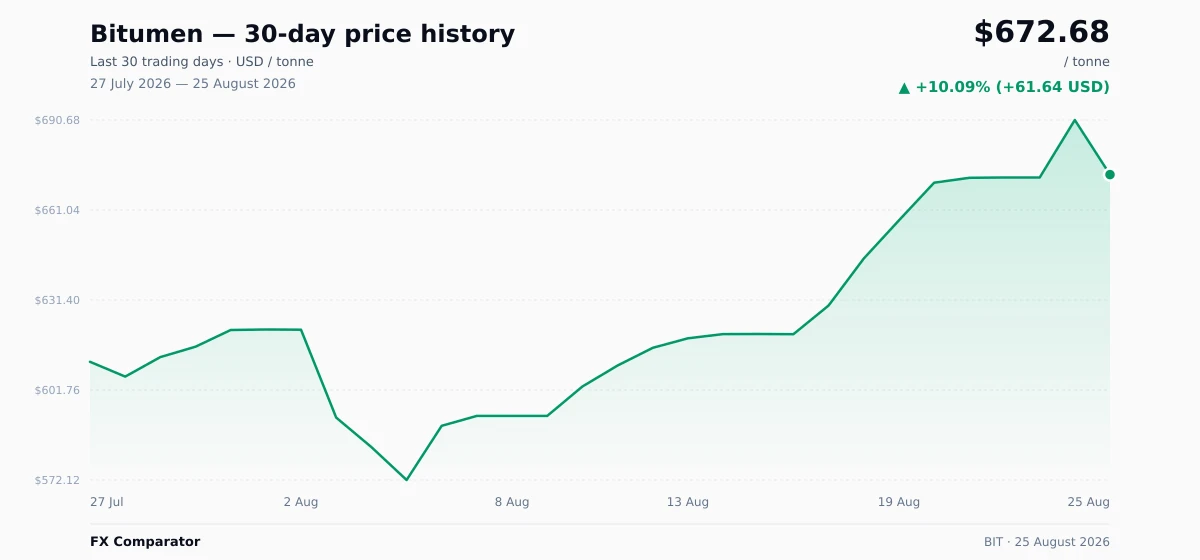
Download chart: WebP
Daily close
24 trading days
| Date | Price (USD) | Price (EUR) | Price (GBP) | Daily change |
|---|---|---|---|---|
| 10 Oct 2026 | US$709.84 | €633.44 | £536.93 | ▲ +0.01% |
| 9 Oct 2026 | US$709.78 | €633.40 | £536.89 | ▼ −2.34% |
| 8 Oct 2026 | US$726.79 | €648.57 | £549.75 | ▲ +6.61% |
| 7 Oct 2026 | US$681.71 | €608.34 | £515.65 | ▼ −0.01% |
| 5 Oct 2026 | US$681.72 | €608.35 | £515.66 | ▼ −0.01% |
| 1 Oct 2026 | US$681.75 | €608.38 | £515.68 | ▼ −8.88% |
| 30 Sept 2026 | US$748.22 | €667.70 | £565.96 | ▼ −2.45% |
| 29 Sept 2026 | US$767.05 | €684.50 | £580.21 | ▼ −0.20% |
| 28 Sept 2026 | US$768.62 | €685.90 | £581.39 | ▼ −1.91% |
| 27 Sept 2026 | US$783.59 | €699.26 | £592.71 | ▲ +0.04% |
| 26 Sept 2026 | US$783.25 | €698.96 | £592.46 | ▼ −0.01% |
| 25 Sept 2026 | US$783.32 | €699.02 | £592.51 | ▼ −0.03% |
| 24 Sept 2026 | US$783.57 | €699.24 | £592.70 | ▲ +5.08% |
| 23 Sept 2026 | US$745.71 | €665.46 | £564.06 | ▼ −1.70% |
| 22 Sept 2026 | US$758.64 | €676.99 | £573.84 | ▼ −0.55% |
| 21 Sept 2026 | US$762.84 | €680.74 | £577.02 | ▼ −5.90% |
| 20 Sept 2026 | US$810.70 | €723.45 | £613.22 | ▲ +0.01% |
| 18 Sept 2026 | US$810.60 | €723.36 | £613.15 | ▲ +1.08% |
| 17 Sept 2026 | US$801.96 | €715.65 | £606.61 | ▼ −1.10% |
| 16 Sept 2026 | US$810.88 | €723.62 | £613.36 | ▼ −0.03% |
| 15 Sept 2026 | US$811.13 | €723.84 | £613.55 | ▲ +1.88% |
| 14 Sept 2026 | US$796.18 | €710.50 | £602.24 | ▲ +3.26% |
| 13 Sept 2026 | US$771.06 | €688.07 | £583.23 | ▲ +0.05% |
| 11 Sept 2026 | US$770.68 | €687.74 | £582.95 | — |