Cobalt price
Cobalt currently trades at US$39,245 per tonne (≈ €35,021 · £29,685) — 30.28% below the 12-month high. Over the past 12 months the price has lost 2.91%, with the annual range running from US$39,140 to US$56,290. 24-hour movement is minimal (±0.00%).


Invest in commodity ETFs from just $50
Gold, oil and even whole commodity sectors through ETFs, all in one account, kept simple.
eToro is a multi-asset investment platform. The value of your investments may go up or down. Your capital is at risk.
Cobalt chart
Interactive chart and 30-day overview
The Cobalt chart shows how the cobalt price has moved over time. The interactive view lets you switch the timeframe (from 7 days up to MAX), the currency (USD / EUR / GBP) and overlay moving averages. Click any two points to measure the percentage change between those dates.
How is cobalt priced?
Cobalt is priced per metric tonne (1 t = 1,000 kg) — the standard unit for industrial and bulk commodities on the London Metal Exchange (LME), CME and major European exchanges. Wholesale shipments move in containers or bulk vessels, typically in 25-tonne or 100-tonne lots.
At US$39,245 per tonne, one kilogram is worth US$39.25. End-user pricing for processed goods includes refining margins, transport and tariffs on top of the wholesale benchmark.
What drives the cobalt price?
Global cobalt supply is unusually concentrated. The Democratic Republic of Congo (DRC) alone accounts for about 70% of annual mine production — about 170,000 tonnes out of a global total of roughly 230,000 tonnes. A distant second is Indonesia (~20 kt, mainly as a by-product of nickel laterite processing), followed by Russia (~8 kt, Norilsk Nickel) and Australia. About 70-80% of Congolese output comes from large industrial mines operated by groups such as CMOC, Glencore and ERG. A significant share — about 15-20% — still comes from artisanal small-scale mining, where child labour and severely unsafe working conditions have been documented. This supply structure creates ethical risk and can also lead to periodic export restrictions.
On the demand side, electric-vehicle batteries are the main driver: about 60% of global cobalt use goes into batteries. An EV with an NMC (nickel-manganese-cobalt) cathode contains about 8–12 kg of cobalt, depending on the cell chemistry mix, such as NMC622 versus NMC811. Cathode chemistries are changing quickly. NMC811 uses materially less cobalt than the earlier NMC622 chemistry, while LFP (lithium iron phosphate) cells — common among Chinese manufacturers and in entry-level models — contain no cobalt at all. This shift in the cathode mix structurally lowers average cobalt use per vehicle.
The third major factor is China’s dominance in refining. Most raw cobalt from Congolese mines, in the form of hydroxide or concentrate, is refined in China. Huayou Cobalt, GEM and CMOC together account for more than half of global refining capacity. That creates a concentrated risk for western battery manufacturers, and cobalt is included on the EU critical raw materials list. A smaller but stable source of demand comes from aerospace superalloys. Jet engine combustion chambers and turbine blades often use alloys with high cobalt content, sometimes up to 50%, because cobalt retains strength at high temperatures.
How to invest in cobalt
A direct cobalt CFD market is typically not available at retail brokers in Europe or the UK, and LME Cobalt liquidity is low compared with gold or copper. European retail investors usually get cobalt exposure in three ways. The first is through cobalt and battery-metal ETFs: the Amplify Lithium & Battery Technology ETF (BATT) and the Global X Lithium & Battery Tech ETF (LIT) offer partial cobalt exposure through companies in the battery value chain. The second route is via individual equities: Glencore (GLEN.L) is the largest western cobalt producer, with the Mutanda and Katanga mines in the DRC; Brazil’s Vale (VALE) produces cobalt alongside nickel; and Belgium’s Umicore (UMI.BR) is active in cathode materials and battery recycling. The third route is physical cobalt, which is not widely used by retail investors.
30-day price history
Chart and daily closing prices
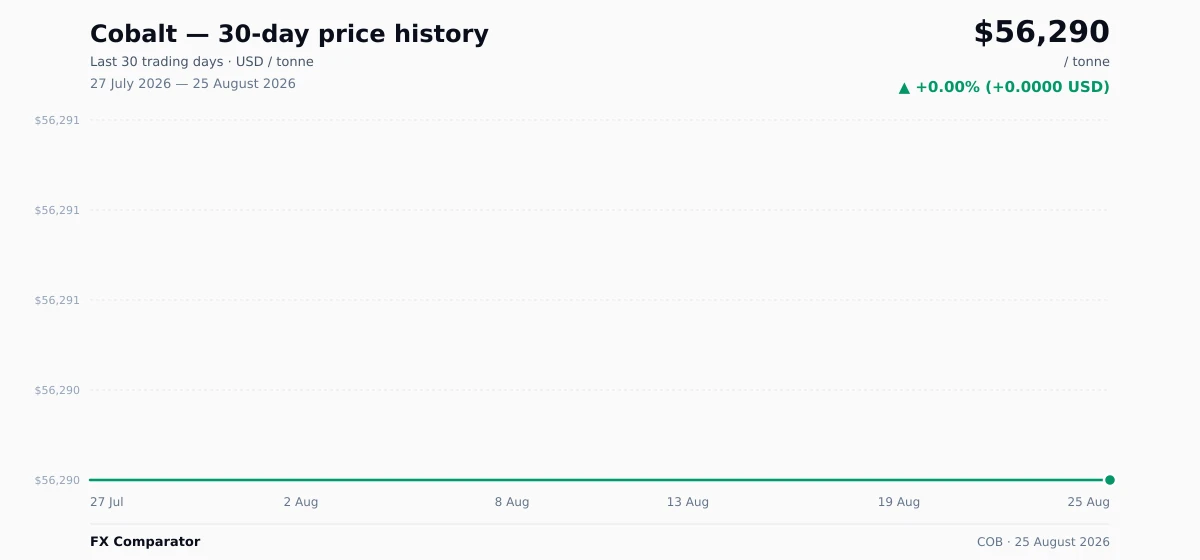
Download chart: WebP
Daily close
11 trading days
| Date | Price (USD) | Price (EUR) | Price (GBP) | Daily change |
|---|---|---|---|---|
| 6 Oct 2026 | US$39,245 | €35,021 | £29,685 | ▲ +0.27% |
| 30 Sept 2026 | US$39,140 | €34,928 | £29,606 | ▼ −1.26% |
| 23 Sept 2026 | US$39,640 | €35,374 | £29,984 | ▼ −0.10% |
| 22 Sept 2026 | US$39,680 | €35,410 | £30,014 | ▼ −0.25% |
| 21 Sept 2026 | US$39,780 | €35,499 | £30,090 | ▼ −0.85% |
| 18 Sept 2026 | US$40,120 | €35,802 | £30,347 | ▼ −1.36% |
| 17 Sept 2026 | US$40,675 | €36,298 | £30,767 | ▼ −1.27% |
| 16 Sept 2026 | US$41,200 | €36,766 | £31,164 | ▼ −1.55% |
| 15 Sept 2026 | US$41,850 | €37,346 | £31,656 | ▼ −1.25% |
| 14 Sept 2026 | US$42,380 | €37,819 | £32,057 | ▼ −1.30% |
| 11 Sept 2026 | US$42,940 | €38,319 | £32,480 | — |