Energy · LGO

Gasoil price

Gasoil currently trades at US$1,123 per tonne (≈ €954.91 · £836.82) — 22.13% below the 12-month high. Over the past 12 months it has gained 84.04%, with the annual range running from US$589.80 to US$1,442. 24-hour movement is minimal (±0.00%).

US$1,123 / tonne
≈ €954.91 ≈ £836.82 Unchanged 24h 63% within the 52-week range
FX Editorial Team · Data updated: · Editorially verified
Gasoil (LGO) price today US$1,123 / tonne, ↑ +0.00% (24h)

Gasoil chart

Interactive chart and 30-day overview

7 days
▼ −5.76%
−US$68.60
30 days
▼ −3.27%
−US$38.00
1 year
▲ +84.04%
+US$512.70
52-week range
US$589.80 63% US$1,442
Gasoil (LGO) 30-day price chart — USD, EUR, GBP

The Gasoil chart shows how the gasoil price has moved over time. The interactive view lets you switch the timeframe (from 7 days up to MAX), the currency (USD / EUR / GBP) and overlay moving averages. Click any two points to measure the percentage change between those dates.

How is gasoil priced?

What drives the price of gasoil (LGO)?

LGO prices are shaped mainly by the structure of European diesel demand. EU distillate consumption is roughly 6 million barrels a day, and a large share cannot be replaced quickly. Continental truck and bus fleets, agricultural machinery such as tractors and combines, construction equipment and low-sulphur marine bunker fuel after the IMO sulphur rule all consume middle distillates. Europe’s diesel-heavy passenger-car fleet is fading only gradually as electrification advances, while demand from logistics and agriculture remains high. LGO is therefore more sensitive to recession concerns than petrol benchmarks: a slowdown feeds into distillate demand quickly through freight traffic.

The central supply issue is the EU embargo on Russian diesel and the trade rerouting that followed. Since the embargo took effect, the EU has not accepted Russian refined products, leaving suppliers in the Atlantic basin — US Gulf Coast refineries, Saudi exporters and Indian refiners — to cover the missing volumes. India has become the largest non-EU diesel supplier, with European shipments of around ~0.4–0.5 mbpd in peak periods, often refined directly or indirectly from Russian crude. US diesel exports to Europe are more often in the range of a few hundred thousand barrels a day. The shift has kept the LGO–Brent crack spread in a wider range than the 12–15 dollar level seen in the years before the embargo.

The third factor is refinery yield logic. A simple refinery produces petrol, middle distillates such as diesel and kerosene, and heavier fuel oil in roughly fixed proportions when it fractionates crude. More complex cracking plants can shift yields. When the diesel margin, or crack spread, is significantly higher than the petrol margin, refiners maximise middle-distillate output and time planned maintenance accordingly. In the winter half of the year, the heating-oil overlap tightens supply further. Household heating oil and road diesel come from the same ICE-listed fraction, so in cold winters heating demand and transport demand compete for the same barrel.

How to invest in gasoil

Retail investors do not usually hold physical gasoil. Storage rules and sulphur regulation make that impractical. The most common route for financial exposure is a LGO CFD, listed as GASOIL by many brokers, which tracks the London futures price and can be traded with leverage. For a longer horizon, refining and integrated oil-company shares are another route. TotalEnergies (TTE), Shell, BP, Repsol (REP.MC) and MOL (MOL.BD) all have exposure to diesel crack pricing. A refinery share can give more direct exposure to middle-distillate margins than a simple crude-oil position. The ETF market for distillates is narrow; broad energy-sector ETFs such as XLE usually provide only indirect exposure.

30-day price history

Chart and daily closing prices
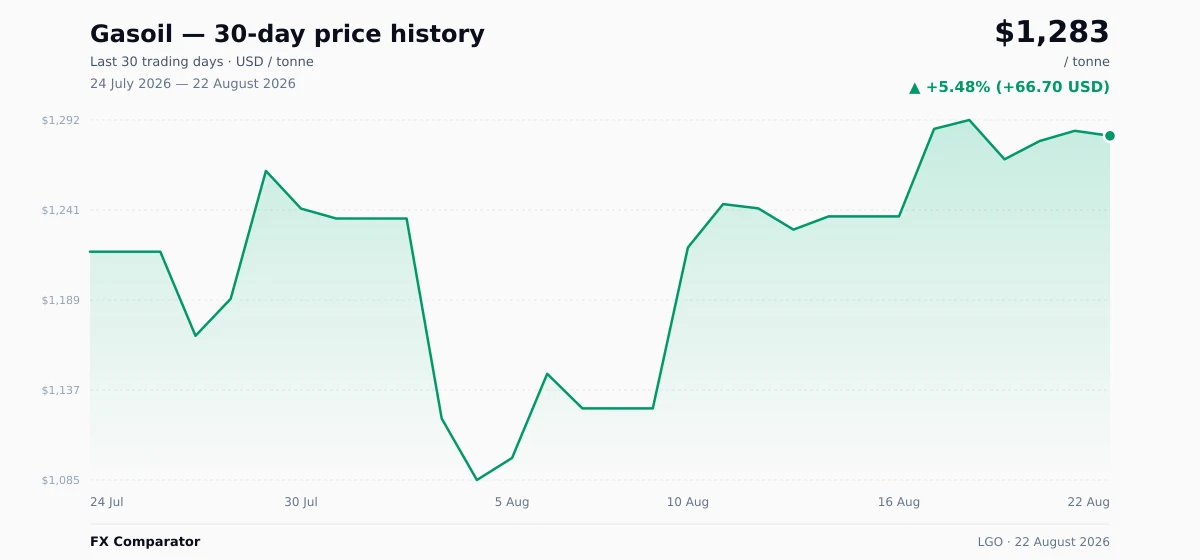
Gasoil (LGO) 30-day price chart — USD, EUR, GBP

Daily close

30 trading days

Date Price (USD) Price (EUR) Price (GBP) Daily change
23 May 2026 US$1,123 €954.91 £836.82 ▲ +0.51%
22 May 2026 US$1,117 €950.06 £832.57 ▼ −2.90%
21 May 2026 US$1,151 €978.47 £857.47 ▼ −0.38%
20 May 2026 US$1,155 €982.21 £860.75 ▼ −4.29%
19 May 2026 US$1,207 €1,026 £899.35 ▼ −0.79%
18 May 2026 US$1,216 €1,034 £906.51 ▲ +2.09%
16 May 2026 US$1,191 €1,013 £887.95 ▼ −0.54%
15 May 2026 US$1,198 €1,019 £892.79 ▲ +4.55%
14 May 2026 US$1,146 €974.47 £853.96 ▼ −2.94%
13 May 2026 US$1,181 €1,004 £879.83 ▼ −1.74%
12 May 2026 US$1,201 €1,022 £895.40 ▲ +2.93%
11 May 2026 US$1,167 €992.67 £869.91 ▲ +1.81%
10 May 2026 US$1,147 €975.06 £854.49 ▼ −0.62%
6 May 2026 US$1,154 €981.10 £859.78 ▼ −6.24%
5 May 2026 US$1,230 €1,046 £917.02 ▼ −2.40%
4 May 2026 US$1,261 €1,072 £939.60 ▲ +2.29%
2 May 2026 US$1,233 €1,048 £918.58 ▼ −0.29%
1 May 2026 US$1,236 €1,051 £921.27 ▼ −2.68%
30 Apr 2026 US$1,270 €1,080 £946.68 ▲ +5.65%
29 Apr 2026 US$1,202 €1,023 £896.07 ▼ −0.83%
28 Apr 2026 US$1,212 €1,031 £903.60 ▼ −0.32%
27 Apr 2026 US$1,216 €1,034 £906.51 ▲ +1.32%
25 Apr 2026 US$1,201 €1,021 £894.73 ▲ +3.42%
22 Apr 2026 US$1,161 €987.23 £865.14 ▲ +8.95%
21 Apr 2026 US$1,065 €906.09 £794.04 ▼ −0.10%
20 Apr 2026 US$1,067 €907.03 £794.86

Gasoil FAQ

What is the wholesale price of a litre of gasoil? +
The ICE Low Sulphur Gasoil contract is quoted per tonne. At a density of about 0.85 kg per litre, one tonne is roughly 1,175 litres. At about USD 700 a tonne, the wholesale commodity price is therefore around USD 0.60 per litre. The diesel price paid at the pump is several times higher because it also includes refining margins, depot and forecourt logistics, excise duty, VAT or sales tax and the retail margin. Tax treatment varies by jurisdiction; consult a local tax adviser.
How is LGO linked to the diesel price at the pump? +
LGO is the European wholesale diesel benchmark. It prices the stage between the refinery and the depot. The retail pump price also includes excise duty, VAT or sales tax, depot-to-station logistics and the retailer’s margin. Weekly moves in LGO usually feed into posted pump prices with a delay of one to three weeks. Increases tend to pass through faster than declines.
Why is LGO quoted in tonnes rather than barrels, like Brent or WTI? +
European wholesale trade in refined products is traditionally measured in tonnes because physical deliveries move by barge and tanker truck, where mass is the natural settlement unit. For LGO, one tonne is roughly 7.43 barrels, the reciprocal of Brent’s approximate 0.137 tonnes per barrel conversion. Global crude-oil pricing inherited the barrel from 19th-century Pennsylvania practice. Refined-product markets differ by region: US NYMEX ULSD, or Heating Oil, is quoted by the gallon, while European gasoil is quoted by the tonne.
What is the LGO–Brent crack spread, and why does it matter? +
The crack spread is a rough proxy for the refining margin. The gasoil price per tonne is converted into a barrel equivalent and the Brent price per barrel is subtracted. The difference shows how much the market is paying to turn crude oil into diesel. Since the Russian diesel embargo, the LGO–Brent crack has traded at a persistently higher and more volatile level than the previous 12–15 USD average range. That reflects higher Atlantic-basin shipping costs and the logistics premium on Indian and US replacement supply.
Where does Europe get diesel from since the Russian embargo? +
The EU’s distillate import dependence, on top of its own refining capacity, is about 30%. Since the embargo took effect, Russian refined products have been removed from the EU supply mix. The shortfall has mainly been filled from three sources: the United States, with Gulf Coast refineries shipping a few hundred thousand barrels a day; India, including Reliance Jamnagar and Nayara Energy, at around 0.4–0.5 million barrels a day; and the Middle East, including Saudi Arabia, the United Arab Emirates and Kuwait. For Indian shipments, a significant share of the feedstock has previously been Russian crude. Russian oil therefore still reaches the European market indirectly in some cases, but as Indian distillate.
How can I invest in gasoil? +
Retail investors do not hold physical gasoil. Storage, sulphur regulation and taxation make that impractical. The financial routes are: a Gasoil CFD for direct exposure to the London LGO quote, which is leveraged and high risk; refining and integrated oil-company shares such as TotalEnergies, Shell, BP, Repsol and MOL, which benefit from middle-distillate margins and often pay dividends; and broad energy-sector ETFs such as XLE and iShares Global Energy, which provide indirect exposure. Pure distillate ETFs are rare in Europe. The US United States Diesel-Heating Oil Fund attempted to offer this exposure, but did not remain in operation.
What is the IMO sulphur rule, and how did it affect gasoil prices? +
The IMO sulphur rule is a requirement set by the International Maritime Organization that limits sulphur content in marine fuel to a maximum of 0.5%, down from the previous 3.5%. The change shifted substantial demand away from traditional high-sulphur fuel oil, or HSFO, towards compliant middle distillates and low-sulphur blends. That created structurally higher demand for LGO and a wider gasoil-fuel oil spread. Compliance can also be achieved by installing scrubbers, but a large share of the fleet still meets the rule by burning compliant fuel.
Why does the gasoil price often rise in winter? +
LGO represents the same refinery fraction as household and industrial heating oil. Switching between the two products is largely a matter of additives and customs treatment. In cold winters, heating demand in northern and central Europe draws supply away from road diesel, while refinery maintenance season typically falls in late autumn. The resulting tightness often produces a winter peak in LGO, especially when Rhine water levels are low and barge logistics are constrained. During a low-water period, output from refineries around Karlsruhe and Mannheim cannot reach consumer markets efficiently.