Naphtha price
Naphtha currently trades at US$834.28 per tonne (≈ €745.82 · £631.70) — 16.21% below the 12-month high. Over the past 12 months the price has gained 53.00%, with the annual range running from US$488.37 to US$995.66. In the past 24 hours the price has risen by 0.74%.

Invest in commodity ETFs from just $50
Gold, oil and even whole commodity sectors through ETFs, all in one account, kept simple.
eToro is a multi-asset investment platform. The value of your investments may go up or down. Your capital is at risk.
Naphtha chart
Interactive chart and 30-day overview
The Naphtha chart shows how the naphtha price has moved over time. The interactive view lets you switch the timeframe (from 7 days up to MAX), the currency (USD / EUR / GBP) and overlay moving averages. Click any two points to measure the percentage change between those dates.
How is naphtha priced?
Naphtha is priced per metric tonne (1 t = 1,000 kg) — the standard unit for industrial and bulk commodities on the London Metal Exchange (LME), CME and major European exchanges. Wholesale shipments move in containers or bulk vessels, typically in 25-tonne or 100-tonne lots.
At US$834.28 per tonne, one kilogram is worth US$0.8343. End-user pricing for processed goods includes refining margins, transport and tariffs on top of the wholesale benchmark.
What drives the price of naphtha?
The main source of naphtha demand is the petrochemical steam-cracker industry. Around 85% of global output ends up in plastics, fibres and chemical supply chains as ethylene, propylene, butadiene and aromatics such as benzene, toluene and xylenes. The cracker margin, also known as the steam cracker margin, is the difference between the value of olefin products and the cost of naphtha feedstock. When the margin narrows, crackers cut utilisation and naphtha demand falls. Asian crackers, especially plants in South Korea, Japan, China and Taiwan, account for ~60% of global naphtha demand, so marginal pricing is centred on the Platts CFR Japan assessment.
The main structural challenge for naphtha prices is competition from US ethane-based crackers. Since the shale gas boom, a series of crackers has been built on the US Gulf Coast, especially in Texas and Louisiana. These plants produce ethylene from ethane separated cheaply from natural gas, typically with a USD 200–400 / tonne cost advantage on an ethylene-equivalent basis versus naphtha cracking. An ethane cracker, however, produces almost pure ethylene and very little propylene or aromatic by-product. A naphtha cracker produces a broader product slate, which gives the chemical industry a more valuable yield mix. The two models are therefore partly complementary and partly competitive. Each new unit of US ethane-cracker capacity indirectly reduces olefin-equivalent demand for naphtha.
A third driver is the refinery gasoline–naphtha switching decision. Naphtha is also a feedstock for gasoline production. The light fraction is converted into higher-octane motor gasoline through reforming or isomerisation. When global gasoline demand is strong, for example during the US summer driving season, refiners direct naphtha into the gasoline pool as blendstock, tightening supply for crackers. When gasoline markets are weak and cracker margins are high, more naphtha flows to petrochemical plants and prices adjust lower. Regional imbalances are handled through Atlantic–Pacific naphtha arbitrage: European surplus, priced off the Argus Mediterranean basis, is shipped by tanker to Asian crackers. The movement is reflected in the spread between the two benchmarks.
How to invest in the naphtha market
Naphtha is mainly a B2B commodity. The physical market operates between refineries and petrochemical plants, and most retail CFD brokers, including XTB, eToro and Plus500, do not list direct naphtha CFDs. A European retail investor therefore gains exposure through companies linked to the industry: integrated oil majors such as TotalEnergies (TTE), Shell and BP, whose refining and petrochemical divisions are directly affected by naphtha pricing; large Asian crackers such as LG Chem, Lotte Chemical and Formosa Plastics, the latter listed in Taiwan; and refinery-focused shares such as Reliance Industries on India’s NSE, which operates one of the world’s largest cracker complexes, or South Korea’s S-Oil. On the US ethane-cracker side, Dow (DOW) and LyondellBasell (LYB) offer exposure. Crude oil CFDs such as Brent and WTI also provide indirect exposure, but they do not track naphtha-specific margin moves precisely.
30-day price history
Chart and daily closing prices
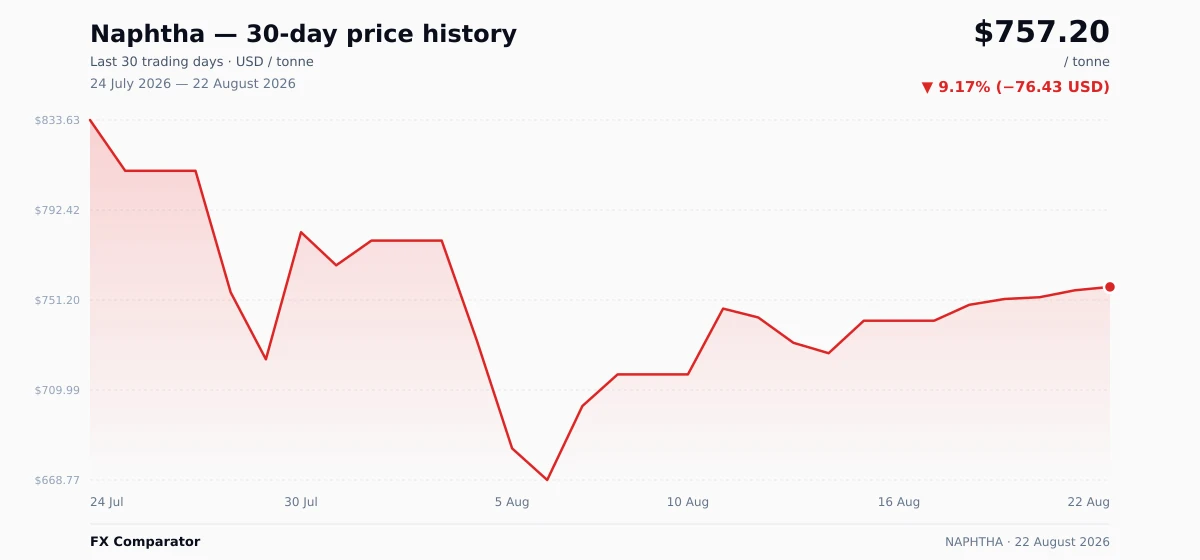
Download chart: WebP
Daily close
22 trading days
| Date | Price (USD) | Price (EUR) | Price (GBP) | Daily change |
|---|---|---|---|---|
| 8 Oct 2026 | US$834.28 | €745.82 | £631.70 | ▲ +0.74% |
| 7 Oct 2026 | US$828.19 | €740.38 | £627.09 | ▲ +0.91% |
| 6 Oct 2026 | US$820.74 | €733.72 | £621.45 | ▼ −0.58% |
| 3 Oct 2026 | US$825.53 | €738.00 | £625.07 | ▼ −0.41% |
| 2 Oct 2026 | US$828.92 | €741.03 | £627.64 | ▲ +4.30% |
| 1 Oct 2026 | US$794.74 | €710.47 | £601.76 | ▼ −0.31% |
| 30 Sept 2026 | US$797.20 | €712.67 | £603.62 | ▼ −1.00% |
| 29 Sept 2026 | US$805.26 | €719.88 | £609.73 | ▼ −0.81% |
| 26 Sept 2026 | US$811.83 | €725.75 | £614.70 | ▼ −3.19% |
| 25 Sept 2026 | US$838.56 | €749.65 | £634.94 | ▲ +0.60% |
| 24 Sept 2026 | US$833.59 | €745.20 | £631.18 | ▲ +2.46% |
| 23 Sept 2026 | US$813.61 | €727.34 | £616.05 | ▼ −0.45% |
| 22 Sept 2026 | US$817.25 | €730.60 | £618.81 | ▼ −2.62% |
| 19 Sept 2026 | US$839.25 | €750.26 | £635.46 | ▲ +0.18% |
| 18 Sept 2026 | US$837.76 | €748.93 | £634.34 | ▼ −0.75% |
| 17 Sept 2026 | US$844.07 | €754.57 | £639.11 | ▼ −2.41% |
| 16 Sept 2026 | US$864.93 | €773.22 | £654.91 | ▲ +1.75% |
| 15 Sept 2026 | US$850.07 | €759.94 | £643.66 | ▼ −0.61% |
| 12 Sept 2026 | US$855.28 | €764.59 | £647.60 | ▼ −1.82% |
| 11 Sept 2026 | US$871.17 | €778.80 | £659.63 | ▲ +5.52% |
| 10 Sept 2026 | US$825.61 | €738.07 | £625.14 | ▲ +1.94% |
| 9 Sept 2026 | US$809.88 | €724.01 | £613.22 | — |