Potato price
Potato currently trades at US$1.57 per 100 kg (≈ €1.40 · £1.19) — 92.57% below the 12-month high. Over the past 12 months the price has lost 81.68%, with the annual range running from US$1.57 to US$21.15. In the past 24 hours the price has fallen by 0.20%.

Invest in commodity ETFs from just $50
Gold, oil and even whole commodity sectors through ETFs, all in one account, kept simple.
eToro is a multi-asset investment platform. The value of your investments may go up or down. Your capital is at risk.
Potato chart
Interactive chart and 30-day overview
The Potato chart shows how the potato price has moved over time. The interactive view lets you switch the timeframe (from 7 days up to MAX), the currency (USD / EUR / GBP) and overlay moving averages. Click any two points to measure the percentage change between those dates.
How is potato priced?
Potato is priced per 100 kg on European exchanges — the legacy quintal-based unit common in EU agricultural pricing. The unit makes per-tonne and per-kilogram conversion straightforward.
At US$1.57 per 100 kg, one tonne is worth US$15.70 and one kilogram US$0.0157. Most international wholesale trade now references the metric tonne, but the 100 kg unit persists in EU spot markets.
What drives the price of potatoes?
North-west European weather is the main driver of the potato market. Around 60% of the EU potato crop comes from six countries: the Netherlands, Germany (~10 Mt), France, Belgium, Spain and Poland. Potatoes have shallow roots, high water needs, and tuber formation in mid-summer is especially sensitive to both drought and prolonged heat. Spring frost can cut emergence in the weeks after planting, while a July and August heatwave can reduce tuber size and starch content. Both can quickly lift the EEX EAPO price. Market participants closely follow weekly crop reports from NEPG (North-Western European Potato Growers — the joint association for the Netherlands, Belgium, France and Germany) and Belgian Belgapom wholesale price releases, because these also shape the actual procurement prices paid by processors.
The second major factor is demand from French-fry (frites) processors. Four large groups dominate the European and North American processing industry: Canada’s McCain Foods, the world’s largest frozen-potato producer (privately held, with no listed shares); US-based Lamb Weston (LW), the largest listed pure-play potato company; US-based J.R. Simplot (privately held), one of McDonald’s main French-fry suppliers; and Dutch group Aviko, a subsidiary of the Royal Cosun cooperative. These processors secure part of growers’ output through long-term fixed-price contracts, but buy the remainder on the spot market, where EEX prices and NEPG/Belgapom quotes are the reference points. The global expansion of QSR (quick-service restaurant) chains — McDonald’s, Burger King, KFC and Wendy’s — supports structural demand for frozen fries.
The third set of drivers is substitute crops and planting decisions. Farmers decide each year how to allocate available arable land. Potatoes typically compete with cereals, mainly wheat and maize, for field area. If grain prices (Euronext wheat, CBOT maize) are high, many growers shift towards cereals because of higher margins and lower labour requirements. In recent years, potato area has been in persistent decline in several EU member states, including the Netherlands and Belgium. Higher fertiliser and crop-protection costs, water regulation and drought sensitivity all play a role. A fourth factor to watch is Russian and Belarusian winter stocks. Although these countries account for a significant share of global output (Russia ~17 Mt), their exports mainly go to the CIS region and Central Asia, and affect the EU market only indirectly because of political and sanctions risks.
How can investors access the potato market?
There are relatively few ways to gain exposure to the potato market without physical ownership. European retail brokers such as XTB and eToro typically do not offer potato CFDs, because liquidity in the EEX EAPO contract is much lower than in wheat, maize or soybeans. There is also no pure-play potato ETF. A European retail investor mainly gets indirect exposure through processing-industry shares: US-based Lamb Weston (LW) is listed on the NYSE and is the world’s second-largest frozen-potato producer; McCain Foods of Canada and J.R. Simplot of the US are private companies and their shares are not exchange-listed; Dutch group Aviko is a cooperative subsidiary of Royal Cosun and is also not listed. Two regulated brokers where potato-related shares and broader agricultural exposure are available:
30-day price history
Chart and daily closing prices
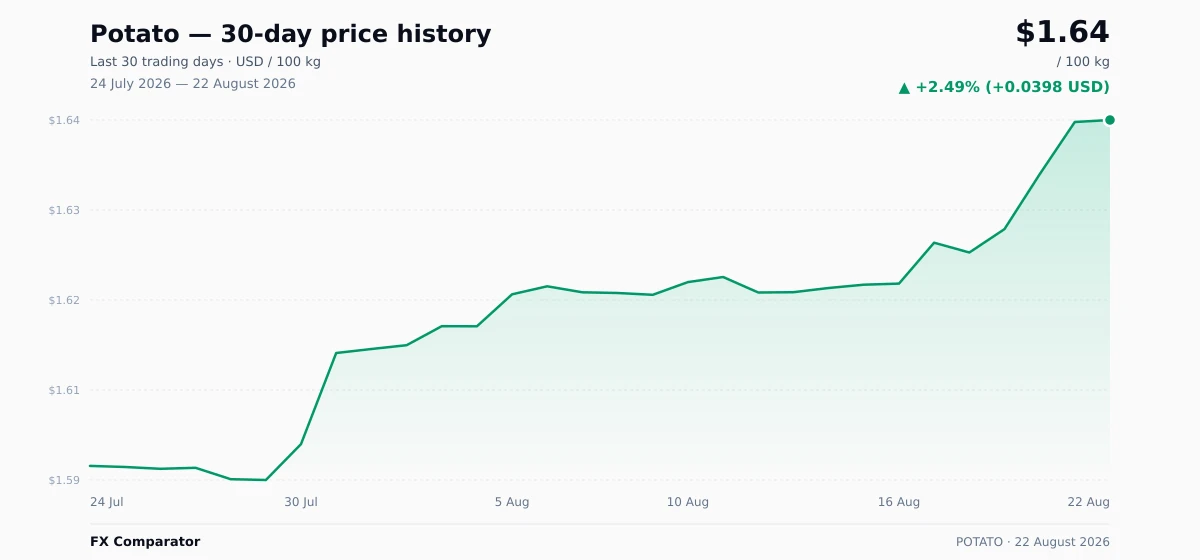
Download chart: WebP
Daily close
27 trading days
| Date | Price (USD) | Price (EUR) | Price (GBP) | Daily change |
|---|---|---|---|---|
| 8 Oct 2026 | US$1.57 | €1.40 | £1.19 | ▼ −0.20% |
| 7 Oct 2026 | US$1.57 | €1.41 | £1.19 | ▲ +0.03% |
| 6 Oct 2026 | US$1.57 | €1.41 | £1.19 | ▼ −0.04% |
| 5 Oct 2026 | US$1.57 | €1.41 | £1.19 | ▼ −0.42% |
| 4 Oct 2026 | US$1.58 | €1.41 | £1.20 | ▼ −0.03% |
| 3 Oct 2026 | US$1.58 | €1.41 | £1.20 | ▼ −0.04% |
| 2 Oct 2026 | US$1.58 | €1.41 | £1.20 | ▼ −0.32% |
| 1 Oct 2026 | US$1.59 | €1.42 | £1.20 | ▼ −0.19% |
| 30 Sept 2026 | US$1.59 | €1.42 | £1.20 | ▼ −0.15% |
| 29 Sept 2026 | US$1.59 | €1.42 | £1.21 | ▼ −0.25% |
| 28 Sept 2026 | US$1.60 | €1.43 | £1.21 | ▲ +0.01% |
| 25 Sept 2026 | US$1.60 | €1.43 | £1.21 | ▼ −0.04% |
| 24 Sept 2026 | US$1.60 | €1.43 | £1.21 | ▼ −0.41% |
| 23 Sept 2026 | US$1.60 | €1.43 | £1.21 | ▼ −0.29% |
| 22 Sept 2026 | US$1.61 | €1.44 | £1.22 | ▼ −0.02% |
| 21 Sept 2026 | US$1.61 | €1.44 | £1.22 | ▼ −0.07% |
| 20 Sept 2026 | US$1.61 | €1.44 | £1.22 | ▼ −0.02% |
| 19 Sept 2026 | US$1.61 | €1.44 | £1.22 | ▼ −0.01% |
| 18 Sept 2026 | US$1.61 | €1.44 | £1.22 | ▼ −0.17% |
| 17 Sept 2026 | US$1.61 | €1.44 | £1.22 | ▼ −0.31% |
| 15 Sept 2026 | US$1.62 | €1.45 | £1.22 | ▼ −0.27% |
| 14 Sept 2026 | US$1.62 | €1.45 | £1.23 | ▼ −0.26% |
| 13 Sept 2026 | US$1.63 | €1.45 | £1.23 | ▼ −0.01% |
| 12 Sept 2026 | US$1.63 | €1.45 | £1.23 | ▼ −0.04% |
| 11 Sept 2026 | US$1.63 | €1.45 | £1.23 | ▼ −0.15% |
| 10 Sept 2026 | US$1.63 | €1.46 | £1.23 | ▲ +0.01% |
| 9 Sept 2026 | US$1.63 | €1.46 | £1.23 | — |