The internet is full of people selling forex and crypto signals, free or paid. But have you ever stopped to ask why somebody would sell signals at all, if their own published numbers say they are making a fortune every month?
The answer is simple. They aren’t. People like you are the income. That doesn’t make every signal service a scam — it means it deserves exactly the same scepticism as any other offer built on the promise of easy money.
What a trading signal actually is
A trading signal is an instruction of the form “buy this instrument here, put your stop there, the target is here”. Nothing more. It is not a strategy and it is not a risk management system — it is one specific entry into one specific trade.
Two very different groups sell them. Brokers sometimes provide them to clients as an add-on to the account, usually above a certain deposit. Alongside that sits a broad grey zone of private operators selling membership of a closed group. The rest of this article is about the second group.
Where signals live now
A few years ago signals went out by email or SMS. Both are dead, and being offered either is a reliable warning sign in itself: an email trade instruction will most likely be worthless by the time you read it. With SMS you can add international delivery, which is perfectly capable of adding hours of delay.
The reality in 2026 is different. Almost all signals run through Telegram or Discord: a closed channel, a monthly subscription and a bot that pushes the message to everyone at once. Speed, in other words, is no longer the problem. Everything else is.
The third option plugs straight into a trading platform, where the instruction is executed on your account automatically, stop and target included. Technically it is the fastest route and it removes the manual copying. It does not, however, make the question of signal quality go away — it just moves it one level up.
Why the published results never match
This is the heart of the matter and it is worth understanding before you send anyone money.
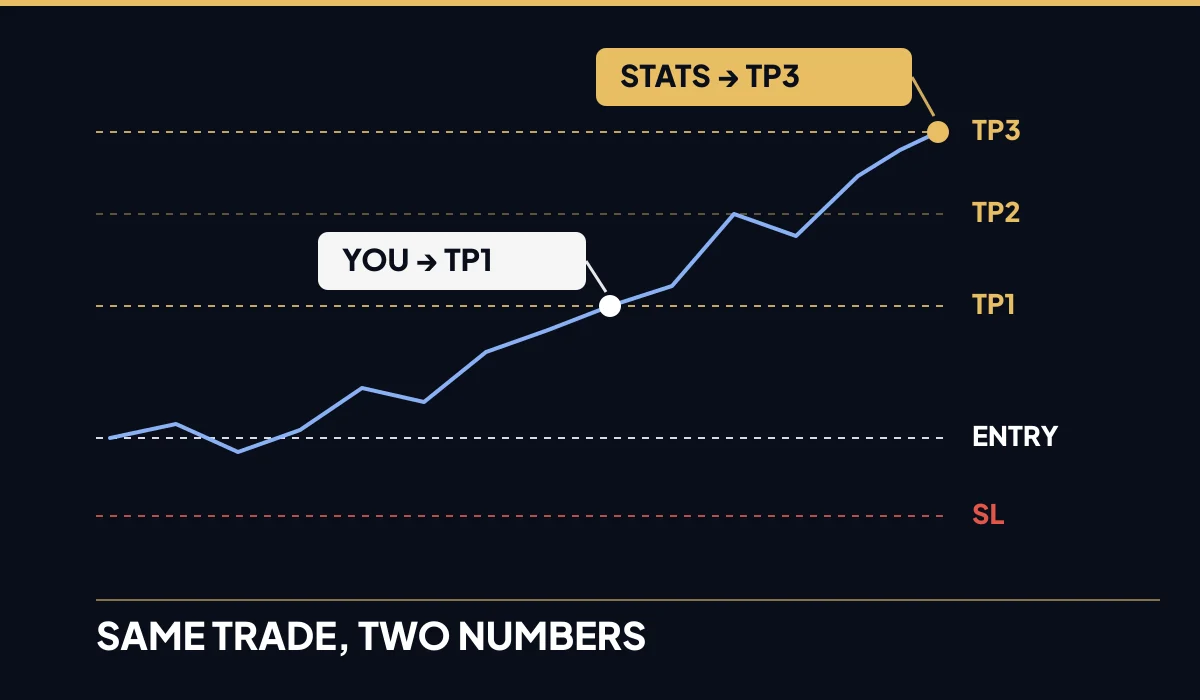 The same trade, two different numbers. Point 1 is the ordinary subscriber leaving at TP1; point 2 is the provider recording TP3 in the statistics.
A typical signal looks roughly like this: an entry, a stop-loss and three target levels labelled TP1, TP2 and TP3. It looks professional. In practice it is a construction that guarantees the provider’s results will always beat yours.
Have a guess which of those three levels goes into the statistics. The most profitable one the price actually reached, of course. You, meanwhile, are a real person in a real trade who had to get out somewhere — and once you close at TP1, TP2 and TP3 are gone for good. The gap between your result and the advertised one is not a mistake; it is a feature of the design.
The second mechanism is quieter still. When a position reaches neither the target nor the stop within a certain time, some providers record the highest level of profit the price touched along the way. A trade you closed at breakeven turns up in their table as a winner.
What it costs
Prices run from the low tens of dollars a month at the cheapest channels up to several hundred a month for packages presented as a service for advanced traders. We deliberately give no specific figures — they change almost daily, and naming providers we have not tested would be advertising rather than information.
More telling than the price is something else: the cheapest channels frequently offer no trial at all. You are paying in advance for something you cannot verify, to somebody under no obligation to give you anything back.
Who is actually allowed to recommend trades
Here is the distinction most people have never heard, and it is the most important one.
A personal investment recommendation — advice tailored to a particular person and their circumstances — is a regulated activity in the European Union and requires a licence. A generic signal blasted to a group of a thousand people usually falls outside that definition, which is how signal sellers operate outside the investment advice regime. That does not put them outside the rules altogether: investment recommendations and their promotion carry further obligations, and European supervisors have been paying steadily more attention to this area in recent years, paid promotion on social media very much included. Paid partnerships have to be disclosed.
For you, one practical consequence follows. When you buy access to a private channel, in most cases you are not dealing with a licensed institution. Nobody stands behind your losses, no regulator is watching, and the day the channel disappears your subscription goes with it.
The regulated equivalent: copying a specific trader
If what you actually want is to have somebody who knows more do the trading, there is a regulated route to that. A number of licensed brokers offer copy trading: you pick a specific person, their trades are mirrored on your account automatically, and their full history sits on the platform.
The difference from a Telegram channel is not that copying guarantees a profit. It doesn’t, and past results are never a promise of future ones. The difference is structural: there is a licensed entity behind the service, the statistics are calculated by the platform rather than by the person selling them, and you can stop copying whenever you like. Three things a closed group gives you none of.
eToro is a multi-asset investment platform. The value of your investments may go up or down. Your capital is at risk.
What to check before you pay
If after all that you still decide to buy signals, go through at least the following:
- Is there a trade-by-trade record? A monthly or annual summary is not enough; it can say anything.
- How many target levels do the signals carry? The more TP levels, the more room for the statistics to show something other than what you get.
- How is an unfinished trade scored? If the highest profit level touched goes into the results, the numbers are not worth reading.
- Is there a trial period? Anyone confident in the quality has no reason to refuse one.
- Who is behind it, and from where? A name, a company, a jurisdiction. If you can find none of the three, you have your answer.
Before sending money, read discussions somewhere other than the provider’s own channels. Foreign trading forums tend to be considerably more honest on this subject than the reviews on their website.
Conclusion
Signals are not inherently a scam, but at best they are suggestions for entering a trade — and they are sold to look like a great deal more. You will not get the results shown on the website, because those results rest on exits an ordinary subscriber never reaches. On top of that, behind most private channels there is nobody accountable for anything.
In the end it comes down to what it always came down to: the only reliable way to trade better runs through your own education. Our free trading course is a place to start, and that one rule alone will save you a great deal of money and disappointment.