A pip is the smallest ordinary step a currency pair’s price moves in. It is the unit traders use to measure both market movement and their own results — instead of “I made a hundred dollars” you will hear “I made ten pips”.
The definition itself is simple. It gets tangled the moment you want to know what a pip is worth in money, because that depends on your position size, on the quote currency and on what currency your account is held in. And that conversion is the part most people get wrong.
What a pip is
The abbreviation comes from percentage in point, sometimes price interest point. It denotes the smallest ordinary change in a currency pair’s price.
Most pairs are quoted to four decimals. When EUR/USD stands at 1.0834 and moves to 1.0835, it has moved by one pip. Pairs with the Japanese yen follow a different convention, because the yen is worth markedly less per unit than the other majors: they are quoted to two decimals, so USD/JPY moving from 149.99 to 150.00 is likewise exactly one pip.
Pip, pipette and point
This is where most of the confusion starts. Your platform probably shows EUR/USD to five decimals, something like 1.08345. That last digit is not a pip. It is a pipette, a tenth of a pip. Brokers introduced them for finer spreads.
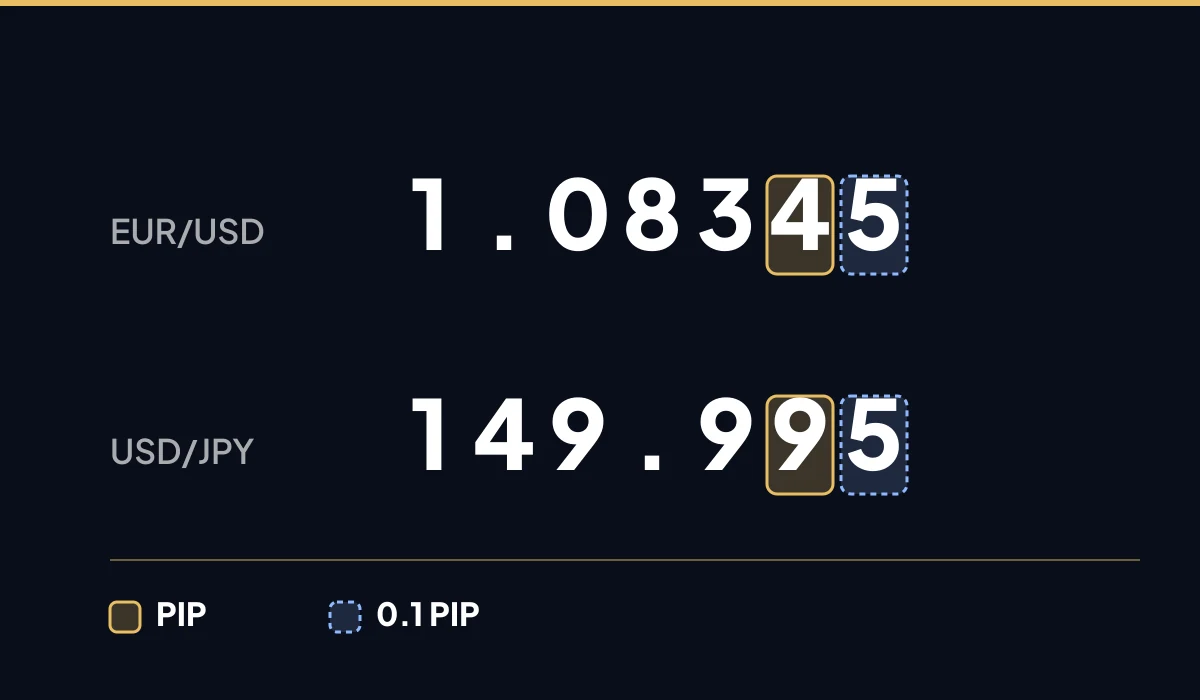 Gold is the pip, blue the pipette. On yen pairs it sits two places to the left.
Yen pairs work the same way one order of magnitude across: a quote to three decimals means the third is the pipette.
On top of that comes terminology. Some brokers say point where others say pip, and a few confusingly label as a pip what is really a pipette. When you read a statistic somewhere claiming “+150 pips”, it is worth checking which unit is meant — the difference is tenfold.
What a pip is worth in money
Pip value in the quote currency is the pip size multiplied by the number of units traded. A standard lot is 100,000 units of the base currency, a mini lot a tenth of that and a micro lot a hundredth.
For pairs with the dollar on the other side — EUR/USD, GBP/USD, AUD/USD and so on — it always works out like this:
| Position size | Units | Value of 1 pip |
|---|---|---|
| standard lot (1.00) | 100,000 | 10 USD |
| mini lot (0.10) | 10,000 | 1 USD |
| micro lot (0.01) | 1,000 | 0.10 USD |
The sum is 0.0001 × 100,000 = 10. It holds whether you trade EUR/USD or AUD/USD — the pair’s exchange rate does not enter into this part of the calculation at all. That is a common mistake.
On yen pairs only the pip size changes. USD/JPY, standard lot: 0.01 × 100,000 = 1,000 JPY per pip.
Work it out
There is no point doing that conversion by hand, especially with rates moving. We built a pip value calculator for it — pick the pair, the position size and your account currency and you get the pip value in the quote currency and after conversion, along with the rate used.
The pip size comes pre-filled by convention but can be overwritten. That matters on exotic pairs and above all on CFDs on indices or commodities, where a lot is not 100,000 units and the instrument specification at your broker decides.
Why it is worth knowing
Pip value is not an academic figure, it is an input to position sizing. If you know you want to risk at most fifty euros on a trade and your stop-loss sits thirty pips from the entry, pip value tells you how large a position you can afford to open. Without that number, risk management is guesswork.
The second reason is comparability. A profit expressed in pips can be compared across pairs and account sizes, which is precisely why traders talk in pips rather than in money.
Conclusion
A pip is the fourth decimal, or the second on yen pairs. The fifth, the one your platform shows, is a pipette. Pip value in the quote currency is the pip size times the number of units, so on a standard lot against the dollar it is always ten dollars — and the pair’s rate plays no part in it.
What does play a part is the conversion into your account currency. That is the step that decides whether the number is any use to you when planning risk, or stays a curiosity from the chart.