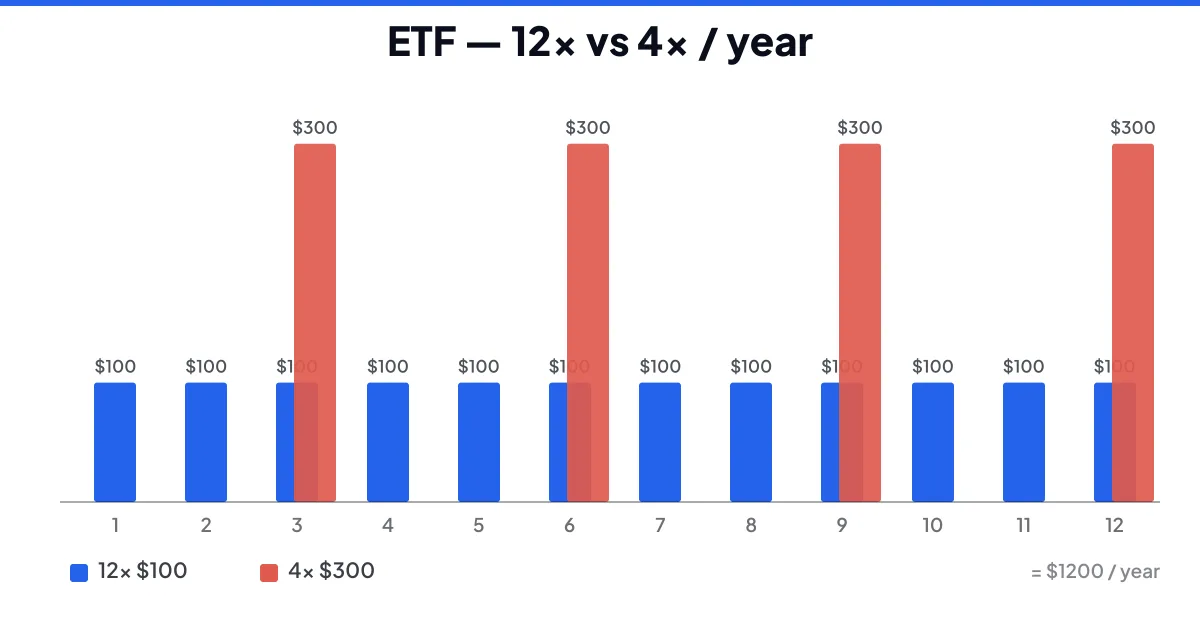
Investors who want to draw a regular income from a portfolio tend to end up looking at monthly dividend ETFs. The money lands twelve times a year instead of four, which makes it far easier to line up with rent, bills and other standing costs.
The word dividend, though, means something different in almost every one of these funds. Only a minority pass on dividends actually declared by companies. In the rest, the payment is an option premium or interest from bonds, and that changes both the tax treatment and the risk you are carrying. The groups below are split by where the money genuinely comes from, with a note on what sits behind the monthly payout in each case.
ETFs paying real dividends from shares
These funds hold dividend-paying shares and hand on what the companies themselves declare. The payout follows the dividend policy of the underlying businesses, so it is usually the most modest of the four groups, but it is covered by company profits.
The monthly rhythm comes from holding dozens or hundreds of positions with different payment dates and pooling whatever arrives into a single distribution each month. If companies in the portfolio cut their dividends, the fund’s payment falls with them. That is why the length and stability of the distribution record matters more here than the headline number.
| Company | Price | Dividend | Yield |
|---|---|---|---|
| Global X SuperDividend ETF SDIV | 24,22 USD | 2,18 USD | 9.02% |
| Global X SuperDividend U.S. ETF DIV | 19,47 USD | 1,25 USD | 6.41% |
| Invesco S&P 500 High Dividend Low Volatility ETF SPHD | 50,23 USD | 2,34 USD | 4.66% |
| Amplify CWP Enhanced Dividend Income ETF DIVO | 47,37 USD | 1,39 USD | 2.94% |
| Invesco KBW High Dividend Yield Financial ETF KBWD | 11,73 USD | 1,62 USD | 13.79% |
Quotes are indicative and delayed.
Covered call ETFs: income from option premiums
These funds hold shares and sell call options against them. Most of the monthly payout is the premium collected on those options, not dividends paid by companies, which is why the headline yield sits well above the previous group.
That income is paid for with a cap on growth. When the underlying index rallies hard, the option buyer exercises and the fund has to sell the shares at the agreed price, so it lags behind the market. In flat or falling markets the premiums keep arriving and soften part of the decline. A slice of the distribution can also be a return of capital, which is paid out of the value of your holding rather than out of profit.
| Company | Price | Dividend | Yield |
|---|---|---|---|
| JPMorgan Equity Premium Income ETF JEPI | 56,24 USD | 4,48 USD | 7.97% |
| JPMorgan Nasdaq Equity Premium Income ETF JEPQ | 60,24 USD | 6,53 USD | 10.84% |
| Global X NASDAQ 100 Covered Call ETF QYLD | 18,55 USD | 1,79 USD | 9.67% |
| Global X Russell 2000 Covered Call ETF RYLD | 15,74 USD | 1,38 USD | 8.76% |
| Global X S&P 500 Covered Call ETF XYLD | 41,72 USD | 3,93 USD | 9.43% |
| NEOS Nasdaq-100 Hedged Equity Income ETF NUSI | 26,78 USD | 2,04 USD | 7.61% |
| NEOS NASDAQ-100(R) High Income ETF QQQI | 54,39 USD | 0,05 USD | 0.09% |
| Neos S&P 500(R) High Income ETF SPYI | 53,09 USD | 0,77 USD | 1.45% |
| NEOS Russell 2000 High Income ETF IWMI | 50,00 USD | 2,17 USD | 4.33% |
| iShares 20+ Year Treasury Bond Buywrite Strategy ETF TLTW | 21,01 USD | 2,14 USD | 10.20% |
| Simplify Volatility Premium ETF SVOL | 16,70 USD | 2,11 USD | 12.62% |
Quotes are indicative and delayed.
Bond and preferred share ETFs: interest, not dividends
These funds hold bonds, preference shares or corporate loans. What reaches your account is interest rather than a dividend. It does not depend on company profits but on interest rates and on borrowers keeping up their repayments.
A monthly schedule is natural here, because coupons arrive steadily through the year. The share price, however, moves in the opposite direction to rates: when rates rise, older bonds carrying a lower coupon are worth less. The highest-paying funds in this group mostly hold lower-rated debt, where the fatter coupon is bought with a higher chance of default.
| Company | Price | Dividend | Yield |
|---|---|---|---|
| iShares Preferred and Income Securities ETF PFF | 30,00 USD | 1,82 USD | 6.07% |
| Global X U.S. Preferred ETF PFFD | 18,02 USD | 1,18 USD | 6.54% |
| Invesco Preferred ETF PGX | 10,45 USD | 0,68 USD | 6.51% |
| iShares iBoxx $ High Yield Corporate Bond ETF HYG | 78,53 USD | 3,80 USD | 4.84% |
| State Street SPDR Bloomberg High Yield Bond ETF JNK | 94,55 USD | 4,24 USD | 4.49% |
| State Street Blackstone Senior Loan ETF SRLN | 40,61 USD | 2,94 USD | 7.25% |
| Janus Henderson Mortgage-Backed Securities ETF JMBS | 43,39 USD | 2,49 USD | 5.74% |
Quotes are indicative and delayed.
ETFs with a mixed payout
These funds combine several sources at once — property trusts, preference shares, closed-end funds and bonds. The distribution is then a blend of dividends, interest and, in some months, a return of capital.
The breakdown is hardest to follow in this group, and without opening the fund documents there is no way to tell how much of the quoted yield is genuine income. This is where the annual report earns its keep, because that is where the manager sets out how each distribution was made up.
| Company | Price | Dividend | Yield |
|---|---|---|---|
| Global X Alternative Income ETF ALTY | 12,05 USD | 0,91 USD | 7.54% |
| Amplify CEF High Income ETF YYY | 10,83 USD | 1,39 USD | 12.83% |
Quotes are indicative and delayed.
How to read the tables
The tables list only funds whose payment history confirms at least ten distributions over the past twelve months. Quarterly payers are left out, even though they are sometimes filed under monthly dividend funds elsewhere.
Yield is the sum of a year of distributions measured against the current price and it loads live. A large number does not mean a better fund. With covered call ETFs it is paid for by giving up part of any rally, with bond ETFs by taking on more credit risk.
The tables do not show the ongoing charge, because the data source does not supply it. Check it in the KID or with the fund manager, since it comes straight out of what you receive.
What to watch for
A monthly schedule is not an advantage in itself. A fund paying twelve times a year does not earn more than a comparable one paying quarterly, it simply cuts the same money into smaller pieces. What you gain is predictability, not a bigger total return.
With the highest-paying funds it is worth finding out how much of the distribution is return of capital. That portion is not taken from profit but from the money you put in, so over the years it grinds down the value of your holding.
Access is the practical hurdle in Britain. Almost every ticker above is listed in the United States, and a retail account here can generally only buy funds that publish a KID in English. American managers rarely produce one, so many of these funds are open only to clients classified as professional.
Tax follows the source of the payment. Dividends, interest and return of capital are each treated differently, and US-listed funds have withholding tax deducted before the money reaches you, at a rate that depends on whether your broker holds a signed W-8BEN form. It is also worth checking whether a fund has HMRC reporting status, because gains on non-reporting funds are taxed as income rather than as a capital gain.
Can I live off monthly dividend ETFs instead of a salary? +
Not from a standing start. Replacing an average wage with distributions means holding a portfolio worth several hundred thousand pounds, and even then the payments are not guaranteed and move from month to month.
How much do I need to start? +
That depends on the broker. Shares in these funds usually cost tens of dollars, so the entry price is rarely the obstacle, and brokers offering fractional shares let you begin with smaller amounts.
When does the first payment arrive after I buy? +
You have to own the fund before the ex-dividend date. Buy after it and the first payment reaches you a month later. The dates are published in advance on the manager's website.
Does a high yield mean a better ETF? +
No. With covered call funds the high yield is paid for by giving up part of any rally, with bond funds by carrying more credit risk. What tells you something is the total return including the change in the share price, not the payout figure on its own.
What is the difference between a dividend and a distribution? +
A dividend is a share of a company's profit. A distribution is a wider term and can include interest, an option premium or a return of the capital you invested. Most monthly payers make distributions rather than paying pure dividends.