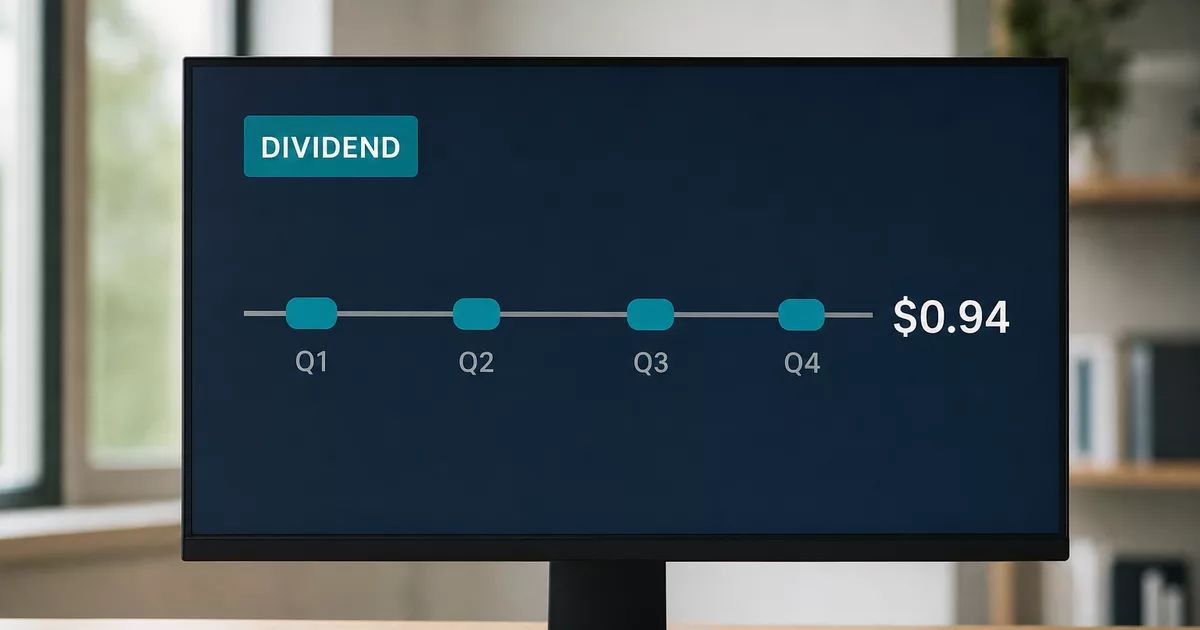
A share is a small piece of a company. Buy one and you become a part owner. When the company makes money, it can hand some of that profit to its owners. The payment is called a dividend and it arrives as cash.
To get one, you only have to own the share. You buy it through a broker, a firm that buys and sells shares on your behalf. After that you do nothing. The money lands in your account with them by itself.
This guide is mostly about American shares. That is where dividends come up most often, and they are usually paid four times a year.
When the dividend arrives and who gets it
American companies usually pay four times a year. The people running the company decide that themselves. European companies mostly pay once a year, because the owners have to approve the payment at the annual meeting.
Watch out for one trap. A company paying four times a year does not hand out more money than one paying once. It is the same yearly sum split into four.
One specific day before each payment decides who has a claim. It is called the ex-dividend date. Buy the share on that day or later and you get nothing. The dividend goes to the person who sold it to you.
Buy earlier and the dividend is yours. How long you hold makes no difference at all. Owning the share one day before is enough. The company announces the date well in advance. You will find it on the share page and in your broker app.
Now the surprising part. On that day the share price drops by roughly the size of the dividend. This is not the market reacting. The exchange cuts the price automatically as trading opens. The company is about to send cash out of the door, so it is worth that much less.
In numbers: a share costs $50 and pays out $0.50. In the morning it trades at $49.50. You hold $49.50 in the share and $0.50 in cash. That is still $50 in total. Buying just before a payment therefore earns you nothing on its own.
What the dividend is worth in percentage terms
The amount per share tells you nothing on its own. You need to compare it with the share price. The dividend yield does exactly that.
The yield says what percentage of the share price comes back to you over a year. A share at $50 that pays $2 a year has a yield of 4%.
Two shares from the table below show this nicely. Essex Property, an American landlord that rents out flats, pays $2.59 every quarter. Realty Income, a landlord that rents out shops, pays $0.27 every month.
That looks like a vast gap. It is not. Essex shares cost around $288, Realty Income shares around $63. Turn both into a yearly payment and divide by the price. Essex comes out at 3.6% and Realty Income at 5.2%. Those figures are as of 6 August 2026.
Why a high yield is often a warning
The yield is worked out from the share price. When the price falls, the yield jumps by itself. The company can be paying exactly the same money as before.
An example. A share at $100 pays $4 a year, so the yield is 4%. The price then drops to $70. The payment stays where it was and the yield is suddenly 5.7%. The company has done nothing at all.
Prices usually fall for a reason. Investors expect the company to run short of cash and stop paying. A normal American share yields around 2%. Eight or more is four times that, so it is worth finding out why.
Whether a company can keep the dividend going is hinted at by the payout ratio. It says what share of the profit goes out to the owners.
Paying out 40% of profit leaves the rest for the business and a cushion on top. Paying out more than 100% means handing over more than the company earns. The difference has to be borrowed or taken from savings. That does not last long.
REITs are one exception. A REIT is a company that owns houses, flats or shops and rents them out. The law tells it to hand at least 90% of its profit to shareholders. In return it is let off the profit tax that other companies pay. A high yield there is not suspicious in itself, because it comes straight from those rules. Three of them sit in the table below. Realty Income rents out shops and Federal Realty owns shopping centres. Essex Property rents out flats.
Aristocrats and kings
The S&P 500 is an index, which is simply a list of shares put together by one company. This one holds the five hundred biggest American businesses. Dropping out of it hurts, because large investment funds buy according to lists like that.
A dividend aristocrat is a company from that list which has raised its dividend every single year for at least twenty five years. In 2026 there are 69 of them. Twenty five years gets you into the club, but most members have been at it far longer. The average is 43 years.
The longest runs belong to Coca-Cola, Johnson & Johnson and Procter & Gamble. Coca-Cola sells soft drinks. Johnson & Johnson makes medicines and plasters. Procter & Gamble is behind household goods such as washing powder and razors. All three have raised the dividend for 63 years.
A dividend king is an informal label for fifty years of rises in a row. No exchange body keeps that list. Private websites do. One of them counts 58 kings as of August 2026, another counts 54. That is not a mistake. Each simply counts by slightly different rules.
The title guarantees nothing, though. Cut the dividend and you drop off the list. The past few years have served up three examples.
Walgreens, an American chemist chain, had 47 years of rises behind it. In January 2024 it cut the dividend by 48% and fell off the list. The shares lost 64% over 2024. In January 2025 the company scrapped the payment altogether, for the first time in 92 years. It also fits what we said about high yields. Walgreens yielded a lot mainly because the shares had been falling for years.
3M, which makes sticky tape and industrial materials, raised its dividend for 66 years. In 2024 its healthcare arm was split off into a separate company. The smaller business then shared out a smaller dividend, roughly half of the old one. This was not a sign of trouble. It knocked the company off the list all the same.
AT&T, an American phone company, did not even cut its dividend. It simply failed to raise it one year, and that was enough. Out it went in February 2022, after 36 years.
Tax: one form at your broker
The United States takes 30% of every dividend paid to a foreigner. The money reaches you already reduced.
The UK has a treaty with the United States that brings this down to 15%. It does not happen by itself. You have to show the Americans that you live here.
That is what the oddly named W-8BEN form is for. It is a statement that you are not an American taxpayer. You do not have to hunt it down or post it anywhere. You give it to your broker, who these days handles it electronically. It usually happens while you are opening the account.
It lasts three years. Sign it in 2026 and it runs out at the end of 2029. Then you sign a new one.
A foreign dividend is your own job to declare. Your broker will not report it for you. Foreign dividends belong on a Self Assessment tax return, at the full amount before the American deduction, converted into pounds. Whether you have to file at all depends on your situation, so check that with HMRC.
UK tax on dividends has its own rates, and the American 15% can normally be set against it as Foreign Tax Credit Relief. The rates and thresholds change, so take the current ones from HMRC rather than from an article.
One more thing worth knowing. An ISA keeps UK tax off your dividends, but it does not stop the American deduction. The W-8BEN form still matters inside one.
Germany makes a useful comparison. The German state takes 26.375% and there is no way to bring that down in advance. You claim the overpayment back on paper and the wait runs past twenty months. The American system is far simpler in this respect.
Aristocrats with the highest yield
These are American shares, so prices and dividends are in dollars. The yields are as of 6 August 2026 and they move with the price every day.
| Company | Price | Dividend | Yield | Market cap |
|---|---|---|---|---|
 Amcor AMCR Amcor AMCR | 41,90 USD | 2,60 USD | 6.21% | 19,37 mld. USD |
 Realty Income O Realty Income O | 56,66 USD | 3,26 USD | 5.75% | 53,61 mld. USD |
 Clorox CLX Clorox CLX | 83,10 USD | 5,00 USD | 6.02% | 10,05 mld. USD |
 Hormel Foods HRL Hormel Foods HRL | 20,83 USD | 1,17 USD | 5.62% | 11,46 mld. USD |
 Kimberly-Clark KMB Kimberly-Clark KMB | 97,86 USD | 5,12 USD | 5.23% | 32,48 mld. USD |
 T. Rowe Price TROW T. Rowe Price TROW | 104,16 USD | 5,20 USD | 4.99% | 22,22 mld. USD |
 PepsiCo PEP PepsiCo PEP | 129,75 USD | 5,92 USD | 4.56% | 177,24 mld. USD |
 Chevron CVX Chevron CVX | 209,51 USD | 7,12 USD | 3.40% | 410,98 mld. USD |
 Federal Realty Investment Trust FRT Federal Realty Investment Trust FRT | 110,91 USD | 4,64 USD | 4.18% | 9,64 mld. USD |
 Franklin Resources BEN Franklin Resources BEN | 33,01 USD | 1,32 USD | 4.00% | 16,77 mld. USD |
 McCormick & Company MKC McCormick & Company MKC | 48,72 USD | 1,92 USD | 3.94% | 13,10 mld. USD |
 Essex Property Trust ESS Essex Property Trust ESS | 270,05 USD | 10,36 USD | 3.84% | 18,61 mld. USD |
 Medtronic MDT Medtronic MDT | 92,13 USD | 2,88 USD | 3.13% | 117,85 mld. USD |
 Stanley Black & Decker SWK Stanley Black & Decker SWK | 89,58 USD | 3,36 USD | 3.75% | 13,53 mld. USD |
 Consolidated Edison ED Consolidated Edison ED | 105,43 USD | 3,51 USD | 3.33% | 38,99 mld. USD |
Quotes are indicative and delayed.
Of the 63 aristocrats we hold a current price for, only seventeen yield 3% or more. Most of them sit around 2%. Anyone hoping to top up their income as much as possible will not find much in this group.
What to take from all this
A dividend is not extra money. It is cash moving from the company to the shareholder, and the share price drops by that amount.
A high yield is more often the result of a sunken price than of generosity. A long run of rises tells you how a company behaved before. It promises nothing about what comes next. Walgreens and 3M both showed that.
And whether you hand over 15% or 30% of an American dividend comes down to one form at your broker.