
Preferred stocks, also known as preference shares, sit halfway between a stock and a bond. They carry a fixed dividend set at issue, rank ahead of common stock when payouts are made, and their price stays close to par value. The investor gives up any share in the company’s growth along with voting rights, and in exchange receives a yield that beats common-stock dividends over the long run.
In the US this is a large, liquid market. The issues trade on US exchanges at a $25 par value and come mostly from banks, insurers and energy companies. For an ordinary investor, though, the more practical route is through ETFs, which hold hundreds of issues at once and pay out every month.
How preferred stocks work
The dividend is set in advance as a percentage of par. An issue with a $25 par value and a 6% rate pays $1.50 a year, usually in quarterly instalments. The amount never changes, whether the company earns a little or a lot.
The priority over common stock works in two ways. Until the preferred dividend has been paid, the company may not pay common shareholders anything. And if it ever comes to liquidation, preferred shareholders’ claims are settled before common ones — though only after creditors and bondholders.
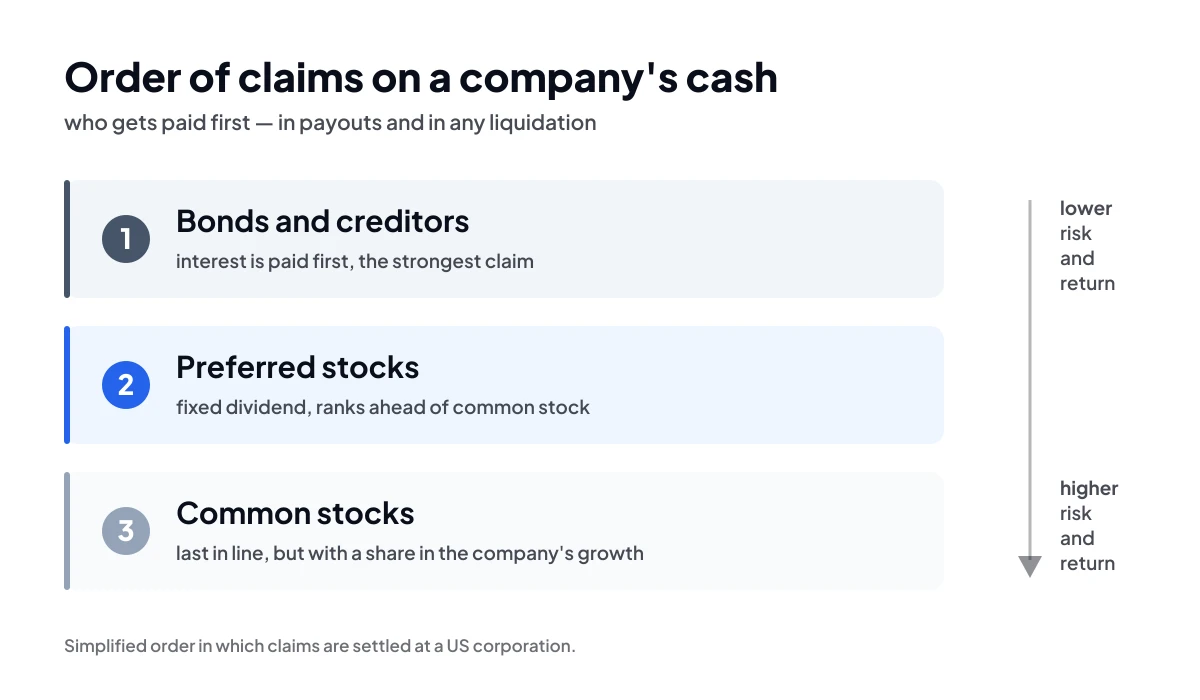
Preferred stocks generally carry no voting rights. From the company’s point of view, they are a way of raising capital without diluting control.
Why the yield is high
The higher yield is the price of three concessions.
The first is subordination. When a company runs into trouble, creditors and bondholders stand in line ahead of preferred shareholders. The market charges a higher rate for that position in the queue.
The second is the right of redemption. Most issues allow the issuer to buy the shares back at par after five years. When market rates fall, the company retires an expensively priced issue and replaces it with a cheaper one — for the investor, this right caps any price gain above par.
The third is a dividend that never grows. A common stock can raise its payout year after year. A preferred cannot. Over the long run, total return therefore converges on the dividend itself.
Then there is rate sensitivity. Preferred stock prices behave like long bonds — when rates rise, older issues with lower rates lose value. Many issues also have no maturity at all, which makes the sensitivity all the greater.
There is also a difference in what happens when a company suspends the payout. Cumulative issues must make up the missed dividends before anything goes to common shareholders. Banks, however, issue non-cumulative preferreds for regulatory reasons — with those, a suspended payment is gone for good.
Who issues preferred stocks
Preferred stock counts towards banks’ regulatory capital, which is why the financial sector issues by far the most of it. In preferred stock index ETFs, banks and insurers account for roughly 60 to 80 percent of the portfolio. The rest is held by utilities, real estate trusts and telecoms.
The concentration in a single sector shows up every time banks struggle. In March 2023, during the collapse of Silicon Valley Bank, preferred ETF prices fell alongside bank stocks, even though most issuers in the portfolios had no trouble at all.
Individual issues or ETFs
Individual issues trade on the New York Stock Exchange under their own tickers and are bought just like an ordinary stock. Before buying, though, you need to go through the prospectus: when the issuer may first call the shares, whether the dividend is cumulative, and whether the rate switches from fixed to floating after a set period.
ETFs do that work for the investor. They spread single-issuer risk across a portfolio of dozens to hundreds of issues. The cost is the management fee — for the funds compared here, from 0.23% to 0.83% a year.
Examples of preferred stocks
The following five issues are not a buy recommendation. They are chosen so that each shows a different type of structure — a fixed coupon, a reset, a floating rate, a deep discount, and an issue inside its call window. All have a $25 par value.
Bank of America, Series GG (BAC-PB)
Listed elsewhere as BAC.PR.B or BAC PRB. A fixed 6.00% coupon, non-cumulative, and the issue is already callable. A classic US bank issue. If the bank suspends the payout, missed dividends are not made up — capital regulation effectively bars large US banks from the cumulative structure. The issue trades below par.
Rithm Capital, Series D (RITM-PD)
Listed elsewhere as RITM.PR.D or RITM PRD. A fixed 7.00% coupon, cumulative, and the date that matters is November 2026. From then on, the rate resets to the five-year US Treasury yield plus 6.223 percentage points — with the five-year yield currently around 4.4%, the new rate would come out above ten percent. From the same date the issuer may call the issue at par. It therefore faces a choice: retire the issue, or pay considerably more. For an investor who did not buy at a premium above par, neither scenario is a bad one.
Annaly Capital, Series F (NLY-PF)
Listed elsewhere as NLY.PR.F or NLY PRF. Originally a fixed 6.95%, today a floating rate at a spread of 4.993 points over a short-term reference rate, cumulative. This mortgage trust issue trades above par and is inside its call window. In August 2026 Annaly announced the redemption of the entire sister Series I — all 17.7 million shares at $25, payable on 1 October 2026. Anyone who bought Series F at a premium would likewise receive only par in a call. The floating coupon, moreover, falls as short-term rates decline. The high yield in the table describes the present, not the future.
Duke Energy, Series A (DUK-PA)
Listed elsewhere as DUK.PR.A or DUK PRA. A fixed 5.75% coupon, cumulative. The lowest rate of the five is by design — Duke Energy is a regulated utility with an investment-grade rating, and the market does not demand the same risk premium from it as from a mortgage trust. The gap of roughly three percentage points between Duke and Annaly is not a market inefficiency but the price of credit risk.
Public Storage, Series H (PSA-PH)
Listed elsewhere as PSA.PR.H or PSA PRH. A fixed 5.60% coupon, cumulative, and this real estate trust issue trades at the deepest discount to par of the five. The coupon dates from the low-rate era and sits below today’s market level, so the issuer has no reason to call — it would be swapping cheap capital for dearer capital. The market prices the issue as a perpetual annuity with no prospect of redemption. The table yield is therefore real, but it comes at the cost of the longest duration on the list. When long rates rise, it loses the most in price.
The table shows how the issues currently trade. Volumes in individual issues tend to be orders of magnitude lower than in common stocks, and on larger orders the gap between the bid and ask price feeds through into the yield.
| Company | Price | Dividend | Yield |
|---|---|---|---|
| Bank of America Corporation BAC-PB | 22,06 USD | 1,50 USD | 6.80% |
| Rithm Capital Corp. RITM-PD | 25,31 USD | 1,75 USD | 6.91% |
| Annaly Capital Management, Inc. NLY-PF | 25,39 USD | 2,26 USD | 8.90% |
| Duke Energy Corporation DUK-PA | 21,58 USD | 1,44 USD | 6.67% |
| Public Storage PSA-PH | 19,96 USD | 1,40 USD | 7.01% |
Quotes are indicative and delayed.
The main preferred stock ETFs
PFF (iShares Preferred and Income Securities ETF) is the largest fund in the category. It manages over $13 billion across more than 450 issues, tracks the ICE Exchange-Listed Preferred & Hybrid Securities index and charges 0.45% a year. It has been running since 2007.
PGX (Invesco Preferred ETF) holds around 270 fixed-rate issues. Its 0.50% fee is the highest among the passive funds compared here.
PFFD (Global X U.S. Preferred ETF) is the cheapest on fees, at 0.23% a year. Its portfolio differs from PFF only in the details, but the fund is smaller and less liquid.
FPE (First Trust Preferred Securities & Income ETF) is actively managed. The manager follows no index and picks issues based on its own valuations, including foreign ones. For that it charges 0.83% a year.
PFXF (VanEck Preferred Securities ex Financials ETF) is the only one that leaves out banks and insurers. It builds its portfolio around utilities, real estate trusts and industrials, so it avoids the sector concentration of the other funds.
The table shows current prices, dividends and yields of the funds, including the UCITS variant.
| Company | Price | Dividend | Yield |
|---|---|---|---|
| iShares Preferred and Income Securities ETF PFF | 29,20 USD | 1,82 USD | 6.24% |
| Invesco Preferred ETF PGX | 9,95 USD | 0,68 USD | 6.85% |
| Global X U.S. Preferred ETF PFFD | 17,36 USD | 1,18 USD | 6.82% |
| First Trust Preferred Securities and Income ETF FPE | 17,04 USD | 1,07 USD | 6.27% |
| VanEck Preferred Securities ex Financials ETF PFXF | 17,51 USD | 1,10 USD | 6.29% |
| Invesco Preferred Shares UCITS ETF PRFD.L | 13,22 USD | 0,80 USD | 6.09% |
Quotes are indicative and delayed.
How to buy them from Europe
The US ETFs cannot be bought through a European broker. They lack the European KID information document, and without it the EU rules on packaged products do not allow them to be offered to retail investors.
There is one UCITS alternative: Invesco Preferred Shares UCITS ETF (PRFD). It tracks the ICE BofA Diversified Core Plus Fixed Rate Preferred Securities index with physical replication, charges 0.50% a year and pays dividends quarterly. It trades in London, Milan and on the Swiss SIX exchange. It is a small fund, with less than €100 million under management, which also means wider spreads when trading.
Individual preferred stocks do not fall under the packaged products rules. Anyone whose broker offers access to the US exchanges can buy them just like any common stock.
Frequently asked questions
What does a ticker with PR in the middle mean? +
They are different notations for the same preferred issue. Yahoo Finance writes BAC-PB, other platforms BAC.PR.B and Interactive Brokers BAC PRB. The letter after PR or after the dash denotes the series.
Does it make sense to buy a preferred stock above par value? +
Only with caution. What matters before buying is the yield to call, not the current yield.
When can a company redeem a preferred stock? +
From the call date stated in the prospectus, typically five years after issue, at par value. Older issues are often already inside their call window and the issuer can announce a redemption at any time.
How can European investors buy US preferred stocks? +
Individual issues are not a packaged product, so they fall outside the PRIIPs rules and can be bought through any broker with access to the US exchanges. The US preferred stock ETFs cannot be offered to European retail investors at European brokers. The UCITS alternative is the Invesco Preferred Shares UCITS ETF.
Who they make sense for
Preferred stocks belong in the part of a portfolio expected to deliver a regular payout, where the investor accepts that the price of the holding goes nowhere over the long run. Anyone looking for capital growth is better served by common dividend stocks. Anyone who wants more certainty will find it in government bonds.