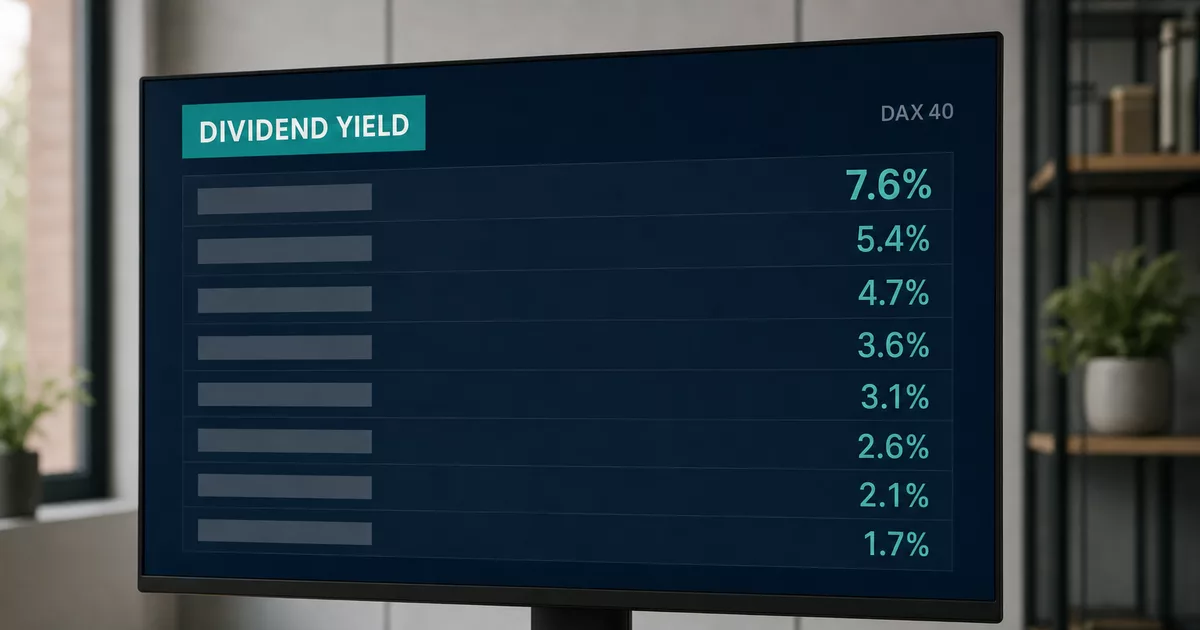
German stocks have a reputation for being generous payers. The data confirms that only in part. The MSCI Germany index showed a dividend yield of 2.57 percent on 31 July 2026. The MSCI Europe stood at 2.80 percent the same day. Germany therefore sits slightly below the European average.
The real gap shows up only against America. The MSCI USA came in at 1.13 percent on the same date. The German dividend is roughly twice the American one, not twice the European one.
A figure of around six percent turns up from time to time. It comes from lists of individual stocks, not from the index average. The most generous shares in the DAX did reach six percent in the 2026 season. The index average, though, has moved between 2.6 and 3.3 percent in recent years. DZ Bank put the expected DAX yield at 3.3 percent in February 2026 and itself called that the range of the long-term average.
The index provider does not publish an official dividend yield for the DAX in any case. The main version of the index is a performance index, where dividends are already reflected in the value. Every figure therefore comes from a data vendor and applies to a particular date.
One payment a year, not four
An American company declares the dividend on its own, usually four times a year. In Germany the annual general meeting decides. Before its resolution no claim arises at all.
Under the stock corporation act the ordinary general meeting has to be held in the first eight months of the financial year. The payment date is tied firmly to it. The claim falls due on the third business day after the meeting resolves. That rule has applied since the start of 2017; before then the money moved on the very next business day.
The ex-date, the first day of trading without entitlement to the dividend, comes the day after the meeting. Allianz ran it like this: general meeting on 7 May 2026, ex-date on 8 May, payment on 12 May. The dividend was 17.10 euros per share.
A widespread myth says German law bans quarterly payments. It does not. The law allows an advance on profit, only the conditions are narrow. The articles of association have to permit it, the supervisory board has to agree and an interim account has to show a profit. The annual rhythm is a convention rather than a ban.
For the calendar this means one thing. May is the centre of gravity. According to DZ Bank, roughly half of the dividends of DAX and MDAX companies are distributed in that month. Exceptions exist, though. Siemens has a financial year ending in September and paid as early as February in 2026. Deutsche Telekom paid in early April.
German dividend stocks by yield
The overview shows fifteen German companies with the highest dividend yield. The order reflects the position on 6 August 2026, when the table was put together. Prices and yields load live, so they change with every move in the share price and the order can drift.
| Company | Price | Dividend | Yield | Market cap |
|---|---|---|---|---|
 Mercedes-Benz Mercedes-Benz | 11,54 USD | 1,03 USD | 8.93% | 44,19 mld. USD |
 BMW BMW | 21,00 USD | 1,70 USD | 8.10% | 37,75 mld. USD |
 Volkswagen Volkswagen | 7,98 USD | 0,59 USD | 7.39% | 40,00 mld. USD |
 Vonovia Vonovia | 9,63 USD | 0,73 USD | 7.58% | 16,34 mld. USD |
 Porsche Porsche | 2,85 USD | 0,17 USD | 5.96% | 8,91 mld. USD |
 Hannover Rück Hannover Rück | 48,66 USD | 2,45 USD | 5.03% | 35,21 mld. USD |
 Munich Re Munich Re | 11,39 USD | 0,56 USD | 4.92% | 71,65 mld. USD |
 BASF BASF | 14,25 USD | 0,66 USD | 4.63% | 50,41 mld. USD |
 Continental Continental | 7,66 USD | 0,32 USD | 4.18% | 15,32 mld. USD |
 Daimler Truck Daimler Truck | 23,72 USD | 1,12 USD | 4.72% | 36,06 mld. USD |
 Allianz Allianz | 47,24 USD | 2,00 USD | 4.23% | 179,17 mld. USD |
 Deutsche Telekom Deutsche Telekom | 29,67 USD | 1,17 USD | 3.94% | 141,90 mld. USD |
| Deutsche Post | 32,31 USD | 1,12 USD | 3.47% | 72,33 mld. USD |
 E.ON E.ON | 19,13 USD | 0,67 USD | 3.50% | 50,01 mld. USD |
 Deutsche Bank Deutsche Bank | 36,13 USD | 1,16 USD | 3.21% | 67,89 mld. USD |
Quotes are indicative and delayed.
The fifth row belongs to Porsche Automobil Holding. That is the holding company with the stake in Volkswagen, not the carmaker Porsche AG.
How to read the table
The dividend yield is the ratio of the dividend paid to the current share price. It is a backward-looking view. It says nothing about how much the company will pay next time.
The yield rises in two ways. Either the company raises the dividend, or the share price falls. Both routes lead to the same number in the table, yet they mean the exact opposite.
The tickers in the table are American and the prices are in dollars. The section below the table explains why.
Where the numbers in the table come from
German shares also trade in the United States, in the form of certificates that a bank there issues against the original share. The data comes from that market. That is why prices are in dollars and do not match the price on the XETRA exchange.
On top of that, one certificate usually does not represent a whole share, only a fraction of it. A third at BMW, a quarter at Mercedes. The price is therefore lower than in Frankfurt, but the dividend yield in percent stays the same.
Data straight from the German exchange requires a separate licence that is not available here. Treat the numbers in the table as indicative. Check them against another source before deciding, ideally with your own broker or on the company’s investor pages.
How much of the dividend reaches the investor
Germany withholds 26.375 percent of the gross dividend. It consists of 25 percent capital gains tax and a solidarity surcharge of 5.5 percent on that tax.
The double taxation treaties, meanwhile, give a small shareholder a cap of 15 percent. The difference is 11.375 percentage points.
Here is the catch. There is no reduction at source for individuals. Germany has no equivalent of the American W-8BEN that a broker handles. The full rate is withheld and the investor has to claim the difference back.
The application is filed electronically with the federal office BZSt. The deadline is four years from the end of the year of payment. The office itself notes on its website that processing can take more than twenty months.
The practical obstacle lies elsewhere. The application requires a tax certificate from the paying agent, and that has to be a German institution. A confirmation from a foreign broker or custodian is usually not enough in the office’s reading. The second attachment is a certificate of tax residence from the tax authority in the country of residence.
With the American certificates the refund runs through the bank that issued them and is built mainly for residents of the United States. A route for everyone else exists, but the bank charges a fee for each certificate and does not process claims below fifty dollars at all. On a smaller portfolio it does not pay off.
The German dividend in a home tax return
A dividend from abroad is declared at home in its gross amount, that is before the German withholding.
The credit for the German tax is usually limited to the 15 percent from the treaty. The remaining 11.375 points do not come back through the credit; that is what the application to the BZSt is for.
Rates, forms and deadlines differ from country to country. Check them against local rules or with a tax adviser.
A high yield is not a sign of generosity
Carmakers occupy the top of the table. Yet they are exactly the ones cutting the dividend. Four DAX companies cut in the 2026 season and three of them build cars. Volkswagen took off 17 percent, Mercedes 19 percent and Porsche 56 percent.
The high yield there did not arise because they hand out more money. They hand out less than before.
The German dividend is tied to the profit of the given year. No commitment to steady growth stands behind it. According to DZ Bank, German dividends over the past fifty years were cut by a quarter in the worst case, leaving out the covid slump. Profits fell by almost half over the same period.
A dividend can be cut to almost nothing
Bayer is the textbook example. In February 2024 it changed its dividend policy and proposed a cut from 2.40 euros to 11 cents per share. The general meeting approved it, and eleven cents stayed in place for 2024 and 2025 as well. That is a drop of roughly 95 percent.
The company cited debt, high interest rates and tight free cash flow. On the data used here, the dividend yield of Bayer works out at 0.2 percent as of 6 August 2026.
Fresenius shows another variant. It paid nothing at all for 2023. The reason was a legal restriction tied to the use of state energy aid for hospitals.
Germany has no dividend aristocrats
In America, companies with 25 years of dividend growth in a row are called dividend aristocrats. Germany does not have a single one.
The dividend study by the DSW association and the FOM university says so outright. The longest streak belongs to the family lubricants maker Fuchs, with 24 increases in a row. Cewe follows with seventeen and SAP with sixteen.
Eleven companies have at least ten increases in a row. Two of them trade only on the open market.
Outside the main index the picture is weaker. In the MDAX and SDAX only 40 percent of companies raise the dividend. One in five cuts or scraps it. Below the indices more than half pay nothing.
Anyone looking for an unbroken run of increases will not find it in Germany. The German dividend tracks the profit of the given year. The average yield is roughly twice the American one, but over the past five years four DAX companies have cut the dividend.