
Epic Games is one of the largest companies in entertainment that ordinary investors cannot own a piece of. It built Fortnite, it licenses Unreal Engine to much of the games industry and to film and television production, and it runs its own PC storefront in competition with Steam. None of that shows up as a share price, because there is no share price. Tim Sweeney founded the company in 1991 and it has stayed private through every stage of its growth since.
The question keeps coming up anyway, usually with the assumption that a flotation must be close. On the evidence the company itself has produced, it is not.
What Epic Games is worth today
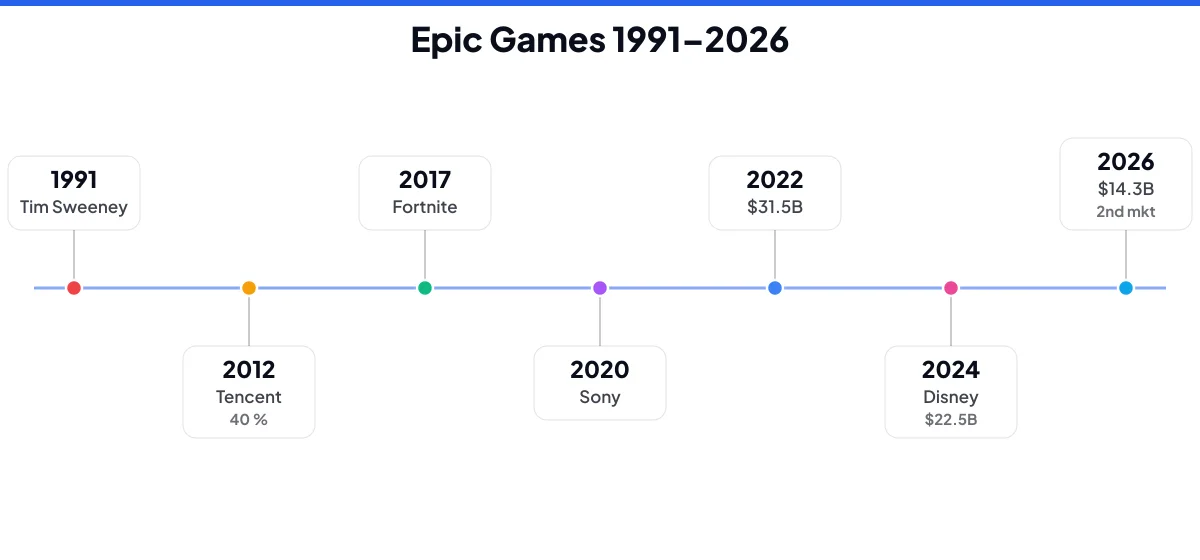
The valuation peaked in April 2022 at 31.5 billion dollars, at the top of the pandemic-era games boom. It has come down since. Disney invested 1.5 billion dollars in February 2024, and that round valued the business at 22.5 billion, nine billion below the high-water mark.
The secondary market, where employees and earlier backers sell holdings to one another and to specialist funds, tells a harsher story. By the middle of 2026 those trades implied a valuation of roughly 14.3 billion dollars, about a 30 per cent discount to the last official round. The gap is informative on its own. Buyers who are actually parting with cash are paying well below the price the most recent funding round set.
Neither number is a market price in the way a listed share has one. Volumes are thin, the pool of buyers is small, and nothing obliges the two figures to converge.
When is the Epic Games IPO
There is no date. More to the point, none of the paperwork that has to come before a date exists either.
A US listing follows a sequence that is visible from the outside long before the first day of trading. The company files a registration statement, the S-1, with the Securities and Exchange Commission. It appoints underwriting banks. It sets a share count and a price range. Epic Games has done none of these things. No S-1, no named underwriters, no price range, no date. The absence of those steps is a more reliable signal than any speculation about timing.
Sweeney has been consistent about the reasoning. He has argued for years that remaining private lets the company make decisions without having to justify them every quarter, and the ownership structure supports him. Tencent has held a large minority stake since 2012, Disney joined the register in 2024, and Sweeney retains control.
What has been happening in the meantime
November 2025 brought a partnership that would have looked improbable a few years earlier. Epic agreed a deal with Unity, the rival engine behind much of the mobile games industry. Games built in Unity will be publishable directly into Fortnite, and Unity’s commerce tooling extends to Unreal Engine during 2026.
The logic points back at Fortnite, which is still where the revenue is concentrated. More studios building for it means more content, and content is what keeps a live-service game earning.
Why you cannot buy Epic Games shares
Epic Games shares are not listed on any public exchange. There is no ticker, no order book, and no way to buy them through an ordinary investment account or ISA.
What exists instead is a private market. Stakes change hands between existing shareholders, mostly employees selling equity they earned through incentive schemes and funds from earlier rounds adjusting their positions. Those trades run through pre-IPO platforms open only to accredited or professional investors, with minimum sizes that put them beyond most private investors, and transfers usually need the company’s own consent. The access is restricted by design rather than by oversight.
Private rounds also do not give a reliable picture of what the business is worth. Volumes are limited and there is no broad market consensus behind the price. A definitive valuation would only arrive with a public offering, and that offering has not been announced.
If Epic ever did list, the shares would become available through mainstream stockbrokers in the normal way. Until then, anything marketed as exposure to Epic Games is worth reading closely, because the underlying asset is not publicly traded.
Who has invested in Epic Games
Tencent bought a 40 per cent stake in 2012 for 330 million dollars and remains the largest outside shareholder. Sony invested 250 million dollars in 2020 and added to the position later. In 2022 Sony and KIRKBI, the holding company behind LEGO, put in a billion dollars each in the round that set the 31.5 billion valuation. Disney’s 1.5 billion followed in February 2024.
The money went into Unreal Engine 5, the expansion of the Epic Games Store, the infrastructure behind Fortnite after its 2017 launch turned into a permanent live service, and the company’s wider platform ambitions. That spending is also why the private rounds mattered. Epic has been able to fund long projects without the disclosure and the shareholder pressure that come with a listing.
For anyone watching for a change, the things to look for are public and specific: an S-1 filing, a set of underwriters, a price range. None of them has appeared.