Brave Browser is a web browser built by Brendan Eich, the creator of JavaScript and a co-founder of Mozilla. He started it in 2015 with Brian Bondy and is still its chief executive. The browser blocks ads and tracking scripts by default, which speeds up page loading.
One of its features is that it pays the user in the BAT cryptocurrency for the ads it does show. It is free only in the sense that you pay with attention instead of money. It does not arrive on its own, though. Several conditions sit between switching the browser on and the first reward received.
Nothing arrives without a connected wallet
This is the change that leaves most older guides useless.
BAT used to be collected straight in the browser as so-called virtual BAT, and the user could pass it on without opening an account anywhere. Brave changed that in January 2023 and virtual BAT ceased to exist on 31 October 2023. Since then, anyone without a connected payout account receives nothing for the ads. The rewards do not even accumulate for collection later.
The second condition is the ads themselves. They do not start on their own, you have to switch them on in the settings. The reward arises from the ad being displayed, so there is no need to click.
How to collect the reward in the UK
A user in the United Kingdom has both payout routes open. One of them is a custodial account with Uphold, where opening it means verifying your identity.
The other, which Brave launched in August 2025, sends rewards straight to your own wallet on Solana, with no intermediary in between.
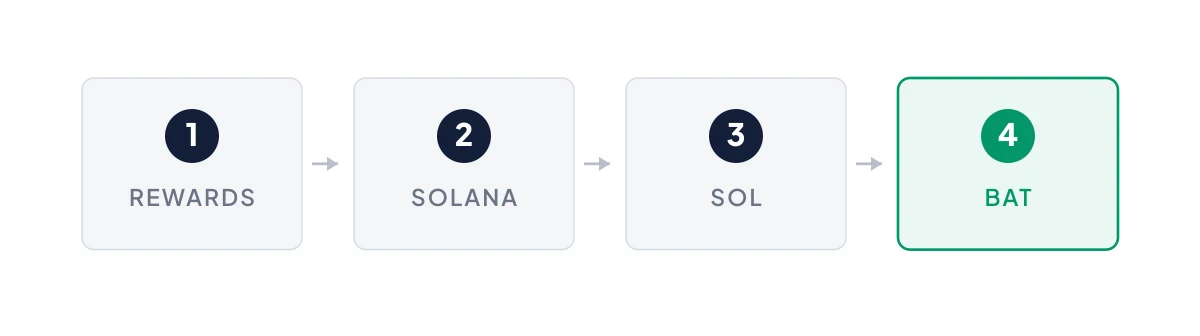
What it takes before the first reward arrives. ① switch on Brave Rewards and allow ads. ② connect your own wallet on Solana. ③ keep a little SOL on it, because opening an account for BAT costs a fee. ④ the payout comes once a month as SPL-BAT. Source: Brave help centre, own work.
BAT arrives on Solana as a so-called SPL token bridged through Wormhole, and for a wallet to receive it, an account for that particular token has to exist on the wallet. Opening one costs a small fee in SOL, so you have to buy a little SOL first. Brave states explicitly that payouts missed because the account was not there count as forfeited and cannot be claimed retrospectively.
The up-to-date list of supported countries and wallets is in the Brave help centre.
What it actually pays
Brave does not publish average earnings per user, a price per thousand impressions or any breakdown of earnings by country. Neither its help centre nor its page of operating figures names a sum. The numbers circulating on forums and in how-to videos therefore rest on nothing.
What can be compared is the number of campaigns, and it differs a good deal between markets. Brave publishes it by country, and as of 31 July 2026 it had forty-one in the United Kingdom against almost a hundred and fifty in the United States. In the Brave Rewards settings you choose how many ads per hour you see, but that is a ceiling, not a guarantee. How many you see depends on how many campaigns happen to be running.
What Brave has planned
In July 2026 Brave published a document called BAT Roadmap 4.0, and in it announced that notification ads, the ones BAT is earned from today, will be wound down gradually by the end of 2026.
Attention rewards do not end with that, Brave says. What exactly will replace notification ads it has not said yet, and the separate text it promised on the subject has not appeared.
Spending BAT already earned has been possible since March 2025 in the so-called Offer Wall, where Brave gathers discounts from partner companies, from travel to domains.
Brave Browser: faster and free of outside ads
Brave now reports more than 122 million monthly and roughly 51 million daily active users, a figure valid as of 31 July 2026 from its own page of operating numbers.
It blocks ads and pop-ups by itself, with no add-ons to install. That is handled by its Shields component, which works with public filter lists and with Brave’s own lists. The filtering happens on the device.
Ad blocking has nothing to do with the blockchain. The blockchain in Brave serves only to record and transfer BAT tokens.
Ads that are never downloaded save both data and battery. Brave itself says that pages load three to six times faster than in rival browsers. It is a vendor measurement, using a methodology it published in January 2020 on a sample of thirty-five addresses.
The browser can open a private window with a connection through the Tor network. It is a separate mode rather than a permanent state, and it is on desktop only. Brave itself points out that it is no substitute for the Tor Browser and that anyone who genuinely depends on anonymity should reach for that instead.
Besides the versions for Windows, Linux and macOS there is also a mobile version for Android and iOS. On iOS, though, you cannot earn anything through Brave Rewards, it only serves to support creators.
Rewards for creators
Content creators, YouTube channels, Twitch accounts or active profiles on networks such as X and Reddit, receive BAT from the users who follow and support them. They register at creators.brave.com, where a personal website, YouTube, X, Reddit, Twitch, Vimeo and GitHub can all be added. Brave reports more than 1.6 million verified creators and publishers.
The mechanics have changed twice, though. The reward button next to individual posts on X, Reddit and GitHub was removed by Brave in January 2024. Contributions now go through the BAT icon in the address bar. And the automatic split of BAT among visited sites according to time spent on them was scrapped at the start of 2025.
Two options are left. A one-off contribution is open to anyone, a recurring monthly one only to accounts connected to a custodial payout service such as Uphold. A user in the United Kingdom keeps both, but the recurring contribution has to run through an Uphold account, not through a self-custody wallet.
Advertisers are the third participant in the system, alongside users and creators. Brave offers targeted advertising without intermediaries and promises that private data never leaves the user’s browser in the process. What share of the ad revenue goes to the user today, Brave does not state as a number. On its Rewards page it says only that with eligible ads the user’s share is at least as large as Brave’s.
Basic Attention Token
Basic Attention Token is an open-source ERC-20 token on Ethereum. The contract has not changed since 2017. Brave has also bridged it to Solana, where it exists as SPL-BAT.
The token sale took place on 31 May 2017 and the entire public issue, one billion tokens, was gone in about thirty seconds. Brave set the price in ether, one ETH for 6,400 BAT, and raised 156,250 ETH in total, worth roughly 35 million dollars at the time. Only around a hundred and thirty addresses managed to buy, and about half the issue went to five buyers, so the speed of the sale was not the work of a rush of small investors.
Total supply is 1.5 billion BAT and more than 99 per cent of it is in circulation. No further issue has happened and none is planned. Brave buys the rewards for users on the market.
BAT trades on the large exchanges. Current rates are in our crypto price overview. The token detail is on the BAT page.