The Swiss stock exchange (SIX Swiss Exchange) is one of the steadiest and most respected financial harbours in Europe. It is not merely a place where shares change hands, but above all a symbol of Swiss economic strength, precision and long-term reliability. For many investors it stands for safety, which comes from the strong Swiss franc as much as from the presence of globally significant, well-established companies. Around 260 companies are listed there, and the twenty in the main index alone are worth roughly 1.5 trillion francs together (mid-2026). Many of them rank among the world leaders in their fields. That standing makes the exchange attractive to companies looking for prestige and stable investors.
From cantonal exchanges to a European hub
Organised trading in Switzerland reaches deep into the 19th century. Geneva had its own exchange from 1850, Basel from 1866 and Zurich from 1873. The modern shape of the Swiss exchange was born in 1993, when those three regional markets merged into a single institution; it has carried today’s name, SIX Swiss Exchange, since 2008.
What came immediately afterwards is the step that wrote it into the history books. In 1995 it became the first exchange in the world to automate the whole chain at once — trading, clearing and settlement. The point was not that it traded electronically first, but that it was first to link all three steps into one system. The Zurich floor closed on 16 August 1995 and everything has happened inside computers since.
Today the SIX Swiss Exchange is not just a trading platform; it provides a full range of services from settling trades to financial information. Its reputation is inseparable from the prosperity of Switzerland, which rests on innovation, pharmaceuticals, luxury goods and first-rate financial services. Thanks to its resilience to economic swings and its safe-haven reputation, it attracts capital from around the world, particularly in uncertain times.
Its dominant position in Europe comes from a concentration of huge multinationals in the so-called defensive sectors: healthcare, food and consumer goods. The shares traded on the Swiss exchange form the backbone not only of the Swiss economy but of the European one as well. Shares trade in Swiss francs, while euros and dollars show up with some ETFs and bonds.
The index that mirrors Swiss strength: SMI
The Swiss exchange belongs among the markets where trades worth several billion francs are done every day. Its global weight is underlined by the main equity index:
SMI (Swiss Market Index): the most closely watched gauge of the Swiss market. It covers the 20 largest and most heavily traded companies on SIX and is led by the trio of Roche, Novartis and Nestlé.
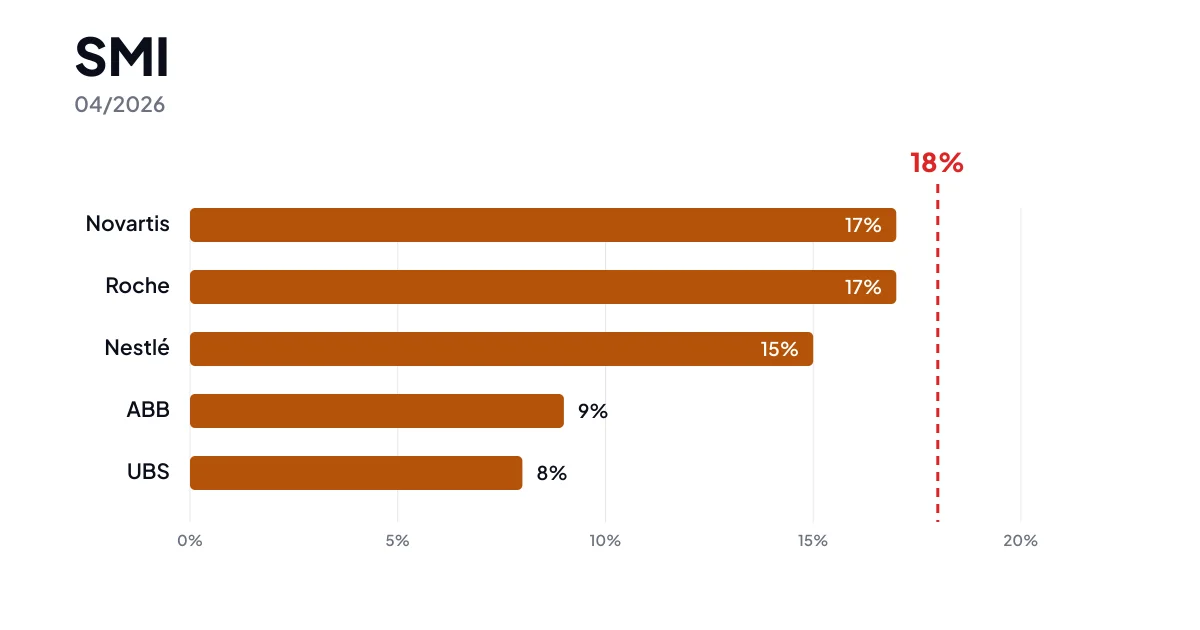
Here is a detail that is not usually mentioned and yet changes a great deal. If the index were weighted purely by market capitalisation, that trio would account for over 60% of its value and the SMI would essentially be a chart of three companies. That is why a cap of 18% per company has applied since 2017 — nobody may carry more weight, however large they are. In April 2026 Novartis and Roche each stood at 17%, Nestlé at 15%, ABB at 9% and UBS at 8%; the top five companies together made up roughly two thirds of the index.
The second thing that is easy to forget: the SMI is a price index and dividends do not enter it. In that it differs from the German DAX, which counts them in. Anyone comparing total return has to reach for the SMIC version. The gap is not small — with Swiss blue chips it runs to several percent a year.
SPI (Swiss Performance Index): this broader index is far more comprehensive. It takes in almost every company traded on the Swiss exchange and so gives an overall view of how the whole market is performing, including small and mid-sized firms. It serves as a more detailed indicator for analysts who want to follow what happens outside the largest twenty as well.
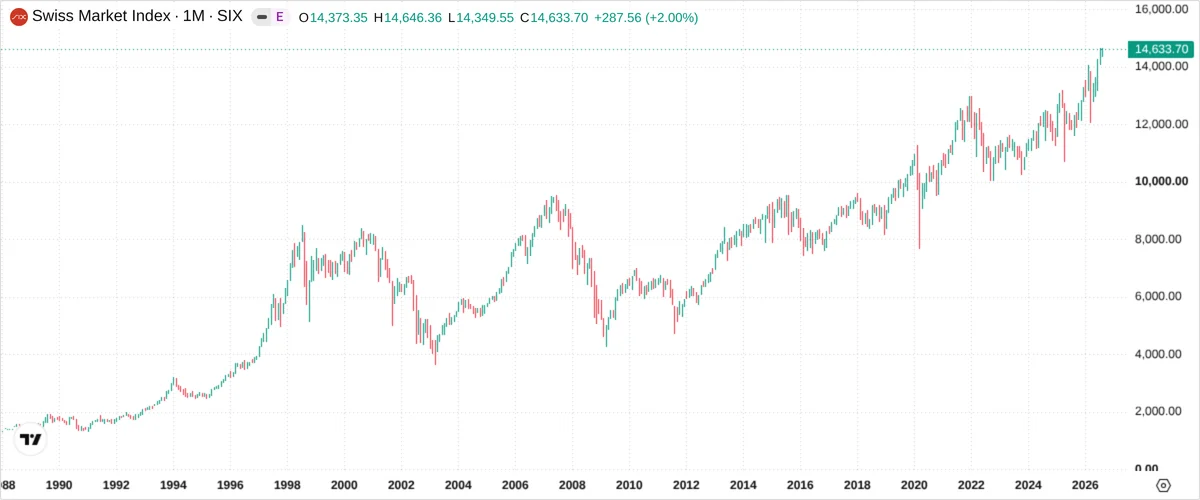 The SMI index, monthly candles. Source: TradingView.
Who carries the Swiss market?
Unlike technology-heavy exchanges, the SIX Swiss Exchange is home to very stable and profitable companies from sectors that are less sensitive to economic cycles. Among the most important names shaping the market are these: the foundation is laid by the pharmaceutical and healthcare giants. This group carries enormous weight on the exchange and includes the global leaders Novartis (NOVN) and Roche (ROG). The two rank among the largest pharmaceutical companies in the world. They are joined by Alcon (ALC), for instance, a specialist in eye care.
The food and consumer sector holds a strong position too. It is led without rival by Nestlé (NESN), the largest food company in the world, whose products sit in households across the planet. Luxury goods makers belong here as well: Richemont (CFR), owner of brands such as Cartier, and Swatch Group (UHR), the largest watchmaker in the world.
And of course the financial sector cannot be missing. This category covers large banking houses such as UBS Group (UBSG) and insurers such as Zurich Insurance Group (ZURN) or Swiss Re (SREN), which rank among the global elite in their field.
How to invest on the Swiss exchange and buy shares
Investing on the Swiss exchange is fairly simple and accessible for retail investors today. Modern online brokers allow shares to be bought directly on SIX Swiss Exchange with no complicated paperwork.
One of the platforms offering this is the broker eToro. It lets its users buy real shares of companies traded directly on the Swiss exchange. The process is straightforward: once the account is opened and funded, you simply look up the company by name or ticker and place the trade.
Shares on SIX trade in Swiss francs (CHF), so currency conversion has to be factored in if you deposit funds in another currency. The eToro platform offers a selection of the main Swiss shares, including the giants mentioned above such as Nestlé, Roche, Novartis, UBS and many others.
eToro is a multi-asset investment platform. The value of your investments may go up or down. Your capital is at risk.
The largest companies listed on the Swiss exchange
| Company | Price | Change | Change % | Market cap |
|---|---|---|---|---|
| Roche | 52,10 USD | -0,16 USD | −0,31 % | 332,09 mld. USD |
 Novartis Novartis | 143,35 USD | -2,36 USD | −1,62 % | 272,47 mld. USD |
 Nestlé Nestlé | 91,31 USD | -0,25 USD | −0,27 % | 234,87 mld. USD |
| ABB | 95,12 USD | -1,92 USD | −1,98 % | 172,18 mld. USD |
| UBS Group | 48,26 USD | -0,52 USD | −1,07 % | 147,76 mld. USD |
 Compagnie Financière Richemont Compagnie Financière Richemont | 21,41 USD | +0,22 USD | +1,04 % | 125,88 mld. USD |
 Zurich Insurance Group Zurich Insurance Group | 33,96 USD | -0,47 USD | −1,37 % | 101,45 mld. USD |
 Lonza Lonza | 69,09 USD | -0,88 USD | −1,26 % | 49,16 mld. USD |
 Swiss Re Swiss Re | 41,57 USD | -0,57 USD | −1,35 % | 49,19 mld. USD |
 Holcim Holcim | 15,82 USD | -0,50 USD | −3,06 % | 43,75 mld. USD |
| Swisscom | 75,85 USD | -0,92 USD | −1,20 % | 39,37 mld. USD |
| Givaudan | 81,83 USD | -0,67 USD | −0,81 % | 37,77 mld. USD |
 Sika Sika | 22,10 USD | -0,09 USD | −0,41 % | 35,46 mld. USD |
 Alcon Alcon | 64,78 USD | -0,66 USD | −1,01 % | 31,31 mld. USD |
 Swiss Life Swiss Life | 53,56 USD | -1,02 USD | −1,87 % | 30,64 mld. USD |
| Schindler | 15,36 USD | -0,05 USD | −0,32 % | 32,80 mld. USD |
| Kuehne + Nagel | 52,92 USD | -1,25 USD | −2,31 % | 31,42 mld. USD |
 Lindt Lindt | 9,54 USD | +0,23 USD | +2,47 % | 21,79 mld. USD |
| Partners | 700,50 USD | -29,50 USD | −4,04 % | 18,06 mld. USD |
| SGS | 11,37 USD | +0,07 USD | +0,62 % | 22,49 mld. USD |
 Geberit Geberit | 65,53 USD | -0,63 USD | −0,95 % | 21,20 mld. USD |
| Straumann | 11,07 USD | -0,50 USD | −4,32 % | 17,95 mld. USD |
 Julius Baer Julius Baer | 17,91 USD | -0,53 USD | −2,87 % | 18,43 mld. USD |
| Sonova | 60,28 USD | -0,24 USD | −0,40 % | 17,90 mld. USD |
| Logitech International S.A. | 101,11 USD | +0,44 USD | +0,43 % | 14,48 mld. USD |
| Swatch | 11,21 USD | -0,21 USD | −1,84 % | 11,84 mld. USD |
 Swissquote Swissquote | 49,29 USD | +0,00 USD | +0,00 % | 7,39 mld. USD |
Quotes are indicative and delayed.
Prices are in dollars because we track these companies through their American ADRs. On the exchange in Zurich the same shares trade in francs under tickers such as NESN, ROG or NOVN.
Watch out for one mix-up that turns up routinely in overviews of Swiss companies. Chubb, Garmin, TE Connectivity, Amcor, On Holding and Sportradar are based in Switzerland but are not listed on the Swiss exchange — their shares trade in New York. The same goes for Glencore, headquartered in Baar and listed in London. A Swiss headquarters and the Swiss exchange are two different things.