One share of Berkshire Hathaway costs more than an apartment. In mid-August 2026 it changed hands on the NYSE for more than $755,000 — for a single piece of paper.
This is not a typo, and it is not some exotic instrument. It is an ordinary common share in a company that has not split its stock once in sixty years. Large companies divide their shares from time to time so that the price per share stays in a friendly range. Berkshire never did, and the result is there on the quote screen.
Yet the price of one share says almost nothing about the company itself. It is the value of the business divided by the number of shares it has issued, and the company sets that number for itself. NVR trades above $6,300 a share, but the whole company is worth just under $17 billion. Apple shares cost around $306, and Apple is roughly 260 times larger.
The most expensive stocks on the US exchanges
The American part of the ranking is the most accessible one. Prices are in dollars, so they can be compared with each other, and every one of these names can be bought at an ordinary broker.
| Company | Price | Change % | Market cap |
|---|---|---|---|
 Berkshire Hathaway Inc. BRK-A Berkshire Hathaway Inc. BRK-A | 750 776,44 USD | −0,34 % | 1,07 bil. USD |
 NVR NVR NVR NVR | 6 152,17 USD | −1,32 % | 16,39 mld. USD |
 Seaboard SEB Seaboard SEB | 3 930,01 USD | −3,09 % | 3,76 mld. USD |
 AutoZone AZO AutoZone AZO | 2 822,29 USD | −1,87 % | 45,64 mld. USD |
 First Citizens BancShares FCNCA First Citizens BancShares FCNCA | 2 068,06 USD | −0,26 % | 23,35 mld. USD |
 White Mountains Insurance Group WTM White Mountains Insurance Group WTM | 2 013,50 USD | −0,40 % | 4,81 mld. USD |
 Markel MKL Markel MKL | 1 732,98 USD | −0,41 % | 21,47 mld. USD |
 Graham Holdings GHC Graham Holdings GHC | 1 140,72 USD | +1,14 % | 4,83 mld. USD |
Quotes are indicative and delayed.
The table updates live; the ranking is based on prices from mid-August 2026.
Behind Berkshire there is a chasm. NVR in second place costs roughly one hundred and twentieth as much, and from fifth place down it is single-digit thousands of dollars a share.
What these companies have in common is not their industry. They build houses, sell car parts, write insurance and carry goods across oceans. What they share is the share count: NVR has just under 2.7 million shares outstanding, Seaboard just under a million. Divide a company of that size into so few pieces and each piece comes out expensive.
Berkshire Hathaway is Warren Buffett’s holding company, based in Omaha — insurers, railroads, utilities and stakes in other businesses. NVR builds family houses in the eastern United States, Seaboard is an agricultural and shipping group from Kansas, AutoZone sells car parts. First Citizens BancShares is a bank from North Carolina, White Mountains and Markel are insurers, and Graham Holdings is an education and media group that published The Washington Post until 2013.
Beyond America: Switzerland, Denmark, Canada
Most rankings of this kind stop at the US exchanges, and in doing so they miss the second most expensive share in the world. It trades in Zurich, on the SIX exchange.
| Company | Price | Change % | Exchange |
|---|---|---|---|
 Chocoladefabriken Lindt & Sprüngli AG LISN.SW Chocoladefabriken Lindt & Sprüngli AG LISN.SW | 81 900,00 CHF | +0,12 % | Swiss |
| Zuger Kantonalbank ZUGER.SW | 11 050,00 CHF | +0,45 % | Swiss |
| Chocoladefabriken Lindt & Sprüngli AG LISP.SW | 7 835,00 CHF | +0,38 % | Swiss |
| A.P. Møller - Mærsk A/S MAERSK-B.CO | 23 650,00 DKK | −1,62 % | Copenhagen |
| Givaudan SA GIVN.SW | 3 410,00 CHF | −0,87 % | Swiss |
| Schweizerische Nationalbank SNBN.SW | 3 180,00 CHF | −0,63 % | Swiss |
 Constellation Software Inc. CSU.TO Constellation Software Inc. CSU.TO | 2 923,66 CAD | +0,94 % | Toronto |
 Hermès International Société en commandite par actions RMS.PA Hermès International Société en commandite par actions RMS.PA | 1 336,50 EUR | −1,18 % | Paris |
Quotes are indicative and delayed.
Prices are in local currency; the order follows the conversion into dollars as of August 14, 2026. Lindt has two securities listed: the registered share (LISN) and the participation certificate (LISP), which carries no voting right.
Shares in the chocolate maker Lindt & Sprüngli cost around 95,800 francs. Its participation certificate makes the global top ten as well, and so does Zuger Kantonalbank. Roughly ten Swiss names trade above the thousand-dollar mark — more than on any other European market.
A special case is the Swiss National Bank. It is one of the few central banks in the world whose shares are listed on an exchange, and it has exactly 100,000 of them outstanding.
The rest of the list is a mixed bag: Givaudan makes fragrances and flavours, Hermès luxury goods, Canada’s Constellation Software buys up smaller software firms, and Denmark’s A. P. Møller-Mærsk ships containers.
One practical caveat. Some of these names trade very thinly — a handful of shares change hands in a day, and the quoted price may be yesterday’s last trade rather than a price at which anyone actually bought today.
Berkshire Hathaway: the stock they never split
| Company | Price | Change % | Market cap |
|---|---|---|---|
| Berkshire Hathaway Inc. BRK-A | 750 776,44 USD | −0,34 % | 1,07 bil. USD |
 Berkshire Hathaway BRK-B Berkshire Hathaway BRK-B | 499,45 USD | −0,58 % | 1,07 bil. USD |
Quotes are indicative and delayed.
Two share classes of the same company. The cheaper class B is the one small investors usually buy.
Class B was created in May 1996, and Berkshire issued it reluctantly. Unit trusts were being prepared at the time that wanted to sell small investors exposure to Berkshire with high fees, so the company decided to offer a cheaper direct route itself. The prospectus also weighed simply splitting the existing shares, but rejected that on the grounds that a split would attract buyers who pay no attention to price.
The class B offering price was $1,110, and one A share was then worth thirty B shares. In January 2010 Berkshire split the B class 50:1 so that it could use it in the takeover of the Burlington Northern railroad. The A class expressly was not split. The original 1:30 ratio therefore became 1:1,500, and that is where it stands today.
Three things follow from this in practice:
- An A share can be converted into 1,500 B shares at any time. It does not work the other way round — the conversion is one-way.
- On dividends and on the claim to assets, a B share carries exactly one fifteen-hundredth of the rights of an A share.
- Voting power is weaker than the economic stake would suggest: one B share has one ten-thousandth of the vote of an A share, a ratio of 1:10,000, roughly six times less.
The market price tracks that ratio almost exactly. As of August 14, 2026 it worked out at 1,499, and the deviation from theoretical parity was in hundredths of a percent.
Why some stocks are so expensive
The price per share is a fraction. The value of the business is the numerator, the number of shares the denominator.
Most companies gradually enlarge the denominator: they issue new shares in acquisitions, pay employees with them, and split them from time to time so they are easier to buy. The companies in this ranking do rather the opposite — they issue almost no new shares and buy back part of the ones already out there.
Nobody is forced into a split. It is a voluntary step that changes nothing about the value of the business: afterwards the shareholder holds more pieces and each one is proportionally cheaper. Companies reach for it mainly so that the share looks more affordable.
Swiss companies clearly reach for it less willingly than American ones. It is otherwise hard to explain why one not particularly large exchange has ten names above the thousand-dollar mark.
A split can knock a stock off the list
A year ago Booking Holdings belonged in every rundown of this kind. Today it does not, even though the company has not shrunk.
In February 2026 it announced a 25:1 split. It took effect on April 2, 2026, and the shares have traded at the new price since April 6. Anyone holding one share held twenty-five after the split, and the value of the position did not change.
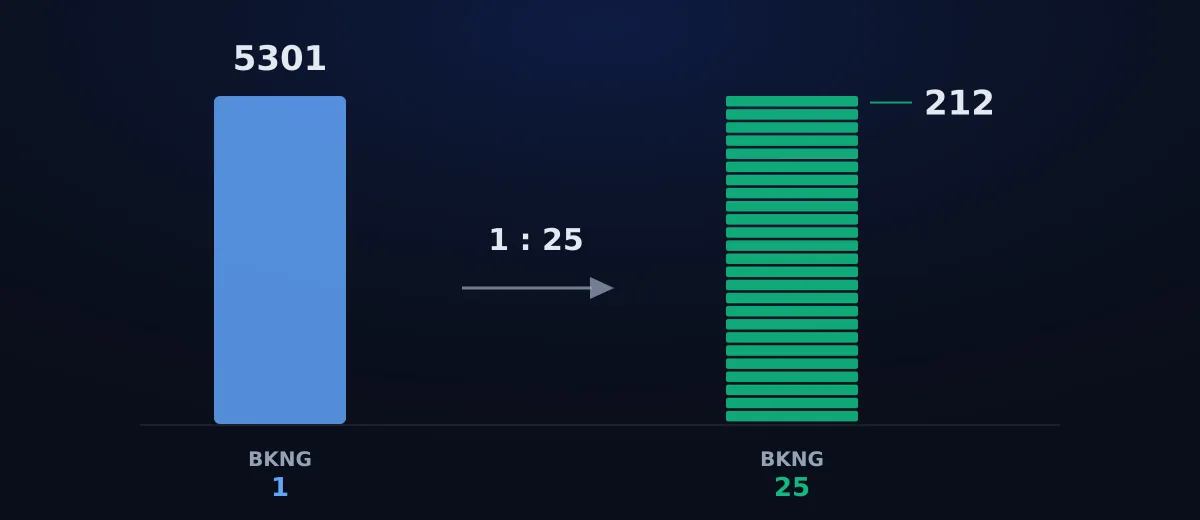
A split changes the number of shares and the price per share, not the value of a position. Today’s $212 per Booking share corresponds to $5,301 before the split.
Without that split, Booking would be second in the American part of the ranking today, right behind NVR. But nobody builds such a list from prices that would apply if something had not happened — and that is the whole point. Being the most expensive stock is largely a decision by the company, not the outcome of its business.
How to buy an expensive stock without millions
With Berkshire the answer is simple: buy class B. One share cost around $504 in mid-August 2026, and economically it is exactly one fifteen-hundredth of an A share.
For the other names, fractional shares help. At selected companies brokers allow you to buy just a fraction of a share, and the minimum purchase usually starts at one dollar. The offer differs from broker to broker, though, so it is worth checking in advance whether a particular name is available in fractions.
A fraction is not the same thing as a whole share. The dividend is prorated, and a voting right usually does not come with it. How such a purchase works step by step is set out in the article on how to buy stocks online.

eToro is a multi-asset investment platform. The value of your investments may go up or down. Your capital is at risk.
A high price does not make a good company
The fact that a share costs thousands of dollars says nothing about whether it is expensive in the sense an investor cares about — that is, whether more is being paid for it than the company earns.
That is what multiples are for, the price-to-earnings ratio among them. They set the price against the company’s performance, and on that measure a $6,000 share can be cheaper than a $30 one.
The second issue is concentration. When a single purchase swallows more than half of a small portfolio, there is no spreading of risk to speak of. That is another reason expensive names tend to be bought through fractions or through the cheaper share class.
And third, liquidity. In names where a handful of shares change hands a day, the gap between the buying and the selling price can get costly — and that is an expense no ranking ever shows.