
If you follow the financial news you have almost certainly run into the word pre-market — a line such as “Nvidia shares are up 4% in the pre-market”. But how is that possible when the exchange has not opened yet?
The widespread idea that shares can only be traded during official hours simply is not true. Prices move outside them too, and the pre-market is one of the windows in which that happens. Let us go through what it means, why it matters and how to work with it.
What is the pre-market
The pre-market is the period before the official opening of the exchange. On the US markets (NYSE, Nasdaq) regular trading starts at 9:30 Eastern time. The pre-market, however, runs from 4:00 Eastern, even though most of the activity is concentrated in the last two hours before the open, from 8:00 to 9:30.
Shares really are traded during the pre-market — this is not a forecast or a projection. These are genuine transactions between buyers and sellers. The difference from regular hours is that volume tends to be markedly lower, which means less liquidity and potentially larger price swings.
Why prices move outside trading hours
The world does not stop when the exchange closes. Companies publish results, central banks announce decisions, geopolitical events happen at any hour of the day or night. All of it affects the value of shares, and investors want to react immediately rather than the next morning after the bell.
Pre-market trading runs through ECNs (Electronic Communication Networks), which match buy and sell orders outside the standard exchange system. After-hours trading works in much the same way — trading after the close, typically from 16:00 to 20:00 Eastern.
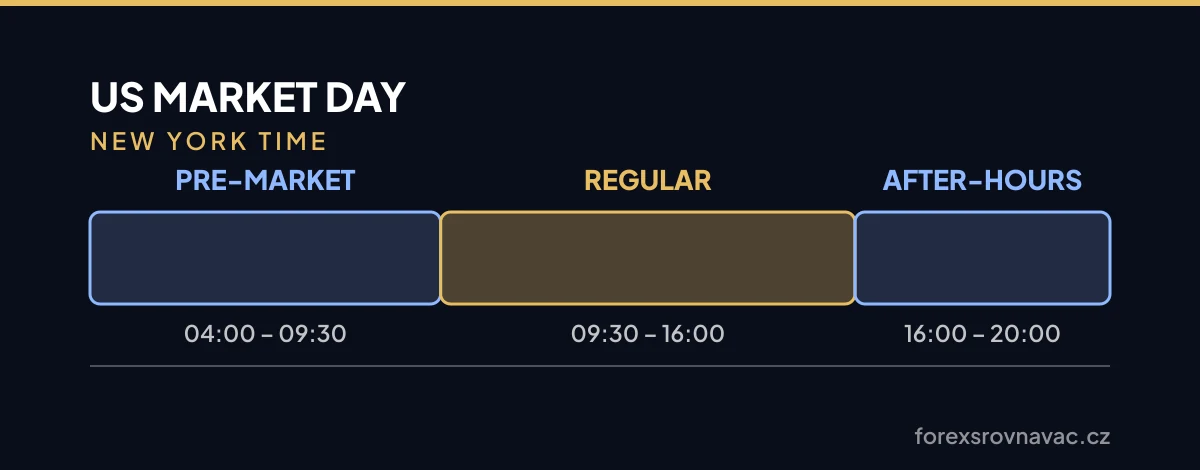 The full trading day in New York time. The regular session (RTH) is only the middle third of it.
Index futures (S&P 500, Nasdaq 100, Dow Jones) play an important role as well. Futures trade almost continuously, from Sunday evening to Friday, and their price movement hints at the direction in which the market is likely to open. When you hear that “S&P futures are up”, it means the market expects a positive open.
What the pre-market is good for
The pre-market price is not merely a curiosity for finance enthusiasts. It has an entirely practical meaning for anyone who trades or invests. It helps gauge market mood and appetite for risk before regular trading gets going, and that is information that can shape your decision.
Picture a typical situation. After the close a company publishes quarterly results that comfortably beat analyst expectations. Revenue is growing, profit is above forecast, the company is raising its outlook for the next quarter. In after-hours trading its shares immediately jump several per cent. In the morning, in the pre-market, the move continues and the shares stand 8% above where they traded the day before. For an investor who was considering buying, that is crucial information: when the exchange opens the price will most likely be somewhere quite different from yesterday’s close. They can decide whether to buy at the higher price, wait for a possible pullback, or let the opportunity go entirely.
It works the other way round too. If a company disappoints — lower revenue, a cut outlook, the loss of a key client — the pre-market price reflects it at once. An investor holding the shares can see the size of the drop before the open and prepare for what is coming.
The pre-market is not only useful for individual shares. When the whole market, meaning most of the large caps, shows red in the pre-market, it can signal broadly low appetite for risk. In such situations the safe havens usually strengthen: the US dollar, government bonds, gold. A green pre-market across the board suggests optimism and a willingness to take on more risk.
What to watch out for
Pre-market trading has several particularities that anyone who wants to use it actively, or make decisions based on it, should know:
| Feature | Regular hours | Pre-market |
|---|---|---|
| Volume | High | Markedly lower |
| Spreads | Narrow | Wider |
| Price swings | Usually smoother | Can be sharp and unpredictable |
| Availability | All brokers | Not every broker offers it |
| Order types | All | Often limit orders only |
Low volume is the decisive factor. It means a relatively small number of trades can push the price substantially up or down. It can therefore happen that a share flies 5% in the pre-market, only for the price to snap back once the exchange opens and most participants join in. The pre-market price suggests direction but does not guarantee it.
Pre-market and earnings season, when it matters most
There is a period in which the pre-market becomes especially interesting, and that is earnings season, when companies publish their quarterly results. In the US it happens four times a year, roughly a month after the end of each quarter, and over a few weeks hundreds of companies report.
Most large companies publish either after the close or early in the morning before the open. The reason is practical: they want to give the market time to digest the numbers before regular trading gets going. In practice it means that the pre-market and after-hours are precisely where the most dramatic price moves of the whole quarter happen.
The typical scenario looks like this. A company reports after the close with numbers well above or below expectations. In after-hours the shares react immediately — a move of 5, 10, sometimes even 20% is nothing unusual. Overnight the news spreads, analysts update their models, and in the morning pre-market the price settles further. Often the largest move happens in exactly these unusual hours, and by the open the matter is already decided.
For investors holding shares through earnings, watching the pre-market is practically a necessity. It shows how the market is interpreting the results and gives them time to prepare a strategy, whether that means selling, adding, or simply calming down and letting the position run.
It is not only individual earnings that move the pre-market. Macro data matters too, and in the US it typically lands at 8:30 Eastern, an hour before the open. The most significant releases include the NFP (Non-Farm Payrolls, the monthly employment data), CPI (the consumer price index), PPI (producer prices) and GDP figures. All of these numbers can shift not just individual shares but the whole market at once in the pre-market. Following the economic calendar is therefore an integral part of preparing for any trading day.
Where and how you can trade the pre-market
Not every broker allows trading outside regular hours. It depends on the provider you use and the instruments it offers. Some brokers do not support the pre-market at all, others offer it for selected names, and only some for a wide range of shares.
One of the brokers that actively offers pre-market trading is eToro. The platform lets you trade selected major US shares in extended hours, the pre-market included. Pre-market orders can be placed at any time, but execution itself takes place between 6:30 and 9:30 Eastern. Instruments intended for extended trading are recognisable by the ”.EXT” suffix in the name. Extended-hours trading on eToro takes the form of CFDs — contracts for difference — with leverage, which allows entry with less capital but also raises the risk. More about the platform and its terms in our eToro review.
If you are only considering pre-market trading, we suggest starting on a demo account. Most brokers offering extended hours let you try them out for practice, and that is a sensible first step. A low-liquidity environment behaves differently from what you are used to in regular hours, and a few trades on paper will show you whether the style suits you.
eToro is a multi-asset investment platform. The value of your investments may go up or down. Your capital is at risk.
Frequently asked questions
Can I trade the pre-market with my broker? It depends on the broker. Some allow it, some do not. If it interests you, check the terms with your provider. Most brokers supporting the pre-market require limit orders — market orders tend to be unavailable during this period.
What is the difference between pre-market and after-hours? The pre-market runs before the exchange opens (typically 4:00 to 9:30 Eastern), after-hours after it closes (16:00 to 20:00). Both work on the same principle: lower liquidity, wider spreads, trading through ECNs.
Is the pre-market price a reliable indicator? It shows the mood and the first reaction to news, but low volume means the price can change substantially after the open. Treat it as an indicative signal, not a guarantee.
What are futures and how do they relate to the pre-market? Index futures (S&P 500, Nasdaq) trade almost continuously and show the expected direction of the market. Their movement before the open is one of the main clues for estimating how the market will start.
Financial instruments carry risk. Invest responsibly. This article does not constitute investment advice.