
Almost every roundup of the oldest ETFs starts with the SPDR S&P 500. That is understandable — it is still the largest ETF in the world. But State Street’s own fund page says something different from what usually gets quoted: SPY was the first ETF listed in the United States. Not in the world.
Three years earlier, on March 9, 1990, the Toronto stock exchange launched a fund that did exactly what today’s ETFs do. It was called TIPs 35 and it traded for ten years.
The longest-traded ETF and the very first one are not the same thing.
The three oldest ETFs still trading today
It is usually third place that gets mixed up.
| Company | Price | Change % | Exchange |
|---|---|---|---|
| State Street SPDR S&P 500 ETF Trust SPY | 767,89 USD | +0,48 % | NYSEArca |
| State Street SPDR S&P MIDCAP 400 ETF Trust MDY | 659,79 USD | −0,07 % | NYSEArca |
| NEXT FUNDS Nikkei 300 Index Exchange Traded Fund 1319.T | 746,40 JPY | +1,83 % | Tokyo |
| iShares MSCI Australia ETF EWA | 28,45 USD | +0,27 % | NYSEArca |
Quotes are indicative and delayed.
Prices load live. All three American funds are listed on NYSE Arca, not on the NYSE or NASDAQ.
SPDR S&P 500 ETF Trust (SPY) started operating on January 22, 1993, and trading began on the AMEX a week later. Today it holds more than $820 billion in assets and costs 0.0945% a year. Since inception it has returned 10.80% a year, counted with dividends reinvested.
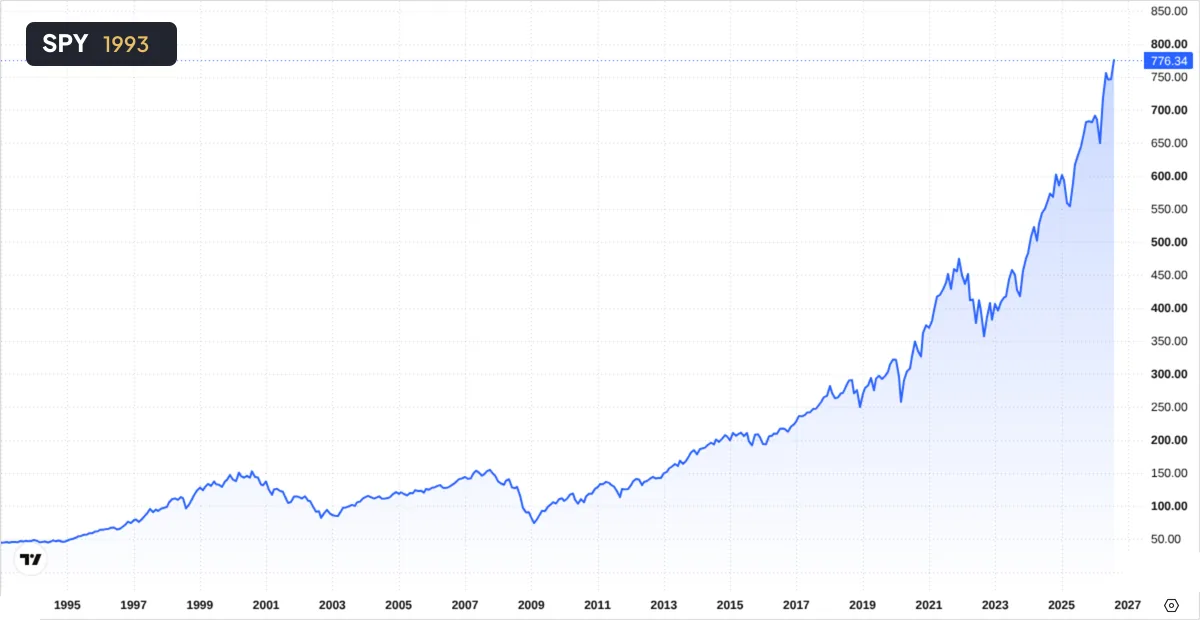 SPY share price since 1993. The chart shows price only — the total return is higher, because the fund also pays a quarterly dividend.
SPDR S&P MidCap 400 (MDY) came two years later. The trust agreement is dated April 27, 1995; State Street gives May 4 as the inception date. The fund tracks four hundred mid-sized American companies, costs 0.23% a year and has returned 11.32% a year since inception — somewhat more than SPY.
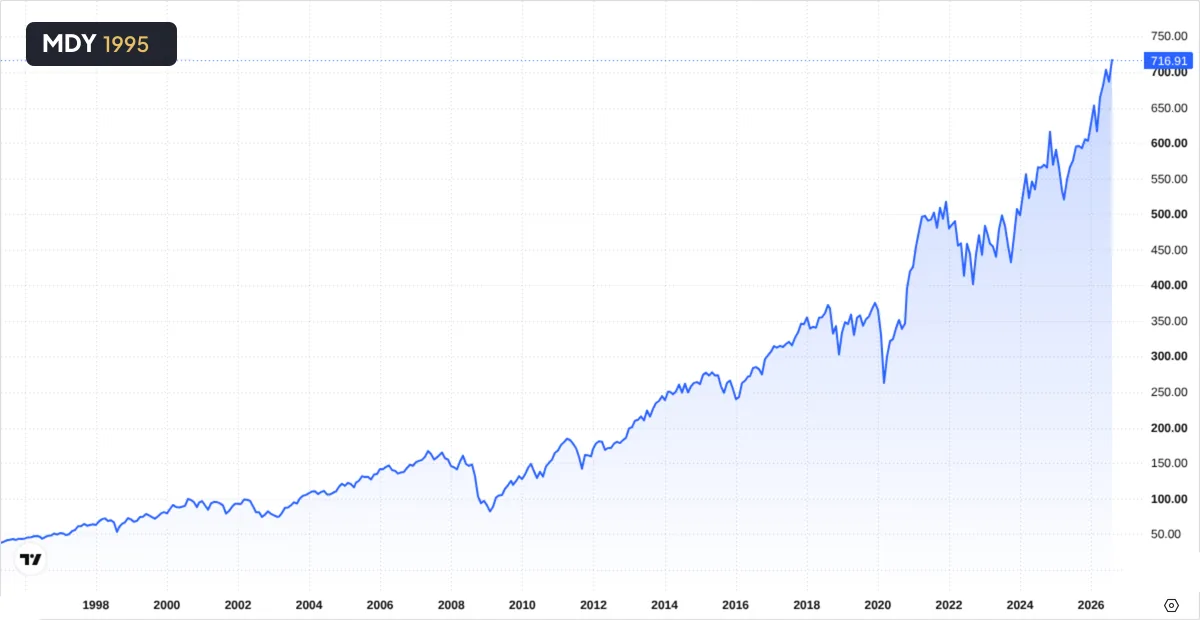 MDY share price since 1995. Mid-sized companies have beaten large ones over the long run, but they paid for it with deeper drawdowns.
NEXT FUNDS Nikkei 300 (code 1319) is the number three nobody writes about. It has traded on the Tokyo exchange since May 29, 1995, three weeks after MDY. Nomura describes it as the very first ETF listed in Japan, and it is the only fund on the Tokyo exchange with a listing date before 2001 — the next Japanese ETFs did not arrive until July 2001. There is no since-inception chart for it here: publicly available data only goes back to 2008.
Who was really first: Toronto, 1990
Toronto 35 Index Participation Units began trading on the Toronto exchange on March 9, 1990. The construction matched what we expect from an ETF today: the trust physically held the shares of the thirty-five index constituents, and above a set minimum the units could be exchanged directly for those shares rather than for cash. The annual fee was 0.05%, which would hold up even now. By the end of September 1996 the fund had more than 91 million units outstanding and over 2.5 billion Canadian dollars in assets.
The exchange later added a second fund, tracking the broader TSE 100. In 2000 it merged the two into one, which today runs under the ticker XIU: unitholders voted on February 28, the regulator ruled on March 3 and the merger went through in the first days of March. TIPs thereby ceased to exist as a legal entity — and that is exactly why they never show up in rankings of the oldest funds. Those lists are usually put together by sorting the funds that exist today.
The exchange operator talks about them cautiously. In a 2020 press release it called them the world’s first exchange-traded fund; five years later, rather a prototype of the modern ETF.
Two attempts that came before
The first attempt dates from 1989, and it was not a fund. Index Participations were approved by the American securities commission on April 11, 1989, and from May they traded on three exchanges. But they were bilateral contracts with no maturity: the seller posted 150% margin and quarterly paid the buyer the equivalent of the dividends, without having to hold the shares themselves. There was no portfolio behind the product. The end came quickly — on August 18, 1989, the Seventh Circuit Court of Appeals ruled that these were futures, over which the commission had no authority, and struck down its approval.
The second attempt came closer. SuperTrust received its exemption in October 1990 and the public offering began on November 5, 1992, two and a half months before SPY. Units could be split into two different securities traded on two exchanges, which made it a product for sophisticated investors rather than for the public. The trust also had a limited life from the start and wound up in November 1995.
The Australian fund and its sixteen siblings
iShares MSCI Australia turns up in these roundups as the third-oldest ETF. The date is right, March 12, 1996. But sixteen more funds started the very same day: under the WEBS brand the manager brought seventeen funds to the exchange at once, one for each country. Picking Australia out of them is arbitrary — Japan, Germany and Mexico have the same claim to third place.
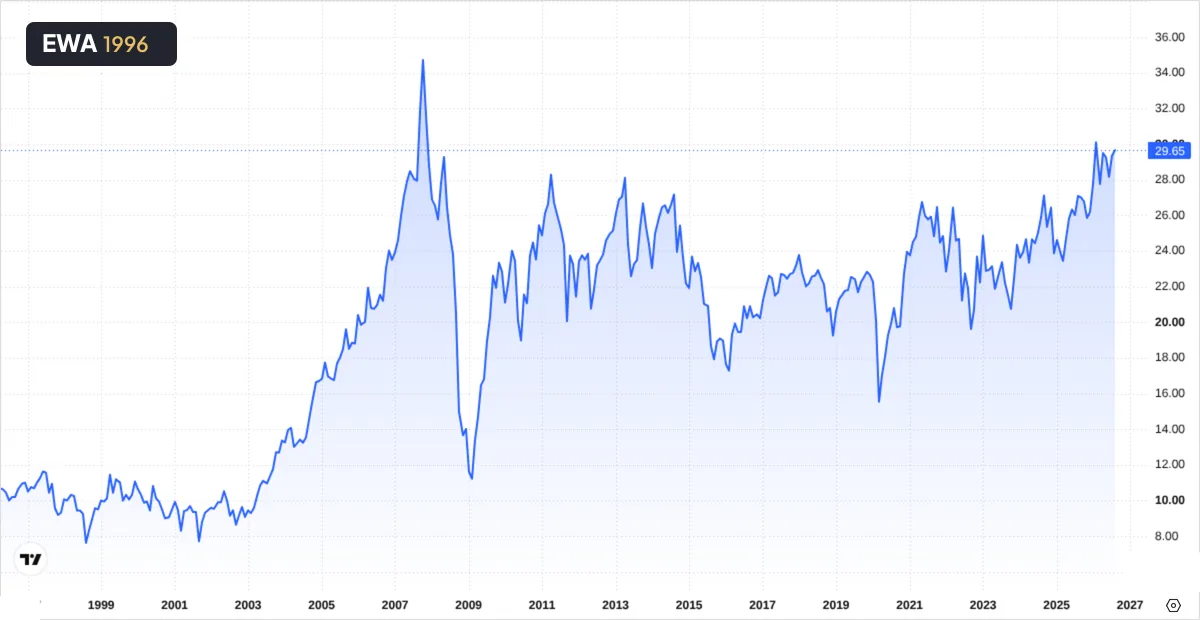 EWA share price since 1996. From the 2007 peak the price went practically nowhere for nine years.
A chart like that gives a return of around 3.5% a year, and that is precisely the figure then quoted as the fund’s return. But Australian shares are among the most generous dividend payers in the world: in its fact sheet as of June 30, 2026, BlackRock reports 7.67% a year since inception with dividends reinvested. Over thirty years that is the difference between roughly three times and nine times the capital invested.
The higher the dividend, the bigger the gap between the price chart and the fund’s real return.
SPY and MDY are not ordinary funds
Both of the older American funds use a legal form that today’s ETFs hardly ever use: the unit investment trust. Their prospectuses forbid them to lend securities, borrow money, trade on margin, sell short or hold derivatives.
Two things follow from that for the investor. Competing funds on the same index offset part of their costs with income from securities lending, and SPY does not — so the real gap to cheaper rivals is wider than the expense ratio alone suggests. And dividends from the shares held sit, per the prospectus, in a non-interest-bearing account until the quarterly payout, so in a rising market the fund lags the index by a fraction.
MDY offers dividend reinvestment through the clearing system; SPY has no such provision in its prospectus, and the broker has to arrange it.
How much would an investor have made? You cannot work it out this way
Articles of this kind almost always add a table showing what regular monthly contributions would supposedly be worth today. The arithmetic in such a calculation is fine. The problem is what it leaves out.
The exchange rate. The funds are denominated in dollars, but the investor pays in a home currency and therefore carries the entire currency result. If the home currency strengthened against the dollar by roughly a quarter over that period, it takes about 1.2 percentage points a year off the return and about a fifth off the modelled final value. The reported “profit” falls by a quarter, because the contributions stay the same.
The sequence of returns. For a lump sum the average annual return is exact and the order does not matter. For regular investing that no longer holds, because each payment lands on a different stretch of the series. Two series with the same average can, with identical contributions, end up almost seven times apart, depending on whether the good years come early or late.
Costs and taxes. SPY’s expense ratio alone takes around two percent off the result over three decades, withholding tax on American dividends adds another five, and on top of that come broker fees and the spread on currency conversion.
A number from such a model is therefore not an estimate but one particular scenario — and, as it happens, a better one than most real paths turn out to be. Anyone who wants to compare honestly will find the costs broken down in the article on ETF holding costs, or can work them out in the fee calculator.
Europe arrived a decade later
Europe’s first ETFs had to wait until April 11, 2000. That was when the Frankfurt exchange put them into its new XTF segment — two funds tracking the EURO STOXX 50 and STOXX Europe 50 indices. Both still exist, only under the iShares name now. The London exchange followed two and a half weeks later, the Swiss one in the same year.