
The first session on the Warsaw Stock Exchange took place on 16 April 1991. Five privatised state companies were traded, seven brokers stood on the floor, 112 orders were placed, and the whole day added up to 1,990 zloty — roughly two thousand dollars at the time.
Today the main market lists 403 companies, and in July 2026 alone shares worth 58 billion zloty changed hands here. That is around twice what the Prague exchange manages in a full year.
From five companies to the largest market in the region
The founding act was signed by the ministers of privatisation and finance on 12 April 1991, and trading began four days later. From the start the exchange had two jobs at once: to be a market and to be an instrument of privatisation. The companies arriving on it belonged to the state, and their flotation was the way of passing them into private hands.
At the turn of the millennium the exchange moved into its own building on Książęca street in central Warsaw, where it sits to this day. And on 9 November 2010 it did something most exchanges never do — it listed on its own market. Its shares have traded under the ticker GPW ever since and belong to the mWIG40 index.
How big the GPW actually is
Capitalisation is easy to get wrong here, because two different figures are quoted side by side. Polish companies on the main market were worth 1,420 billion zloty as of 14 August 2026. Add the foreign issuers and the total comes to 3,037 billion. Foreign companies account for more than half of it.
In the region the GPW has no competitor. The Vienna exchange stood at around 96 billion euros in its domestic segments. Polish companies on the GPW are worth 329 billion in the same terms, three times as much.
An average session on the GPW in 2026 tops 2.5 billion zloty. For comparison: in 2015 it was just under a billion, and in 2020 around 1.2 billion. Turnover on the Polish market has tripled over the past ten years.
The indices that measure the Polish market
The exchange runs plenty of indices, but two of them get mixed up most often.
WIG is the oldest. It is calculated from the day of the first session, 16 April 1991, when it started at one thousand points. It covers practically the whole main market and it is a total return index — besides price moves it counts in dividends and income from subscription rights. Weights are derived from free-float shares rather than the full value of the company, and caps apply: a single company at most ten percent, a single sector at most thirty percent.
WIG20 is younger, calculated from 16 April 1994, and it tracks the twenty largest and most liquid companies on the main market. Unlike WIG it is a price index; dividends do not enter it. It is also the underlying for exchange-traded derivatives — WIG20 futures and options rank among the most heavily traded instruments on the GPW.
Anyone comparing the long-run performance of the Polish market with the American one and reaching for WIG20 is comparing apples with oranges: US indices are normally quoted with dividends included, WIG20 is not. That is what WIG20TR exists for — it counts dividends in and is calculated from December 2012, with the series backdated to 2004.
The rest of the market is covered by mWIG40, with forty mid-sized companies, and sWIG80, with eighty smaller ones. Both are price indices, built so that they do not overlap — a company from WIG20 cannot sit in mWIG40.
WIG20 cleared its 2007 peak only this year
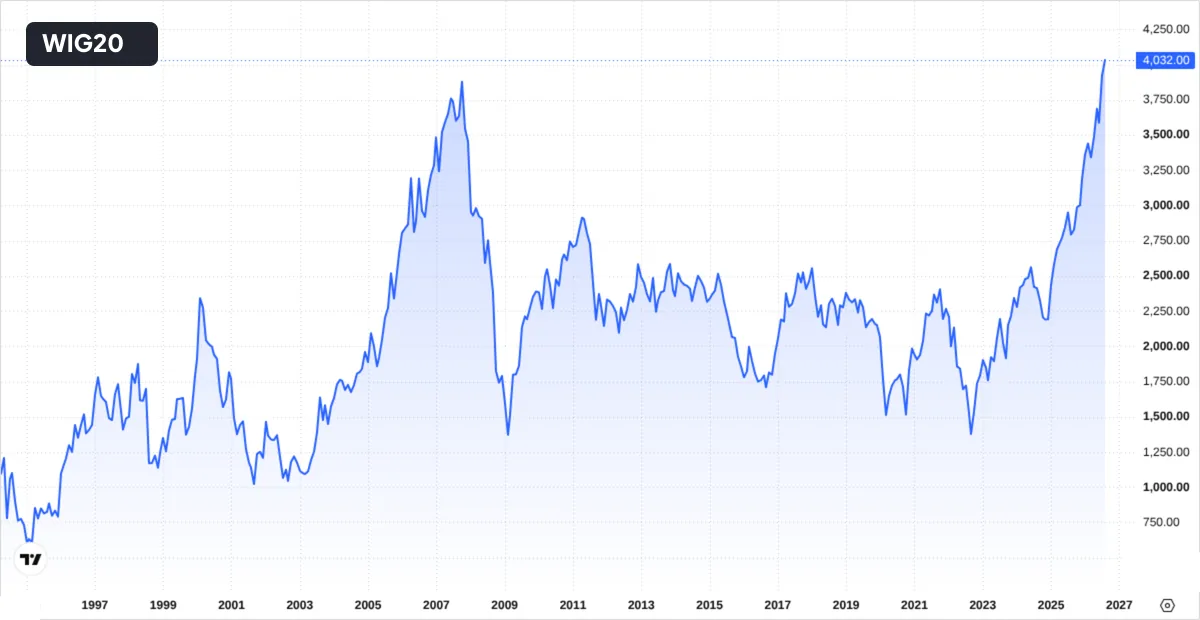 The WIG20 index since 1995. Nineteen years separate the 2007 peak from the new high.
WIG20 climbed to almost 3,900 points in mid-2007, then the financial crisis arrived and the index lost more than half its value. For the next fifteen years it moved inside a range it could not break out of, and in 2022 it was back at levels last seen in the late nineties. It rose above the 2007 peak only in the summer of 2026.
Deciding to buy Polish shares is therefore not the same thing as betting on uninterrupted growth in the region.
The companies that define the market
The structure of the GPW differs from that of Prague. Alongside banks and energy, which form the backbone of both markets, there is a large games studio and fast-growing retail — neither of which Prague has.
| Company | Price | Change | Change % | Market cap |
|---|---|---|---|---|
| Powszechna Kasa Oszczednosci Bank Polski | 124,00 PLN | +0,62 PLN | +0,50 % | 155,00 mld. PLN |
| ORLEN | 146,06 PLN | -0,52 PLN | −0,35 % | 169,57 mld. PLN |
| Powszechny Zaklad Ubezpieczen | 71,30 PLN | -0,44 PLN | −0,61 % | 61,57 mld. PLN |
 Bank Polska Kasa Opieki Bank Polska Kasa Opieki | 280,90 PLN | +4,60 PLN | +1,66 % | 73,73 mld. PLN |
 Dino Polska Dino Polska | 35,07 PLN | -0,34 PLN | −0,96 % | 34,38 mld. PLN |
| LPP | 24 840,00 PLN | -180,00 PLN | −0,72 % | 46,17 mld. PLN |
| KGHM Polska Miedz | 329,55 PLN | +6,55 PLN | +2,03 % | 65,91 mld. PLN |
| PGE Polska Grupa Energetyczna | 15,14 PLN | +0,87 PLN | +6,10 % | 33,97 mld. PLN |
 CD PROJEKT CD PROJEKT | 254,00 PLN | +5,30 PLN | +2,13 % | 25,38 mld. PLN |
| Asseco Poland | 219,00 PLN | -2,40 PLN | −1,08 % | 17,63 mld. PLN |
| Tauron Polska Energia | 9,22 PLN | +0,24 PLN | +2,65 % | 16,16 mld. PLN |
 Budimex Budimex | 669,40 PLN | -0,60 PLN | −0,09 % | 17,09 mld. PLN |
| Alior Bank | 137,70 PLN | +0,90 PLN | +0,66 % | 17,98 mld. PLN |
| Enea | 21,44 PLN | +1,24 PLN | +6,14 % | 11,36 mld. PLN |
| Cyfrowy Polsat | 16,04 PLN | +0,08 PLN | +0,47 % | 8,83 mld. PLN |
 Kruk Kruk | 375,50 PLN | -3,20 PLN | −0,84 % | 7,34 mld. PLN |
| Globe Trade Centre | 2,36 PLN | +0,00 PLN | +0,00 % | 1,36 mld. PLN |
Quotes are indicative and delayed.
Prices from the Warsaw Stock Exchange, loaded live.
The two heaviest names in WIG20 are PKO Bank Polski (ticker PKO), the largest Polish bank, and Orlen (PKN), the petrochemical and energy group that owns refineries as well as a network of filling stations in the Czech Republic. Both are so large that the exchange caps their index weight at fifteen percent.
Behind them come Bank Pekao (PEO) and the insurer PZU — two more names in which the state holds a significant stake. That ownership structure is typical of Poland and worth allowing for, because at companies with the state behind them politics plays a part too, for instance when a dividend is being decided.
Among the private companies there are CD Projekt (CDR), the studio behind The Witcher and Cyberpunk, the clothing group LPP with its Reserved and Sinsay brands, the Dino Polska (DNP) retail chain and the copper producer KGHM (KGH).
How to buy shares on the Warsaw Stock Exchange
Not every broker lets you onto the GPW. Among those we follow, XTB has the access documented — it is a Polish firm based in Warsaw, supervised by the Polish regulator, and it lists Polish shares among the markets it offers.
There is one peculiarity: access to Polish names has to be switched on separately at XTB. The client signs a document opening up Polish shares and sends it to support. It carries no fee, but after three months without activity the access is automatically blocked.
The purchase itself is then commission-free up to a monthly turnover of 100,000 euros; above that limit it costs 0.2% with a minimum of 10 euros. XTB keeps investment accounts in currencies including euros and dollars, but shares on the GPW are quoted in zloty. You pay the conversion on every trade, and XTB charges 0.5% of its own rate for it.
Alongside real shares, brokers also offer CFDs on Polish names. That is a different thing — a leveraged derivative where you own no share and receive no dividend. If you want to hold Polish companies, it has to be a purchase of the actual share.
Trading is risky. Invest responsibly.
What to keep an eye on
Currency. If your account currency strengthens against the zloty, it takes something off your return even when the share itself gains. Exchange rules do allow another freely convertible currency, and euros are genuinely traded on the Catalyst bond market, but for shares the zloty is the only option today.
Liquidity outside the blue chips. Trading is smooth in the twenty largest names, but the further you go from WIG20, the thinner the market. In smaller companies the gap between the buying and the selling price can cost more than the commission.
How much of the return costs eat up. How to add the conversion, the commission and the cost of the product itself together is set out in the article on fund and ETF costs.