
Hedging means opening a second trade alongside an existing position, one that moves as its mirror image: what one side loses, the other gains. A refinery locking in the price of oil three months ahead uses it, and so does a trader who does not want to close a position over the weekend.
It is a technique with a clear purpose and a clear price. When either of those is unclear to you, closing the position is usually cheaper — and that is the hardest decision hedging asks of anyone.
What hedging is
Buying or selling derivatives (options or futures, for instance) in order to limit or neutralise all or part of the risk of owning another security. In other words, against an open position you enter a trade on the derivatives market whose profit or loss mirrors that position.
Imagine you are a refinery that has to buy a large amount of oil in three months. Your goal is not to buy as cheaply as possible but to know in advance what you will pay — a quarterly budget is built from figures, not from guesses. So you open a long position on the exchange.
If the price rises over those three months, you buy the oil more expensively, but you have made money on the exchange position and the difference evens out. If the price falls, you buy more cheaply but lose that difference on the exchange. Either way you end up at roughly the price you locked in. That is the whole point of a hedge: in exchange for certainty you give up the chance that it turns out better. In practice basis risk and the cost of rolling the contract come into it, but as an example this will do.
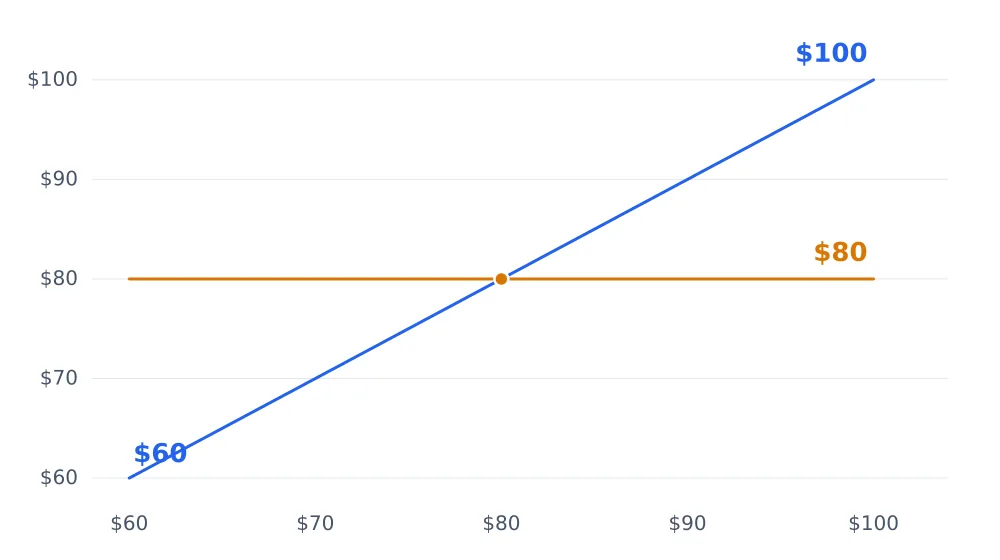
The chart shows it best. The blue line is what the refinery would pay per barrel with no hedge — it tracks the market. The orange line is the price after hedging at eighty dollars: whether the market climbs to a hundred or drops to sixty, the bill is the same.
How hedging positions is used in trading
In several ways. First, it has to be said that this technique is for someone with experience who knows what they are doing.
The position sits in one place for a long time – For whatever reason the contract moves up and down by, say, 50 points and cannot break out of that channel. That is an opportunity to hold both positions and earn on the daily swings in both directions. The technique is used on markets that move slowly and have a narrow daily range.
We want to freeze the position for a while – You believe the euro is going up. You are in profit but do not want to take it yet, and your stop-loss sits further away within the range. You do not want to give up your gains, yet you also believe there is more to come. Say you are going on holiday and cannot watch the markets for a week. So you open the opposite position and freeze it. When you come back you have to look at it all again: either you close both as they are — keeping the original profit — or you try for a better result.
As a substitute for a stop-loss – The same as above, except that you keep watching the market. Because you believe oil will rise, instead of an SL you open the opposite position. When the market turns against you, one position earns while the other goes into the red. The idea is to get the hedged position into profit and wait for the market to turn your way. This one is used in the opposite conditions: on volatile markets where a normal SL throws you out immediately.
Here you have to be precise, because it trips up people who have been trading for years: a lock does not limit the loss, it freezes it. The difference between the two positions stays exactly as it was at the moment you locked, and does not change — except that swaps keep draining from both legs and the margin stays tied up. A stop-loss closes the position and frees the money; a lock does not. And if the equity on the account falls to half the initial margin, the broker closes the positions itself, locked or not.
A HEDGE is a risky business – only use it if you genuinely understand the strategy.
And the advantages
When you know what you are doing, a lock works where a normal stop-loss would throw you out of the market — before data releases, overnight or over the weekend, when the market gaps open and the stop-loss fills at a worse price than you set. The position stays open and you have time to decide with a cool head. You blunt the short-term move against you without having to end the trade.
What is not true, however often forums repeat it, is that this gives you two contracts for the price of one. Whether a broker holds full, half or no margin against a locked position varies from platform to platform — it is their commercial term, not a rule of the market, and it belongs to the things you check in the instrument specification before building a strategy on it.
Note: not every broker allows hedging. Ask yours first whether this technique is available to you.
This is not just a broker’s whim. In the United States, holding opposing positions in retail forex is prohibited: NFA Rule 2-43(b), in force since 2009, requires positions to be closed on a first-in, first-out basis, that is in the order they were opened — the US regulator argued at the time that the economic benefit of such a strategy is minimal at best, because the two transactions cancel each other out. Platforms with so-called netting accounts offset the opposite position against the existing one for the same reason, instead of running it alongside.
The downsides and the risks
The biggest enemy, as usual, is your own head. If you know why you are opening the opposite position and you have a plan, fine. The hard part is what to do next once the hedge position is in the profit you expected — say 500 points. In one case the market bounces back and you start earning on the other side too; that was the goal. But it can also keep moving against you. And then you have exactly two options.
Close everything and take the result you had when you locked, or keep hedging. This is where the psychology starts. You must not go by the “logical” move (it cannot go any lower or higher, it is at the high…) but simply open the next opposite position.
If you cannot handle that, a strategy that was originally profitable can turn into one large loss.
Then there are the costs, easy to calculate and still forgotten. A lock means a second spread on entry, a second on exit and swaps on two positions instead of one — on a currency pair the swap is usually asymmetric on the two sides, so merely holding the lock tends to cost money every day. Locking a position for a week of holiday is negligible. Locking it for three months costs more in indecision than the original paper profit was worth.
Other ways to hedge risk
A lock on the same instrument is only one option, and not always the most sensible. You can also hedge in ways whose price is fixed from the outset.
With an option as insurance. You hold shares and fear a drop: buying a put option fixes the price at which you can sell. If the market falls, the option pays; if it does not, the option expires worthless and you have paid the premium — exactly like insurance on a car you never crashed. The advantage over a lock is decisive: you know the maximum cost in advance and the upside stays open. Anyone who does not want to pay the premium out of pocket sells a call above the market on top of it and funds the put that way; that is called a collar, and its price is giving up gains above a certain level.
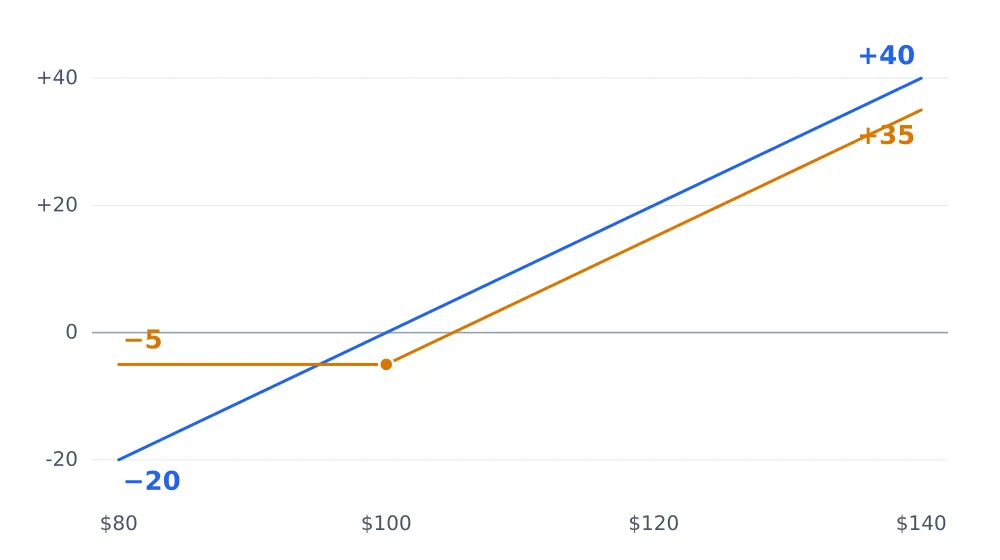
Illustratively: a share at a hundred dollars with a put at the same strike for a five-dollar premium. The blue line is the share on its own, the orange one the share with the option — on the downside the loss stops at the premium paid, on the upside orange trails by exactly those five dollars. That is the entire cost of the insurance.
By hedging currency risk. A euro-based investor buying US shares holds two bets at once: on the share and on the dollar. A stronger euro can wipe out a decent equity return. There are two solutions: a currency-hedged share class of a fund or ETF (the name usually says “EUR hedged”, and the hedge is paid for in the fee), or a short position on the currency pair matching the portfolio value. For long-term investors the first is simpler, because nothing has to be adjusted.
With a cross hedge through an index. You hold ten US shares and a turbulent week is coming. Closing them all is expensive; instead you open a short position on the index closest to your portfolio. It will not cover the risk of one specific company — if one of them disappoints on earnings, the index will not save you — but it dampens the market move. Position size follows the portfolio value, not the number of shares.
With a forward, in business. The original home of hedging is not speculation but an ordinary company. An importer paying an invoice in dollars in ninety days agrees a forward with the bank at a fixed rate and thereby fixes the cost of goods on the day the contract with the buyer is signed. An exporter does the same in reverse. Nothing is being speculated on; one unknown is simply removed from the budget.
With futures on commodities. A farmer sells a wheat contract before the harvest; an airline buys fuel contracts a year ahead. Exactly the same logic applies as with the refinery at the start: the hedge does not bring a better price, it brings a certain one. When the market moves favourably, the hedger earns less than the one who did not hedge — and that is part of the deal, not a flaw.
When hedging makes no sense
There is one question that dissolves most locks before they are opened: why do I not simply close the position? When the answer is “because I would have to admit the loss”, this is not a hedge but a postponement. A lock solves nothing in that situation, it only extends the time over which the decision is deferred — and charges swaps for the privilege.
Hedging makes sense where you cannot or do not want to close the position for a substantive reason: a long-term investment you do not want to sell down over one week, a company contract signed in a foreign currency, or a physical commodity you hold. In every other case it is cleaner to close half the position, move the stop-loss and leave it at that.
NFA rules verified as of August 2026 against the National Futures Association rulebook; margin terms follow each broker’s own documentation.