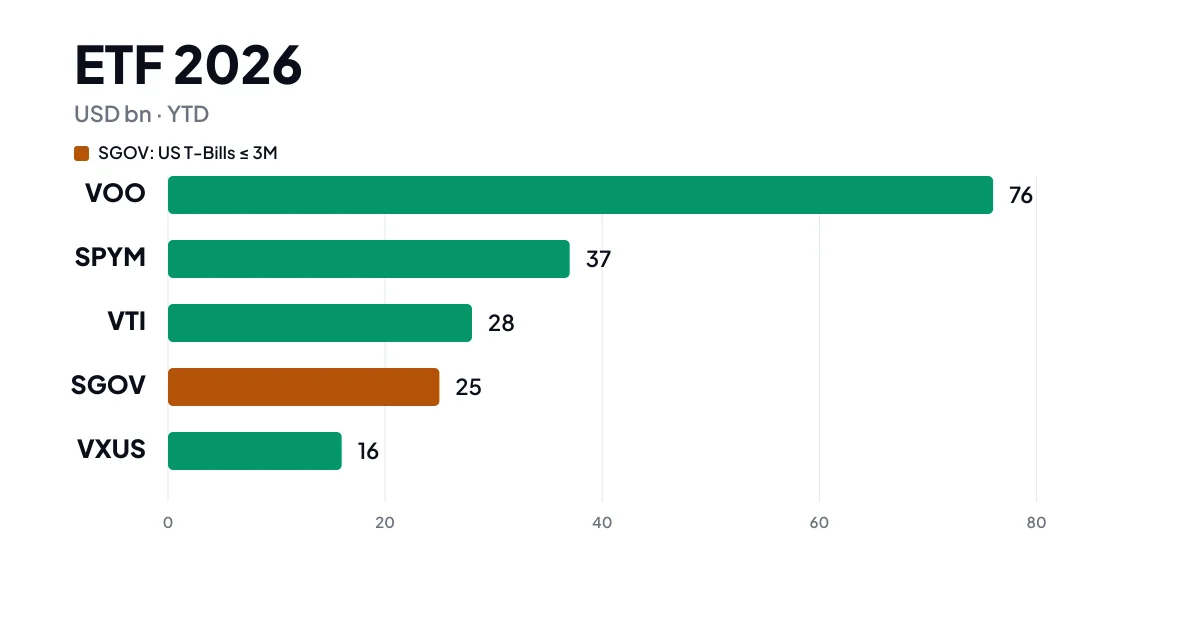
US ETFs have taken in roughly $1.3 trillion since the start of 2026. The one-trillion mark was passed back in June.
One name stands apart in that. The Vanguard S&P 500 ETF became the first ETF ever to hold more than a trillion dollars in assets, on 2 June 2026, and it also leads this year’s inflows.
The five ETFs with the largest inflows in 2026
| Rank | Fund | What it covers | Net inflow 2026 |
|---|---|---|---|
| 1 | Vanguard S&P 500 ETF (VOO) | US shares, S&P 500 index | $76bn |
| 2 | SPDR Portfolio S&P 500 ETF (SPYM) | US shares, S&P 500 index | $37bn |
| 3 | Vanguard Total Stock Market ETF (VTI) | The whole US stock market | $28bn |
| 4 | iShares 0-3 Month Treasury Bond ETF (SGOV) | US Treasury bills up to 3 months | $25bn |
| 5 | Vanguard Total International Stock ETF (VXUS) | Shares outside the United States | $16bn |
This is net inflow since the start of the year, deposits minus withdrawals. It says nothing about how the funds performed.
The fight for second place is a fight over one hundredth of a percent
Whether IVV or SPYM ends up second, both track exactly the same thing: the S&P 500. Their portfolios are practically indistinguishable and performance differs only marginally.
The difference is the price. SPYM from State Street charges 0.02 percent a year, iShares Core S&P 500 and Vanguard S&P 500 both charge 0.03 percent. One hundredth of a percent sounds like nothing; on $100,000 it is ten dollars a year, and at billion-dollar volumes it becomes the reason money moves from one manager to another.
In size the funds are not yet comparable. IVV manages 901 billion dollars, SPYM 157 billion. But SPYM is growing faster, precisely because of the fee.
Bitcoin dropped out of the five
IBIT finished last year fifth with just under 25 billion. This year it did not make the top five.
That does not mean bitcoin funds have lost their audience. More that the first rush after spot bitcoin funds launched was exceptional, and inflows like that do not repeat every year.
Why money pours into a fund that buys no shares
SGOV holds US Treasury bills maturing within three months. It currently has twenty-four of them in the portfolio. Its assets are approaching a hundred billion dollars, even though the fund has only existed since May 2020.
It is not an investment in the usual sense. It is where money waits. Anyone holding cash in a brokerage account who does not want to leave it sitting there buys SGOV and collects the short-term government rate. It can be sold at any point during the trading day.
Its permanent presence in the five is therefore a decent gauge of how much money is waiting on the sidelines.
The 0.09 percent annual fee is three times what the equity funds in the table charge. For an instrument meant to stand in for cash, that is not trivial.
How the funds differ
VOO, SPYM and IVV track one and the same index, the S&P 500. They differ in fee and provider. That three of the five places go to funds on large US companies shows where the bulk of the money still heads. What that index delivers over the long run is a separate story, told in the piece on the average annual return of the S&P 500.
VTI goes wider still. It holds around 3,500 stocks, effectively the entire US market including smaller companies. It manages 696 billion dollars and has been running since May 2001, twenty-five years that include two major crises.
VXUS is its counterpart for the rest of the world. It holds shares in developed and emerging markets outside the United States and tends to be the second half of a two-fund portfolio.
SGOV does not belong in this company by its nature. The other four are investments, this one is a waiting room.
How last year finished
The running numbers will still move, the closed statistics for 2025 will not. And they are worth comparing.
US ETFs took in $1.48 trillion over the whole of last year, more than in any year before. The five looked like this: VOO with 143 billion, still the largest annual inflow any ETF has ever recorded, iShares Core S&P 500 with 78 billion, VTI and SGOV with 39 each, and the bitcoin fund IBIT with 25 billion.
Two things follow from that comparison. VOO led last year and leads this year, and its lead is not narrowing. And SGOV is in the five two years running, so the cash parking lot is not a one-off.
What it adds up to
The strongest message in that table is boring. The overwhelming majority of new money goes into a handful of broad, cheap, long-established funds. None of them is thematic, none bets on a single sector.
The second message is more cautious. When twenty-five billion piles into the cash parking lot, it means a large share of investors do not want to be fully invested.
And third: an inflow is not a recommendation. It shows where other people are sending money, not what will earn it. The fastest growing fund of the year can also be the one that arrived after the biggest run-up.
For most people what the table implies still holds: one broadly diversified fund with low ongoing costs is usually enough. Complexity in a portfolio does not raise returns on its own.
Inflows are running figures from the start of 2026 into the summer. Fund assets and fees are as of August 2026 and come from the individual fund fact sheets.