Investment plans are XTB’s answer to the hardest part of long-term investing, which is discipline. Instead of placing orders by hand every month, you set the composition of the portfolio, the amount and the frequency once, and the system then does the buying for you. In mid-August 2026 the plans went through their biggest rebuild since launch. Alongside ETFs they now take individual stocks, and ready-made portfolios have been added.
What investment plans are
An investment plan is an automated system for regular buying. You pick the assets, set the percentage weight of each one and choose how often and how much you want to invest. The platform then splits the deposit according to those weights and places the orders without any further input from you.
Plans have no fee schedule of their own. The same rules apply as for ordinary stocks and ETFs at XTB, meaning no commission up to a monthly volume of 100,000 EUR. You can run several of them side by side, for example one long-term plan for retirement and a shorter one for a specific goal.
For a long time only ETFs, meaning exchange traded funds, could go into a plan. The rebuild in mid-August 2026 lifted that restriction.
What the plans can do
A low entry point. You can invest from fifteen euros. The product is not aimed at large portfolios but at putting smaller amounts aside regularly.
Flexible management. You can edit a plan at any time, add more assets, pause it or close it. Nothing locks you in and nothing costs extra.
Automated purchases. The system places the orders itself at the frequency you set, so the monthly routine disappears along with the temptation to put a purchase off.
Transparent fees. Plans have no fee schedule of their own, the same rules apply as for ordinary stocks and ETFs at XTB. Opening, holding and managing a plan are free.
Several goals side by side. You can hold up to ten plans on one account, so long-term retirement saving can be kept apart from a nearer goal or from investing for your children.
Stocks in plans and custom allocation
A plan now takes individual stocks as well and you can combine them freely with funds. According to XTB you can choose from more than 3,400 stocks and 1,900 funds. You set the weight of each item in percent, and a single position may make up 5 to 100 percent of the whole.
XTB applies three limits and it pays to know them in advance. One plan holds at most 20 instruments, one account can hold at most 10 plans, and if the weights do not add up to a hundred percent, the rest of the money stays on the plan account as uninvested cash. It does not top itself up.
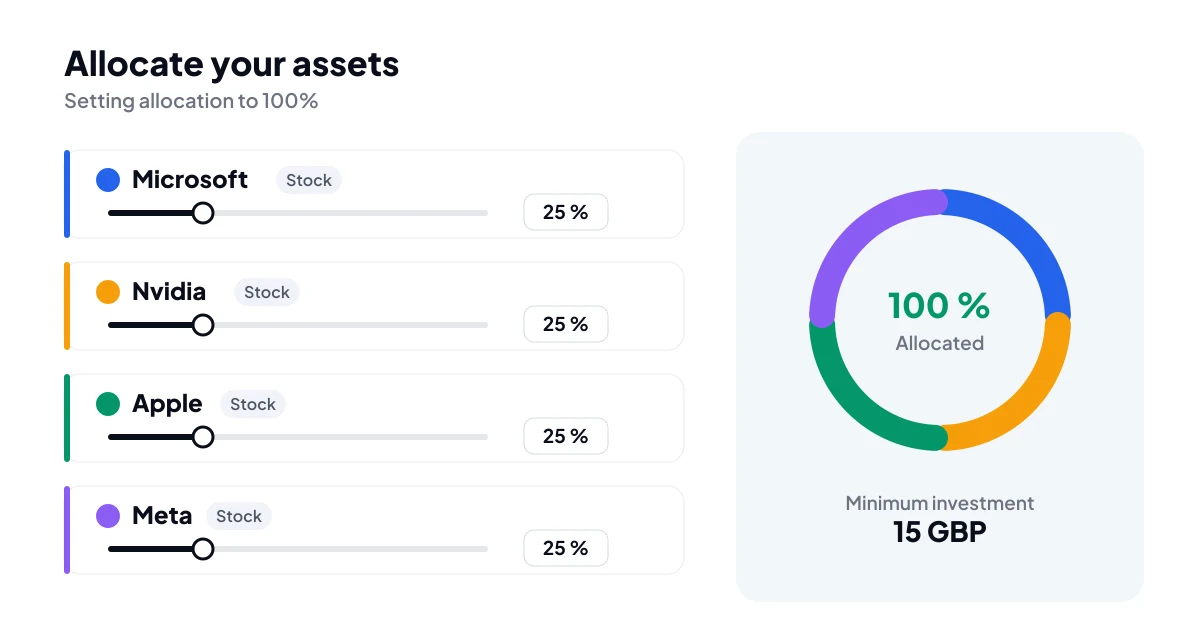 Building your own plan: every item gets a weight in percent and the minimum per plan is 15 EUR. Own illustration redrawn from the XTB app interface.
Ready-made portfolios
If you do not want to pick item by item, you can reach for a finished template. The first group is five Global plans built from equity and bond ETFs and graded by risk level, from conservative through balanced, dividend and growth to dynamic.
The second group is three Sector plans: semiconductors, defence and aerospace, and large technology companies. Expect a different character from the global templates. A bet on a single industry means concentrating risk rather than spreading it, and these plans carry the highest risk rating on the scale.
How to set up a plan step by step
- An account with XTB. You will find the plans in the mobile app and on the desktop platform. If you do not have an account yet, you can open one online. Registration includes an identity check, so have your ID document ready.
- The investment plans section. Open the investment plans section in the app. Right at the start you choose between two routes: your own allocation, or a finished template.
- Picking the assets. With your own allocation you go through the range of funds and stocks. For each one you can look at the composition, past performance and costs, which is worth doing before you buy rather than after. With a template this step falls away and you only choose a plan by risk level.
- Splitting the weights. You assign each item a share in percent. One item can take 5 to 100 percent and a plan may hold at most twenty of them. Watch that the total comes to a hundred, otherwise the remainder will sit there as cash.
- Amount and frequency. You set how much and how often to invest. The minimum per plan is 15 EUR, but the real floor depends on what you have picked and at which weights. There is more on that below.
- Checking the currency. Before you confirm the plan, check its currency. It is tied to the currency of your main account and you cannot change it later. Buying securities in another currency brings a half a percent markup in the exchange rate.
- Going live. Once confirmed, the plan runs on its own. The first purchase takes place at the frequency you set.
- Managing and tracking. You can see the composition and the performance directly in the app. A plan can be edited, extended with more assets, paused or closed at any time, and you can open another one alongside it.
XTB S.A. enables automatic, regular placement of orders to buy financial instruments or fractional shares in line with the investment plan you have created. Investment decisions, including the allocation of funds, the frequency and size of payments and the placing of orders, are entirely up to you. Investing carries risk. Invest responsibly.
The 15 EUR minimum applies only sometimes
This is the most common unpleasant surprise. Fifteen euros is a floor, not a guaranteed figure. The real minimum is worked out from the sum of the minimum amounts needed to buy each of the selected instruments at the weights you have set.
XTB gives its own example. If the fund you choose costs 50 USD and you give it a weight of 5 percent in the plan, the minimum deposit for the whole plan comes out at 1,000 USD. The more expensive the security and the smaller the weight you give it, the higher that minimum climbs. Anyone who wants to stay with small amounts needs either cheaper instruments or a higher weight for them.
Automated investing
Automated investing is the core of the whole product. You set the frequency and the amount and the system then buys on its own, without you opening the app every month and entering orders by hand.
The benefit is not only the time saved. Buying for the same amount regularly means you get fewer units when prices are higher and more when they are lower, so the question of the right moment falls away. Above all it works around the most common reason long-term plans fall apart, which is that people forget about them or skip a month during a nervous week.
The other side of the same coin is that the automation buys regardless of what is happening on the markets. A plan runs until you change it yourself, so a sell-off or a broad rally passes it by. For building a portfolio over years that is more of an advantage. For tactical buying, plans are the wrong tool.
Fees and limits
| Service / feature | Details |
|---|---|
| Minimum investment in a plan | 15 EUR |
| Weight of a single item | 5 to 100 percent, at most 20 instruments per plan |
| Fees for buying ETFs and stocks | no commission up to a monthly volume of 100,000 EUR, 0.2% above the limit (min. 10 EUR) |
| Number of plans per account | at most 10 |
| Opening and holding a plan | free |
| Currency conversion fee | 0.5% |
| Opening and maintaining an account | free for active clients |
Two things in the table are easy to miss. The 100,000 EUR limit is cumulative across all your accounts at XTB, so purchases inside a plan add up with your ordinary trading into a single monthly volume. These are not two separate limits. And the currency conversion fee is not charged separately, it is built into the exchange rate itself.
One more feature follows from that. The currency of a plan is tied to the currency of your main investment account and you cannot change it once the plan is open. If your account is held in one currency and you buy funds denominated in another, you pay that half a percent markup with every purchase.
A detailed look at the broker, including hands-on experience, is in the XTB review.
Who the plans make sense for
The biggest benefit goes to investors who put smaller amounts aside regularly and do not want to enter orders by hand every month. A plan takes both the deciding and the forgetting out of investing. Now that stocks are allowed, it also serves anyone who keeps adding to particular holdings of their own choosing.
It works as a tool for investing on behalf of children or for more distant goals as well. On the other hand, count on the automation buying to your settings whatever the markets are doing. A plan runs until you change it yourself. And with the sector templates, keep in mind that you are buying a narrow position in one industry, not a spread portfolio.
74% of retail investor accounts lose money when trading CFDs with this provider. You should consider whether you understand how CFDs work and whether you can afford to take the high risk of losing your money.