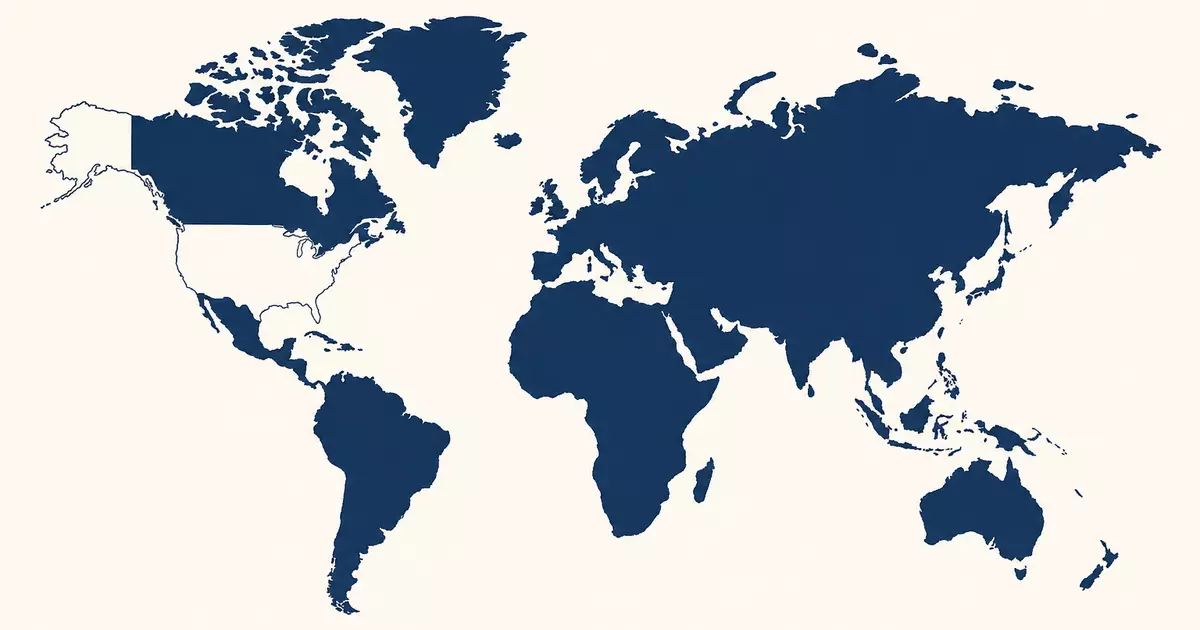
American companies make up 72% of the MSCI World index. Buy an ordinary global tracker and what you are mostly buying is the US market.
There are funds that leave the United States out altogether. They tend to be used by people who already hold American shares somewhere else and do not want a second helping of them. This piece starts with the funds themselves, then explains what is actually inside them and where they differ.
Which funds are available
Every fund below is a UCITS fund, which means it is European. That matters, because the American equivalents are off limits to you, and the last section explains why.
| Fund | ISIN | TER | Size | Dividends |
|---|---|---|---|---|
| Xtrackers MSCI World ex USA 1C | IE0006WW1TQ4 | 0.15% | €6.5bn | accumulating |
| iShares MSCI World ex-USA (Acc) | IE000R4ZNTN3 | 0.15% | €3.1bn | accumulating |
| Amundi MSCI World Ex USA Acc | IE00085PWS28 | 0.15% | €0.7bn | accumulating |
| UBS MSCI World ex USA acc | LU2807512947 | 0.09% | €0.4bn | accumulating |
| Xtrackers MSCI World ex USA 1D | IE000Z0FC0G5 | 0.15% | €0.2bn | distributing |
| Amundi MSCI World Ex USA Dist | IE0009BI8Z04 | 0.15% | €0.1bn | distributing |
| Xtrackers FTSE All-World ex US 1C | IE000YKHGYN2 | 0.15% | €0.05bn | accumulating |
TER is the annual charge. It comes out of the fund itself, so no bill ever lands on your doormat.
The index each fund follows is written into its name. The first six run on MSCI World ex USA. The last one runs on FTSE All-World ex US, and it is the only fund here that owns emerging markets.
An accumulating fund reinvests dividends for you. A distributing fund pays them into your account. The portfolio underneath is the same either way.
The very cheapest funds in this corner of the market sit a little lower still. BNP Paribas Easy MSCI World ex USA has a TER of 0.07%, but it runs only about €10 million. In a fund that small the gap between the buying and selling price tends to be wider, and that gap can swallow the saving on the charge. Alongside these there is a handful of funds that pick their own companies, from dividend and climate versions through to actively managed ones, with charges between 0.2% and 0.38%.
Ex-US does not mean the same thing twice
This is the trap in the whole category. The names look interchangeable. What sits inside can differ by tens of percent of the portfolio.
| Index | Countries | Companies | Canada | Emerging markets |
|---|---|---|---|---|
| MSCI World ex USA | 22 | 755 | yes | no |
| MSCI ACWI ex USA | 46 | 1,933 | yes | yes |
| MSCI EAFE | 21 | 672 | no | no |
| FTSE All-World ex US | 47 | 3,763 | yes | yes |
MSCI EAFE stands for Europe, Australasia and Far East. It drops Canada as well as the United States, so it is not the same thing as the world minus America. There is no European fund tracking it either, because every tracker that exists on that index is based outside the European Union.
The practical difference is simple enough. Funds on MSCI World ex USA hold developed markets only. If you want China, Taiwan, Korea and India in the same fund, the FTSE All-World ex US one is the only route.
What one of these funds actually holds
It is not the world spread out evenly. Japan carries by far the heaviest weight, a fifth of the MSCI World ex USA index on its own.
| Country | Weight |
|---|---|
| Japan | 20.47% |
| United Kingdom | 12.92% |
| Canada | 12.21% |
| France | 8.72% |
| Switzerland | 8.27% |
| all other countries combined | 37.41% |
The sector split is more revealing still. The American market is pulled along by technology companies. Here they barely feature.
Banks and insurers account for 28.36% of the index, industrial companies for 17.81%, and information technology for just 9.8%. Buy the world without America and what you are mainly buying is financial and industrial firms.
The largest holdings tell the same story. The heaviest company is ASML, the Dutch maker of the machines that make computer chips, at 2.56%, followed by HSBC at 1.46% and Roche of Switzerland at 1.23%.
For comparison, the biggest company in the American index, Nvidia, weighs 7.19% by itself. That is more than the three largest companies in the ex-US index put together. The risk of one dominant company overwhelming everything else does not really arise here.
Why the American funds are off the table
The United States has funds with the same remit and noticeably lower charges. Vanguard FTSE Developed Markets has a TER of 0.03%, Vanguard Total International Stock 0.05% and iShares Core MSCI Total International Stock 0.07%. They are in another league for size too. The biggest of them runs over $230 billion.
An ordinary investor in Britain cannot buy any of them through a regulated broker, and it has nothing to do with trading them being banned.
Two separate rules get in the way.
The first is about paperwork. Before a firm sells a fund like this to a retail client, it has to hand over a short standard document covering the costs, the risks and what the fund does. A retail client here means almost anyone investing their own money. Under the PRIIPs rules, which took effect in January 2018 while Britain was still in the EU, that document was the KID. The fund manager has to write it. American managers do not, partly because US law does not ask them to, and partly because the European format wants projections of future performance that they will not publish under their own regulator.
Britain has since moved on from PRIIPs. Since 6 April 2026 the domestic rulebook has been the Consumer Composite Investments regime, built on the Consumer Composite Investments (Designated Activities) Regulations 2024 and a new FCA sourcebook called DISC. The KID has been replaced by a document called a product summary. Firms may keep issuing PRIIPs KIDs instead until 8 June 2027, after which the product summary is the only option. None of that changes anything for American funds, because their managers produce neither document.
The second rule is the heavier one, and it applies whatever paperwork a manager produces. An overseas fund can only be marketed to UK retail investors if it is a recognised scheme, and getting there takes two steps. HM Treasury first has to decide that the fund’s home regime offers equivalent protection to investors. The individual fund then has to apply to the FCA for recognition. So far the Treasury has made that equivalence finding for EEA UCITS regimes only, back in January 2024. No such decision covers funds registered in the United States.
So the fund exists, trades every day and is entirely legitimate. Your broker simply is not allowed to offer it to you.
The charge is not the only number worth checking
Charges of 0.07% to 0.15% are tightly bunched in this category, and in practice the difference between them is small. Two other things usually matter more.
Fund size. A fund holding a few million euros trades thinly, and the gap between the buying and the selling price tends to be wider. You pay that gap every time you buy and every time you sell.
Currency. These funds are priced in euros or dollars, yet they hold Japanese, British, Canadian and Swiss shares. Those exchange rates move your result just as much as the share prices do. None of these funds offer protection against currency movements.
Cheaper than the US market, though the gap has narrowed
At 31 July 2026 the MSCI USA index traded at 27.11 times earnings and yielded 1.13% in dividends. The MSCI World ex USA index stood at 19.08 times earnings with a yield of 2.55%.
So the valuation gap is still there, but it is a good deal narrower than people had grown used to. Markets outside America are no longer cheap in the way they were two years ago, because their valuations have climbed a long way.
Look at the long run and you can see why American outperformance was talked about so much. Over the past ten years the MSCI World index, which includes America, returned 12.73% a year in dollars. MSCI World ex USA returned 9.54% a year over the same stretch. Both figures are after tax withheld on dividends at source.
The recent picture is different. In 2025 the MSCI World ex USA index gained 31.85% in dollars, and it added another 11.44% over the first seven months of 2026. Figures measured to any other date will look different, and past returns tell you nothing about future ones.
How people actually use these funds
A fund without America works as a component, not as a whole portfolio. It leaves out the largest share market on the planet, so by itself it does not spread your risk properly.
The usual reason for buying one is practical. Somebody who already holds the American market separately, through an S&P 500 tracker for instance, uses an ex-US fund to fill in the rest of the world. The balance between the two halves is then their own choice. The alternative is a single global fund, which is simpler to run, but then the market decides how much America you own.
You will also need a broker that lists these funds. Not every one carries the full set, and the smaller funds in the table are where availability varies most.