American depositary receipts, or ADRs, let you buy a foreign company on a US exchange, in dollars, through an ordinary UK broker. They are not shares in that company. An ADR is a certificate issued by an American bank against shares locked away at its custodian in the company’s home market.
The difference is not a formality. Legal title to the underlying shares sits with the bank, not with you. NIO says as much in the annual report it files with the American regulator. Holders of ADSs are not treated as shareholders and have no shareholder rights, because legal title to the shares belongs to the depositary, so the holder has to rely on the bank to exercise those rights on their behalf.
What an ADR actually is
The chain has five links.
The company strikes a deal with an American depositary bank. At Alibaba and TSMC that bank is Citibank, at Baidu it is BNY Mellon, at JD.com and NIO it is Deutsche Bank Trust Company Americas. The bank has the shares deposited with its custodian in the home market, in Alibaba’s case the Hong Kong branch of Citibank, and issues certificates against them. Those are registered in the name of the American clearing house DTC, which is where your broker holds them, and you sit at the far end of the queue as the beneficial owner.
That is why you have no voting rights, why you pay a depositary fee and why getting your hands on the underlying shares is anything but simple.
ADRs save you the currency exchange, not the currency risk
ADRs were created as a simpler route for investors who want to own foreign companies without dealing with the complications of buying shares on exchanges outside the US.
If you wanted to buy a foreign share with no ADR behind it, you would first have to change money into the foreign currency, the Japanese yen or the Chinese yuan. Then you would need an account with a broker that supports that exchange, and you would buy in the foreign currency. The whole thing would mean converting again on every sale and before every further purchase.
With an ADR all of that really does fall away. Settlement runs through the American systems.
Currency risk does not fall away with it. The price of an ADR is derived from the home price of the share, adjusted by the ratio and the exchange rate. If the Taiwan dollar weakens, the dollar price of TSM drops even if the share in Taipei has not moved at all. For a British investor there is a second layer on top of that, the pound to dollar rate charged by the broker.
Buy the local share directly and you carry exactly the same exposure.
The ratio that makes the price look wrong
One ADR need not correspond to one share. At four of the five companies below it does not.
| company | ratio | home listing |
|---|---|---|
| Alibaba | 1 ADR = 8 shares | Hong Kong 9988 |
| TSMC | 1 ADR = 5 shares | Taipei 2330 |
| JD.com | 1 ADR = 2 shares | Hong Kong 9618 |
| Baidu | 1 ADR = 8 shares | Hong Kong 9888 |
| NIO | 1 ADR = 1 share | Hong Kong 9866 |
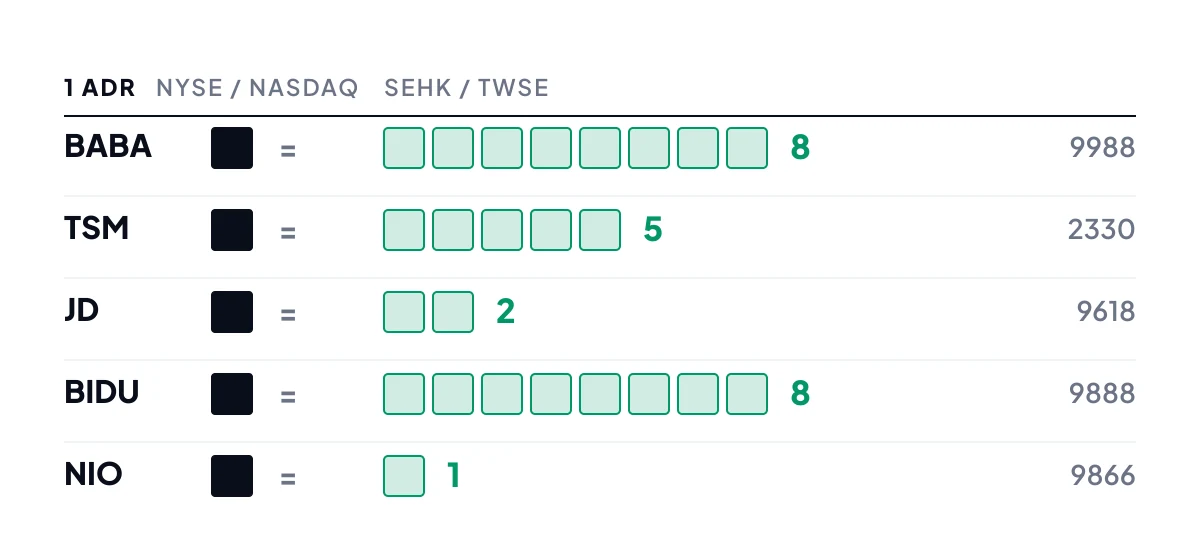
The black square is a single certificate on the US exchange, the green squares are the underlying shares on the home exchange. Alibaba and Baidu have eight of them behind one certificate, TSMC five. The code of the home listing is on the right. Source: the 20-F annual reports of these companies.
The price of an ADR equals the home price of the share multiplied by the ratio and divided by the exchange rate of the home currency against the dollar. Compare the price of TSM in New York with the price of 2330 in Taipei without dividing by five and you will conclude that the American line is five times more expensive.
The ratio can also be smaller than one. DiDi Global has four ADSs registered against a single class A share, so one certificate stands for a quarter of a share.
And the ratio can change without anyone asking you. Baidu has changed its ratio twice, most recently in March 2021 with a share split. Alibaba moved from one share to eight in July 2019. NIO states in its annual report that it can amend or terminate the deposit agreement without the consent of ADS holders. Anyone looking at a historical chart and seeing the price collapse by tens of percent may not be looking at a failing company at all, but at a change of ratio.
What the depositary takes
The bank that issued the ADR charges for looking after it. The American regulator puts it in round numbers, on 1,000 ADRs the fee can come to $20 to $50, which works out at $0.02 to $0.05 apiece. Fidelity quotes a range starting at one cent.
It is deducted from the dividend. Alibaba’s deposit agreement allows up to $0.05 per ADS. In practice Citibank charged $0.02 on the dividend paid in May 2026. When the company pays no dividend at all, as with NIO, the fee is taken straight from the account.
Add the conversion on top. XTB’s fee schedule adds a 0.5% markup over its own rate on every currency conversion connected with trading and with corporate actions, and eToro charges 0.75% in Europe to move money between the local currency and the dollar account.
Check with your own broker whether it passes the depositary fee on to you and how. The word ADR appears nowhere in the fee schedules of XTB or eToro.
Dividend tax is paid at home, not in the US
The dividend of a foreign company is not American income, even though the ADR trades in New York. It is withheld by the country where the issuer is based.
At TSMC that means the Taiwanese 21%. In the depositary’s dividend notice for TSM the Taiwanese tax is the only line, there is no American deduction at all. Alibaba, by contrast, shows no withholding tax whatsoever.
Form W-8BEN does nothing about any of this. It deals with American tax on American income. It will not cut the Taiwanese 21% or the German 26.375%, and it has no bearing on the depositary fee. Your broker wants it so that it can document that you are not a US person, and so that on genuinely American dividends it can apply the reduced treaty rate of 15% under the double taxation convention between the United Kingdom and the United States.
One more trap. When a broker holds shares in an omnibus account, it does not know who the ultimate owner is. XTB writes in its fee schedule that in such a case the payer of the tax has to apply the highest rate under local rules, for example 30% on American shares.
With Chinese companies you are not buying a Chinese company
Four of the five examples below are Chinese.
Alibaba spells it out in its own annual report. Investors in the ADSs and the shares are buying equity securities of a Cayman Islands holding company, not securities issued by the operating companies. Those Chinese operating businesses, the so-called VIEs, are according to the same report owned by Chinese citizens or Chinese entities rather than by Alibaba. The link between the holding company and the business is contractual, not one of ownership.
Then add political risk that has nothing to do with how the company trades. Under the HFCAA, the American regulator put Alibaba on the list of companies facing possible delisting in August 2022, because the American audit watchdog had no access to inspections in China. An agreement at the end of 2022 defused that and the inspections are running, but all four Chinese companies in this article are still audited by a firm based in mainland China. A memorandum from the American administration in February 2025 also ordered the VIE structure to be reviewed.
All four have since taken a secondary listing in Hong Kong, Alibaba in November 2019, JD.com in June 2020, Baidu in March 2021 and NIO in March 2022. Were a delisting from the American exchange to happen, the company would not vanish and its shares would carry on trading in Hong Kong.
When the programme ends
Deposit agreements allow for the programme to be wound up. Depending on the particular agreement, the bank usually gives 30 or 90 days’ notice. After termination the holder has the right to surrender the certificate and receive the corresponding number of underlying shares against payment of a fee and any taxes. Anyone who does not respond will have the shares sold by the depositary once the period set in the deposit agreement has run out, and will be paid the cash without interest.
For a small investor in Britain, collecting the underlying shares is a theoretical option at best. TSMC describes in its annual report what a non-resident needs for it: registration with the Taiwanese exchange, a local agent, an account with a local broker, a local custodian and a tax guarantor approved by the Taiwanese ministry of finance. Without those, the same document says, the holder can neither hold the shares nor transfer them later. On conversion into the Hong Kong line, Alibaba notes that normal delivery takes two business days, and fourteen outside the local settlement system, with the shares untradeable throughout.
Not every ADR is on an exchange
The claim that ADRs trade on the NYSE or Nasdaq holds only for a minority of programmes.
Level 1 trades exclusively off exchange, on the OTC market. The only thing filed for it is form F-6, which says nothing about the company itself. It contains the terms of the deposit agreement and legal opinions, nothing more. An exchange listing starts at level 2, where the company has to go through registration and file the 20-F annual report. Level 3 means a listing plus an issue of new shares.
On top of that there are unsponsored programmes, set up by a bank on its own without the company taking part. By definition those are OTC only, so you will not run into them on an exchange. According to Deutsche Bank’s 2023 overview, roughly 445 ADRs out of some 2,700 programmes were exchange listed, around one in six.
Anything listed on the NYSE or Nasdaq is therefore necessarily sponsored.
Advantages and drawbacks of ADRs
| Advantages of ADRs | Drawbacks of ADRs |
|---|---|
| Easy access on US exchanges | Currency exposure, which an ADR neither removes nor adds |
| Access to foreign shares from exotic markets | The company can be delisted from the American market |
Popular ADRs on US exchanges
By way of example, here are five of the better known foreign companies trading on American exchanges in ADR form. According to a review by the USCC, an American government commission, 286 Chinese companies were listed on US exchanges as of March 2025. Not all of them are ADRs, some have the shares of a foreign holding company listed directly.
| company | ticker | exchange | depositary |
|---|---|---|---|
| Alibaba Group | BABA | NYSE | Citibank |
| Taiwan Semiconductor | TSM | NYSE | Citibank |
| JD.com | JD | Nasdaq | Deutsche Bank |
| NIO | NIO | NYSE | Deutsche Bank |
| Baidu | BIDU | Nasdaq | BNY Mellon |
How to tell whether it is an ADR
Open the company’s latest 20-F annual report on the American regulator’s website and look at the list of registered securities on the cover page. It will say either American Depositary Shares or Ordinary Shares.
A foreign company on an American exchange does not automatically mean an ADR. Spotify files a 20-F as a foreign issuer, but the registered class is the ordinary shares themselves, which trade on the NYSE directly, with no certificate standing between the company and the investor.