Oil trading appeals to traders for many reasons, above all because of the role this commodity plays in the global economy. Crude oil, a naturally occurring mixture of hydrocarbon deposits, is a valuable feedstock for petrol, diesel and other petrochemical products. Part of what makes it so valuable is that it is not renewable, which makes it a scarce resource facing long-term growth in demand.
Oil matters to a whole range of industries, from transport to the manufacture of plastics, fertilisers, computers and even cosmetics. That is why it feeds into the price of almost everything. The best known grades of traded crude are West Texas Intermediate (WTI) and Brent, which differ in where they come from and in their physical properties.
Note: Every drop of oil carries energy that took millions of years to form — it is essentially solar energy captured by plants and animals in prehistoric times.
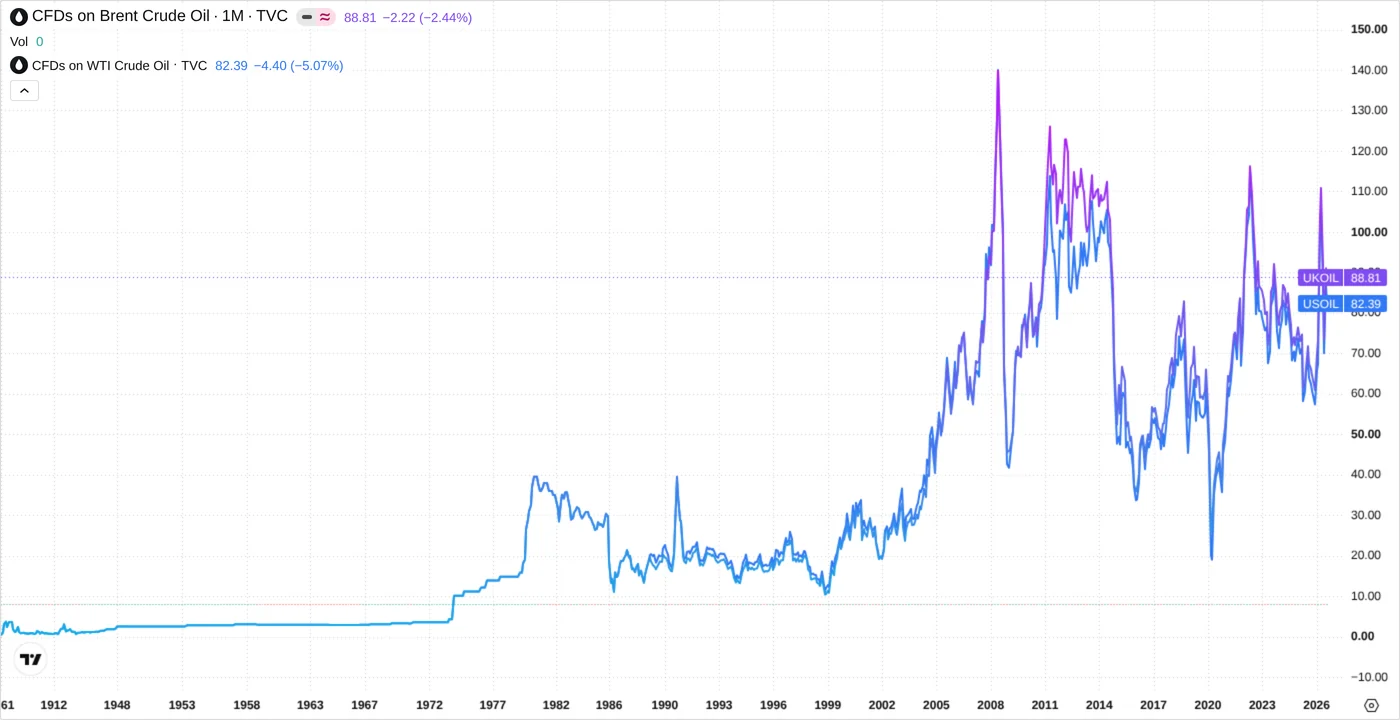
Brent (purple) and WTI (blue) in dollars per barrel, monthly data. For over a century oil traded in single-digit dollars; the violent moves only arrived with the oil shocks of the 1970s, the 2008 peak and the 2020 collapse. The two series track each other closely — the gap between them is a matter of dollars, not tens of dollars. Chart: TradingView, as at 16 August 2026.
What grades of crude oil are there
There are several grades of crude oil, each with different physical properties such as viscosity and sulphur content. Those properties determine whether the crude is light or heavy and sweet or sour, which in turn affects its price and how refineries use it. Each major region sets its own benchmark grade for tracking price moves.
- West Texas Intermediate (WTI) is a light, low-sulphur crude with an API gravity of around 40, which makes it much sought after in the United States.
- Brent crude comes from the North Sea and is also light, with properties similar to WTI but a slightly higher sulphur content.
- Dubai crude (or Fateh) is heavier and has a higher sulphur content, which makes it the “sour” variant. It serves as the benchmark for Middle Eastern crude.
- Urals is a heavier, sour crude and Russia’s main export blend.
- Bonny Light from Nigeria is a light crude popular with European and American refineries and used as the benchmark for African oil.
- The OPEC Basket covers a mix of grades produced in OPEC countries and tends to be heavier than both WTI and Brent.
Why try trading oil at all
Oil trading offers some investors specific advantages over conventional shares. Depending on the investment goal, oil can be used to diversify a portfolio, to hedge against inflation or for speculative trades.
Portfolio diversification
Oil gets added to portfolios because it does not move in step with shares. That only holds conditionally, though, and the condition can be calculated: a small position lowers overall portfolio volatility only when the correlation between the two assets is lower than the ratio of their volatilities. Oil swings roughly twice as much as an equity index, so the threshold sits at around 0.45.
The problem is that correlation is not a constant. Before 2008 it hovered near zero and the condition held comfortably. After the financial crisis it moved to roughly 0.3, and in the acute phase of the sell-off it jumped to 0.8. Above that threshold oil raises portfolio volatility instead of lowering it, so the diversification benefit disappears at precisely the moment it would be needed most.
A hedge against inflation
With oil, what matters is what is driving the inflation. In a supply shock it works well: in 2022 commodities were practically the only asset class in the black, while the S&P 500 shed more than 18%. In a demand-driven crisis the opposite applies. In 2008 oil fell from $145 a barrel to around thirty, more than three quarters, while the equity index lost about 37%. The scale of past price shocks is worth studying before treating oil as a safe haven.
Nor is oil independent of exchange rates. The Czech National Bank calculated that the correlation between returns on the price of Brent and the dollar exchange rate has been around −0.6 since 2007, and that a 1% weakening of the dollar goes hand in hand with a rise in the oil price of 2.1% on average. On top of the price move, an investor outside the dollar area also carries the move in their own currency against the dollar, the currency oil is quoted in.
Speculating on oil prices
Oil is known for its price volatility, though that reputation is usually overstated. The median absolute daily change in WTI works out at around 1.3%, and historically a move of more than 5% comes along on roughly one trading day in twenty. That is still more than an equity index, but a long way from the idea that oil moves a tenth of its value every day.
What is interesting is how those numbers change in a tense market. Since the closure of the Strait of Hormuz, the share of days with a move of more than 5% has more than doubled. It is exactly that unevenness that draws in speculators and institutional investors alike: a quiet spell offers few opportunities, and then a single geopolitical event delivers more of them at once than the whole preceding year.
eToro is a multi-asset investment platform. The value of your investments may go up or down. Your capital is at risk.
How to trade oil with minimal capital
Trading oil calls for a broader set of knowledge and more decisions than some other assets, because the market offers a range of instruments, from oil derivatives to shares in oil companies. Each of these routes has its advantages, but also its own risks and requirements.
Oil CFDs and leverage
One of the simplest ways into oil trading is the oil CFD (contract for difference). A CFD is an agreement between trader and broker on the profit or loss arising from the difference between the opening and closing price of a trade. CFDs let traders speculate on both rising and falling prices without owning any actual oil. They make it possible to trade oil without physical ownership, with the benefit of leverage, a low starting outlay and the option of practising on a demo account first.
Oil CFDs let a trader use leverage, which means controlling a larger position with less capital. At 1:10 leverage, for instance, the trader only needs to put up 10% of the position value. So if the oil CFD were priced at 100 USD, the trader could hold that position with 10 USD. This magnifies the potential profit, but the risk too — a small price move can have a marked impact on the outcome.
Leverage also means it is possible to start trading oil with relatively little starting capital, often just tens of dollars. That puts oil CFDs within reach of a wider group of traders. Even so, it is important to keep in mind that leverage amplifies losses as well as gains, and trading should always be done with a thorough understanding of the risks.
The 1:10 leverage is not an offer from any particular broker, it is a ceiling. It was set for retail clients by a 2018 decision of the European regulator ESMA, and from 2019 national regulators took it over as a permanent measure: the initial margin on commodity CFDs other than gold must be at least 10% of the position value. A broker may offer lower leverage, never higher. The cap applies at brokers regulated in the EU/EEA.
Two more rules come with the ceiling and are easily forgotten. Negative balance protection means a CFD account cannot lose more than the money held in it — and it is the whole account that counts, not the individual position. And once account equity plus unrealised profit falls below half the margin posted, the broker is obliged to close positions. Both apply only to non-professional clients; anyone who has themselves reclassified as professional loses both.
Swaps and the cost of holding
Holding a position overnight brings a swap charge, the interest for financing a leveraged position. The swap depends on how long the position is held and on the difference in interest rates between the currencies funding the trade. On oil CFDs, where the speculation is often on short-term moves, the swap need not matter much, but over a long holding period it can weigh heavily on profitability.
Rolling contracts over
Oil CFDs are usually based on futures contracts, which have a limited life and expire on set dates. So that the trader does not have to close the position before expiry, most brokers offer a rollover, transferring the position to a new futures contract with a later expiry date. A rollover comes with a small fee and usually also an adjustment to the position price to reflect the new contract.
That price adjustment tends to cost more than the fee itself, and behind it lies the shape of the futures curve. Contango is the state in which the more distant contract is dearer than the nearest one: anyone rolling a position sells cheaper and buys dearer, losing something on every switch. Backwardation is the opposite case, where the more distant contract is cheaper and rolling actually pays. In oil, contango shows up when the market is well supplied and storage costs something; backwardation when physical barrels are scarce.
The difference between the two regimes is not academic. Between 2006 and 2020, rolling oil contracts cost around 1% a month on average, while in the 2021 to 2024 period it earned about 0.6% a month. On a position held for a few days that vanishes into the noise. On a position held for a year it runs into tens of percent and decides the outcome more than the direction call itself.
A long and a short oil trade at 1:10 leverage
Oil trading offers a way to profit not just from rising prices but from falling ones too — all it takes is choosing whether to open a long (buy) or short (sell) position. Modern broker apps and platforms make the process straightforward, walking the trader through every step up to execution.
1. A long oil trade (buy position)
Imagine a trader expects the price of oil to rise and decides to open a long position with an oil CFD. The current price of oil is 100 USD a barrel. Thanks to 1:10 leverage, the trader needs only a tenth of the contract value, that is 10%.
Opening the position:
- The trader decides to buy 10 CFD contracts, which corresponds to 10 barrels of oil.
- The position value is therefore 10 barrels x 100 USD = 1,000 USD.
- With 1:10 leverage the trader needs only 10% of 1,000 USD, which is 100 USD.
The price rises:
- The price of oil climbs from 100 USD to 105 USD a barrel.
- The profit on each barrel is therefore 5 USD.
Calculating the profit:
- 10 barrels x 5 USD = 50 USD.
Thanks to the 1:10 leverage the trader has made 50 USD on 100 USD, a return of 50%.
2. A short oil trade (sell position)
Here the trader assumes the price of oil will fall and therefore opens a short (sell) position on an oil CFD. The price of oil is again 100 USD a barrel and leverage remains 1:10.
Opening the position
- The trader decides to sell 10 CFD contracts, which corresponds to 10 barrels of oil.
- The position value is 10 barrels x 100 USD = 1,000 USD.
- Thanks to 1:10 leverage the trader needs 10% of 1,000 USD, that is 100 USD.
The price falls
- The price of oil drops from 100 USD to 95 USD a barrel.
- The profit on each barrel is 5 USD (the difference between the opening and closing price).
Calculating the profit:
- 10 barrels x 5 USD = 50 USD.
Just as with the long position, the trader has made 50 USD on the original 100 USD put up, again a return of 50%.
3. When the market turns against the position
Both of the previous examples worked out, but leverage works just as forcefully in the other direction. That is why a third case belongs in the calculation. The trader holds the same long position on 10 barrels at 100 USD, so 1,000 USD of value covered by 100 USD of margin.
The price falls:
- The price of oil drops from 100 USD to 95 USD a barrel.
- The loss on each barrel is 5 USD.
Calculating the loss:
- 10 barrels x 5 USD = 50 USD.
A five percent move in the wrong direction therefore wipes out half the margin posted. On a 10% fall the margin is gone entirely and the broker closes the position itself. And oil moves five percent in a day roughly once every twenty trading days, so this scenario is not hypothetical — it is an ordinary operating situation that has to be planned for in advance with a stop-loss.
Testing it on a demo account
For beginners, trading oil CFDs on a demo account is an excellent way to try out a trading strategy without risking real losses. A demo account gives access to market conditions but with virtual capital, allowing different approaches to be tested and the dynamics of the oil market to be understood, including the effect of leverage, swaps and contract rollovers.
Bonus: how to invest in oil
Investing in oil can be approached in several ways that suit beginners and more advanced investors alike. Below we look at the main routes into oil, their advantages and their possible risks.
1. Oil stocks
Oil stocks are one of the simplest ways to invest in the oil market. It means buying shares in companies active in the extraction, refining, transport or distribution of oil. Well known names include ExxonMobil, Chevron and BP. The advantage of investing in oil shares is that the investor benefits both from a rising oil price and from the company’s overall profitability.
| Company | Price | Change | Change % | Market cap |
|---|---|---|---|---|
 Exxon Mobil Exxon Mobil | 164,23 USD | +2,88 USD | +1,78 % | 675,30 mld. USD |
 Chevron Chevron | 206,08 USD | +1,70 USD | +0,83 % | 404,24 mld. USD |
 Shell Shell | 95,41 USD | +0,27 USD | +0,28 % | 272,00 mld. USD |
 TotalEnergies TotalEnergies | 86,10 USD | -0,59 USD | −0,68 % | 190,12 mld. USD |
 BP BP | 43,63 USD | +0,11 USD | +0,25 % | 112,36 mld. USD |
 ConocoPhillips ConocoPhillips | 126,28 USD | +0,84 USD | +0,67 % | 151,70 mld. USD |
Quotes are indicative and delayed. Click a company to open its detail page with a chart.
It is important to remember, though, that a rising oil price does not automatically mean higher profits for oil companies. Oil prices can be erratic, and disasters such as spills or changes in regulation can seriously damage an otherwise promising investment. That is why it makes sense to focus on companies with diversified operations and a strong track record.
Advantages:
- Shares are simple to buy and manage
- Scope for the share price to rise along with the oil price
- Dividends at some companies
Disadvantages:
- The risk of falling profitability when oil prices are volatile
- The impact of accidents and environmental disasters
2. Oil ETFs
Oil ETFs (exchange-traded funds) are funds that invest in oil commodities or in shares of oil companies. The two examples cited most often, however, each do something different. The United States Oil Fund (USO) holds WTI futures, so it tracks the price of oil including all the costs of rolling. The Energy Select Sector SPDR Fund (XLE) holds no oil at all — it replicates the energy sector of the S&P 500, that is the shares of twenty-one companies, where ExxonMobil and Chevron alone make up over a third of the fund. It therefore carries equity risk, refining margins and dividends, and moves with the price of oil only in part.
Oil ETFs have the advantage of spreading an investment across several companies, or of giving exposure to the commodity itself without opening an account with a derivatives broker. But before reaching for a fund tracking the oil price, an investor should look at what such a fund has actually done over twenty years.
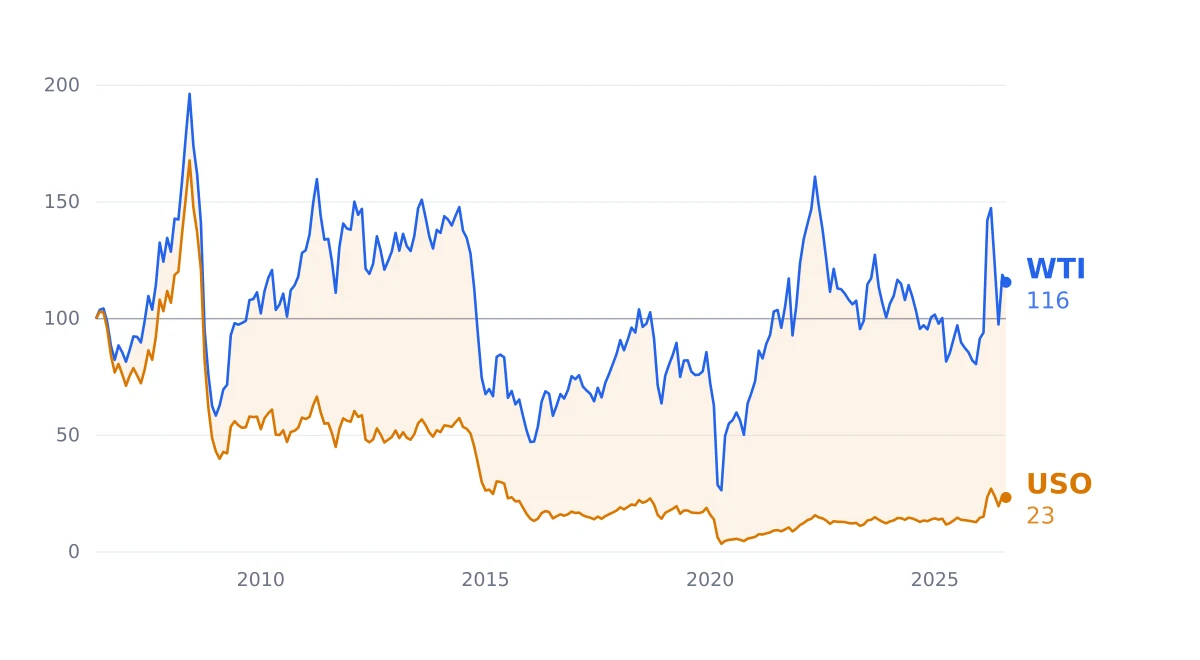
The USO fund and the front-month WTI futures contract since the fund launched, both series rebased to a common start of 100 in May 2006. The price of oil is 16% higher today than it was then; the fund is 77% lower. That gap is not the work of the 0.45% annual management fee but of rolling contracts. Data: Yahoo Finance, monthly closes to 14 August 2026.
The clearest illustration came in 2009, when the spot price of WTI rose 78% but USO added only 14% over the same year. In 2020 the fund lost 68%, while the spot price fell 21%. April’s contract collapse forced it to spread its position across contracts maturing as far out as June 2021 and to carry out a 1-for-8 reverse split; the US Securities and Exchange Commission then fined it 2.5 million dollars in November 2021 over how it had disclosed those changes.
None of this means the fund is badly run — it does exactly what its prospectus says. It means that a futures fund is not the same thing as a barrel of oil in the cellar, and that for holding periods longer than a few weeks that difference has to be priced in beforehand.
3. Oil futures and options
For more advanced investors there are oil futures and options, financial instruments that allow speculation on a rising or falling oil price. A futures contract is a commitment to buy or sell a set quantity of oil at a price agreed in advance for a future date. An option, by contrast, gives the right but not the obligation to buy or sell oil at a pre-agreed price.
These instruments can deliver substantial profits thanks to their high leverage, but they are also very risky. A small move in the price of oil can mean a large gain or loss, which is why this route suits only experienced traders with a high tolerance for risk.
What moves the price of oil?
The price of oil, as with other commodities, depends primarily on supply and demand. As a “fungible” commodity, oil has a standardised value regardless of where it comes from. A thousand barrels of WTI are the same market unit whether they come from Texas or North Dakota. Global stockpiles and the ease with which the commodity moves across borders put pressure on pricing, which means even small swings in supply or demand can have a marked effect on the price.
New sources such as the Canadian oil sands and American shale oil add to global supply and can push the oil price down when demand is high. Extracting from these alternative sources is expensive, however, which means it only makes economic sense at higher oil prices.
The long-term demand outlook has changed substantially in recent years. The International Energy Agency (IEA) no longer works with a single figure but with scenarios: in the one that assumes only policies already adopted, consumption peaks around 2030 at roughly 102 million barrels a day and then turns lower. Growth in consumption in developing countries, in petrochemicals and in aviation is gradually ceasing to outweigh the decline that electric vehicles and more efficient engines are causing in OECD countries.
In the short run, though, it is supply that decides, not the trend. According to the IEA’s monthly report from August 2026, world oil consumption is set to fall by 1.6 million barrels a day this year because of supply outages.
How much oil producers hold in reserve matters just as much. OPEC went through a change in 2026: after the United Arab Emirates left on 1 May it has eleven members and accounts for roughly 31% of world output. More significant than that share, however, is spare capacity, the volume the cartel could bring on stream within a few weeks — today estimated at around 1.1 million barrels a day. When the reserve is that thin, even a local outage shows up in the price immediately.
Note: On 20 April 2020 the American WTI contract for May delivery settled at −37.63 USD a barrel. This was a single expiring contract with physical delivery at Cushing, where storage capacity had run out, and its holders were willing to pay not to have to take the oil. Brent, which settles financially, never went negative — its low was 9.12 USD a day later.