
Where to open a stock market demo account
Both platforms run their demo free of charge and in English. What separates them is the job they suit: eToro the simpler interface and copy trading, XTB the analytical tools inside xStation.
eToro is a multi-asset investment platform. The value of your investments may go up or down. Your capital is at risk.

74% of retail investor accounts lose money when trading CFDs with this provider. You should consider whether you understand how CFDs work and whether you can afford to take the high risk of losing your money.
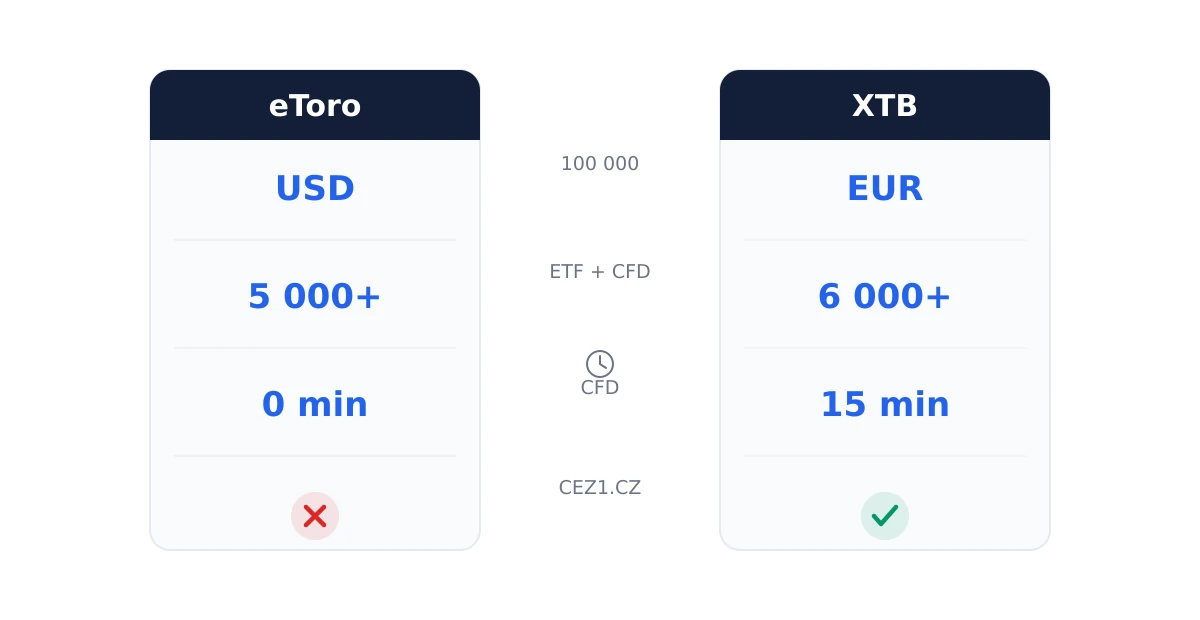
Four differences between the two brokers’ demo accounts. The XTB delay applies to share and ETF CFDs — and for Prague-listed stocks the broker doesn’t state whether they can be traded on the demo.
eToro: real stocks, ETFs and copy trading
eToro answers to several regulators – CySEC in Europe, the FCA in the United Kingdom, ASIC in Australia. Alongside stocks it offers ETFs and CFDs on currencies, commodities, indices and cryptocurrencies.
Shares from twenty exchanges around the world can be bought either as the real underlying asset or in CFD form. The fees differ accordingly:
- Real stocks: a fee of 1 or 2 USD may be charged for opening and closing a position, depending on your country of residence and the exchange where the asset is listed.
- Stock CFDs: the spread is 0.15%; positions in US-listed stocks and ETFs priced at 3 USD or below carry a fee of 0.2 USD per unit.
- ETFs: eToro charges nothing for buying or selling ETFs.
The demo carries 100,000 USD in virtual capital. eToro says it mirrors a live account and runs in the same market conditions, so the demo also shows you how the platform behaves the moment a macroeconomic release moves the market.
Copy trading is the distinctive part. Following and copying other investors’ positions works on the demo as well, so you can let someone else’s strategy run for a month and only then decide whether to put your own money behind it.
XTB: xStation and analytics
XTB gives you 100,000 EUR in virtual funds on the demo and access to more than 6,000 instruments, including stocks, ETFs and forex. The xStation platform is the same one you get on a live account, technical indicators, economic calendar and chart settings included.
XTB charges no commission on real stocks; on CFDs the stock spread runs around 0.2% depending on the market. The broker is regulated by the British FCA, the Cypriot CySEC and the Polish KNF, and it backs the platform with a large education section of webinars and tutorials.
XTB is the choice for anyone who wants to take a market apart in detail – and it is precisely with XTB that the next section deserves a careful read, because it talks about the limits of its demo more openly than the competition.
Which exchanges you can try it on
A stock market demo account means in practice that you get access to the same catalogue of markets as on a live account. eToro lists over eight thousand stocks from more than twenty exchanges, XTB more than 7,100 stocks from the sixteen largest, the US, Polish, German and British markets among them.
One difference between them matters if you want Czech blue chips: XTB carries stocks from the Prague exchange, eToro does not. XTB lists ČEZ under the ticker CEZ1.CZ and Komerční banka as KOMB.CZ, both as a real share denominated in koruna and as a CFD; trading hours follow the Prague exchange, 9:00 to 16:20. Prague does not appear in eToro’s official table of exchanges and there are no pages for individual Czech stocks on its site.
Whether the Czech listings are available on the demo account as well, the broker does not say anywhere. It states neither yes nor no, so the only way to find out is to open a demo and search for the ticker in Market Watch. Expect the demo catalogue to be smaller than the live one: on its education pages XTB talks about roughly 2,100 instruments on the demo against more than ten thousand on a real account.
What a stock demo will not show you
This is where you have to be specific, because a general “a demo is not the same as a live account” helps nobody. These are four differences the brokers themselves describe in their documentation.
The data can be delayed. And it is no marginal exception. XTB states outright for its test account that trading stocks and ETFs in CFD form there runs on a fifteen-minute delay. Interactive Brokers says that on a practice account unsubscribed data for US stocks is delayed by fifteen minutes, and options by fifteen as well, while forex and metals come through with no delay. Real-time data, according to the broker, can only be subscribed to from a fully funded account. Anyone practising intraday stock trading is in that case trading a market that is a quarter of an hour old.
Dividends and corporate actions are ignored on a demo. XTB states explicitly that it pays neither dividends nor other corporate actions on demo accounts. A dividend strategy, or holding a stock through the record date, therefore cannot be tested on a demo – and with a long-term holding the dividend is a substantial part of the return.
Order execution is simplified. XTB writes that execution on the test platform does not take market depth into account, so it always happens at the current price and the size of the transaction has no effect on it. With a liquid US stock that makes no difference; with a small company and a thin order book it does, because the demo buys at a price the real market would never fill you at. Interactive Brokers adds that stop orders and more complex order types are always simulated in practice mode.
A demo cannot simulate emotion. A paper loss is one click away from gone, a real one is not. What comes with it is the urge to win the loss back quickly and the doubt about a strategy that had worked until then. You cannot fully prepare for that in advance, but knowing it is coming softens the blow.
Setting the demo up so the practice is worth something
Set the balance you will actually start with. A hundred thousand dollars looks tempting, but if you plan to deposit a fraction of that, you are practising something entirely different from what you will then be doing. The percentage of the account per trade works out differently and risk is handled differently. At XTB the amount of virtual funds is changed in the Investor Profile under My Accounts and the Demo accounts tab, where every demo has a button for editing the balance.
Switch the fees on. With real stocks the outcome is decided by the order fee and currency conversion; with CFDs there is overnight financing on top. A strategy that looks profitable when you leave the costs out can be a losing one once they are in.
Hold positions as long as you would for real. A stock strategy is judged over months, not days. A demo you close after a week tells you nothing about your strategy.
Keep a journal. For every trade note the instrument, the reason for entry, position size, stop-loss, the result and one sentence on what went well and what did not. A month later you will not remember why you took the trade.
The same routine, only with currency pairs, is covered in our article on the forex demo account. If your interest is the practice itself rather than the broker, there are also free trading simulators that need no registration with a broker at all.
Real stocks, CFDs and ETFs – how the practice differs
Real stocks mean part-ownership of a company. The purchase carries no leverage, the loss is limited to the amount invested and the position can be held for years. On a demo they mainly train stock selection and patience.
Stock CFDs are speculation on price movement with leverage, which regulation caps at 1:5 for retail clients. They train the handling of margin and the stop-loss – and above all how fast leverage can wipe an account down.
ETFs track a basket of stocks at once. On a demo they are useful for checking whether broader exposure suits you better than a bet on individual companies.
A free demo account with no deposit
Opening a practice account takes no deposit and no payment card, just registration and email verification. The broker earns nothing on it and offers it anyway, as every regulated house does, because the demo is its way of letting a client test the platform before sending money to it.
That leads to something worth keeping in mind: the broker’s aim is for you to move to a live account. After you open a demo, an email or a phone call usually follows. There is nothing shady about it, just expect something to be nudging you towards a real deposit before you are ready for one.
When to move to a live account
There is no universal deadline, but there is a sensible guide: consistent results over two to three months, your own rules followed without exceptions, and a written plan of what you buy and why.
Staying on a demo for years, on the other hand, serves no purpose – after a while it stops doing its job precisely because the emotional part is missing. The ideal move is with the smallest amount at which a trade still makes sense, so the psychological jump is as small as possible.
And one more thing that rarely gets said: an open demo account is no proof that you understand risk. ESMA counts it among poor practices when a broker uses the opening of a demo as grounds for concluding that a client understands a product, without checking whether the client ever used it.
Advantages and limits of demo accounts
Advantages
- Practice trading with no risk of losing money
- The same environment and tools as on a live account
- Copy trading available on the demo too (eToro)
What to bear in mind
- Dividends and corporate actions are not paid on a demo
- Order execution ignores market depth
- Stock and ETF CFDs run with a fifteen-minute delay on the XTB demo
- Without real money the emotional side of trading is missing
Frequently asked questions
What is a stock demo account? +
A practice account with virtual funds that runs on the same platform as a live account. It lets you try buying stocks, ETFs and CFDs and test a strategy with no risk of losing real money.
How much virtual money does a demo account offer? +
eToro provides a demo with 100,000 USD in capital, XTB a demo with 100,000 EUR. Both accounts are free and no deposit is needed to open them.
Is a demo account time-limited? +
Terms differ and it pays to check them with the broker directly. XTB states on its education page that the account becomes inactive after thirty days, with the option to extend it, while its own help centre describes a demo with no time limit. Saxo offers a demo for twenty days.
Does a demo account pay dividends? +
XTB states that it pays neither dividends nor other corporate actions on demo accounts. A dividend strategy therefore cannot be tested on a demo and that has to be factored into how you read your results.
Is there a free stock market demo account with no deposit? +
Yes. Every regulated broker runs a practice account free of charge and opening one takes no deposit and no payment card, just registration. Charges come only with trading on a live account.
How does a demo differ from real trading? +
The platform is the same, the data and the order execution are not. XTB reports a fifteen-minute delay on stock and ETF CFDs on the demo, and execution there ignores market depth. The emotions that come with real money are missing as well. Results from a demo therefore do not guarantee success live.