Bitcoin gets called digital gold. Both have a supply that cannot be expanded at will, neither pays anything to the person holding it, and both get bought by people who think money sitting in an account is quietly losing value. The comparison invites a conclusion it does not support - that bitcoin is gold with a faster engine.
Ask which of the two made more money and there are two correct answers. It depends on when you bought, and the gap between the two answers is a hundredfold.
Ten years says bitcoin, five years says gold
Go back ten years, to September 2016, and the contest is settled in the first round. Bitcoin cost 610 dollars and now costs more than 76,000, which is 126 times the money. Gold and the S&P 500 both added roughly 254 per cent over the same stretch.
| period | bitcoin | gold | S&P 500 |
|---|---|---|---|
| 10 years (9/2016 to 8/2026) | +12,500% | +254% | +254% |
| 5 years (9/2021 to 8/2026) | +76% | +164% | +78% |
| largest drawdown from peak | −73% | −23% | −25% |
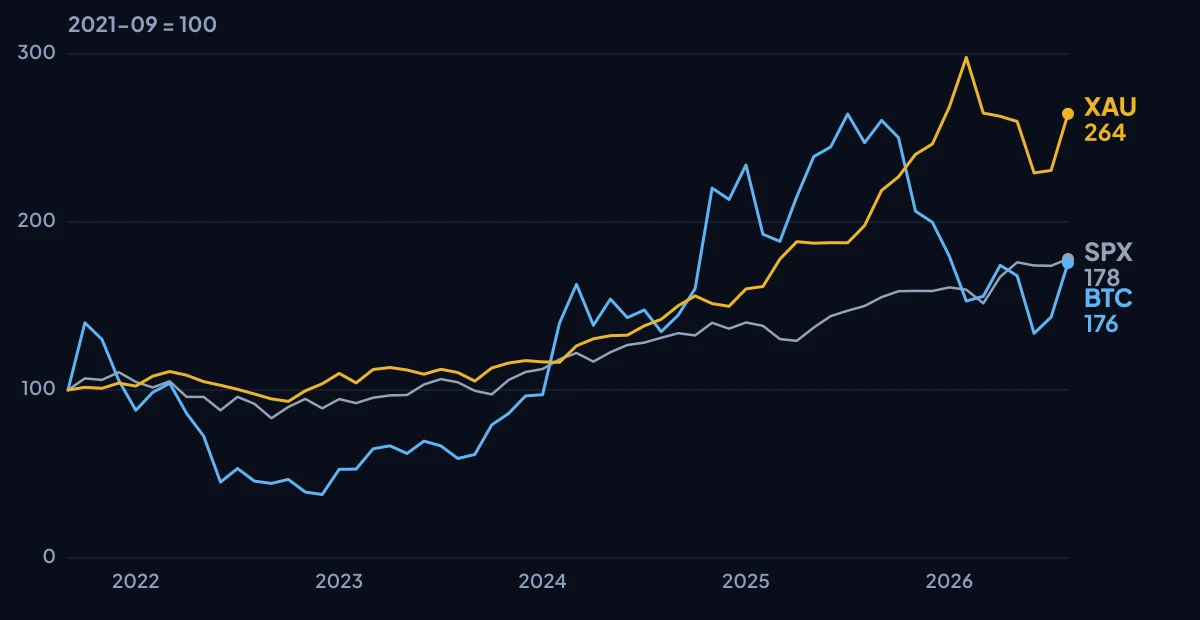
Gold, bitcoin and the S&P 500 since September 2021, each series set to 100 at the start of the period. Source: Yahoo Finance, monthly closing prices for GC=F, BTC-USD and ^GSPC, own calculations.
Since September 2021 gold has added 164 per cent, shares 78 and bitcoin 76. Over the past five years bitcoin has been the worst of the three.
In July 2025 bitcoin reached an index reading of 264, roughly where gold sits today. Then it fell and has not come back. Its peak came on 6 October 2025 at 124,753 dollars and it now trades 38 per cent below that. Gold topped out on 29 January 2026 at 5,318 dollars and has given back 13 per cent.
How far it fell along the way
Across those five years the deepest fall from a peak for bitcoin was 73 per cent, with the low in December 2022. Over ten years it was 76. Gold’s worst drop in the same windows was 23 per cent and US shares 25.
Anyone who wanted the twelve thousand per cent had to watch three quarters of the money disappear first.
One share almost kept pace
Put bitcoin against the shares that did best over the same ten years. Since September 2016 bitcoin has added more than 12,500 per cent. Nvidia has added more than 12,400. On a chart the two cannot be told apart - both are about 126 times the money. The other names that turn up in these comparisons are an order of magnitude behind. Apple added 990 per cent, Microsoft 738, Amazon 520 and Visa 348.
Put in money terms, a thousand dollars invested in September 2016 would now be about 126,000 in bitcoin, 125,000 in Nvidia, 11,000 in Apple and just under four thousand in gold or in the S&P 500.
Nvidia did not need a three-quarters drawdown to get there. And behind Nvidia stands a company that earned those numbers by selling chips.
How much there is and what it costs
Gold has been mined for thousands of years and nobody knows how much is left in the ground. The World Gold Council puts the stock above ground at 220,700 tonnes, two thirds of it dug up since 1950. At 4,482.95 dollars an ounce, the London afternoon price set on 20 August 2026, that comes to roughly 32 trillion dollars.
There will never be more than 21 million bitcoin. Today 20,071,518 exist, almost 96 per cent of the eventual supply. At around 77,000 dollars, every bitcoin in the world is worth 1.55 trillion dollars. Gold is a market twenty times the size.
On the rate at which each one grows, the position reverses. Mines produced 3,672 tonnes of gold in 2025, a record, which added 1.7 per cent to the stock above ground. Bitcoin has been growing by 164,250 a year since the reward halved in April 2024, or 0.82 per cent. The next halving, expected around April 2028, cuts that in half again.
This is the part where the digital gold label fits.
What actually separates them
| gold | bitcoin | |
|---|---|---|
| form | matter | entry in a network |
| divisibility | limited, grams | down to a hundred-millionth |
| transport | slow and costly | minutes, anywhere |
| storage | safe or vault | key on paper or on a device |
| authenticity check | certainty only by destroying a sample | mathematical, anytime and for anyone |
| biggest risk | theft and counterfeit | loss of the key |
Gold is a physical object. It has to sit somewhere, moving it costs money, and checking that it is real needs either a machine or trust in the dealer. In return it cannot be switched off or deleted.
Bitcoin is an entry in a network. Sending it to the other side of the world takes minutes and it divides down to a hundred millionth. The price of that is a key. Lose the key and the coins are gone, and there is nobody to ask for them back.
Shares differ from both. Behind them are companies that earn money and hand part of it back. What gold and bitcoin return rests entirely on somebody paying more for them later.
What holds the gold price up
The biggest buyers of recent years are not private investors but central banks. They hold roughly 38,600 tonnes, 17 per cent of all the gold ever mined, and have bought around a thousand tonnes a year for four years running. In the previous decade the figure was nearer five hundred.
The shape of demand is changing as well. Jewellery used to be the largest single item and made up about half of it only a few years ago. For 2025 it was 31 per cent, and in the second quarter of 2026 just 22. The reason is not fading interest in gold but its price. Fewer pieces are sold because they cost more, and the space that frees up goes to investment demand, meaning bars, coins and funds.
Who owns bitcoin now
The largest corporate holder is Strategy, formerly MicroStrategy, which changed its name in August 2025. By the middle of August 2026 it held 840,447 bitcoin at an average purchase price of 75,385 dollars. At today’s rate the whole position sits at roughly break-even, and this year the company started selling bitcoin for the first time.
The other names that circulate in older articles now matter far less. Tesla holds 11,509 bitcoin and has not touched them since the big sale in 2022. Block has 9,117.
The American exchange-traded funds approved in January 2024 hold more than 1.24 million bitcoin between them, almost 6 per cent of the entire future supply. The largest of them, iShares Bitcoin Trust, runs more than 54 billion dollars. That put bitcoin into portfolios it would never have reached by direct purchase.
Countries have gone the other way. Between 2021 and 2025 El Salvador was the only place on earth where bitcoin was legal tender. Since 1 May 2025 it is not. Its parliament scrapped both the obligation on merchants to accept it and the state-backed conversion into dollars. It was a condition of an International Monetary Fund lending programme.
Where a UK buyer gets it
The thing to understand first is that the coin itself is not regulated here. The FCA says plainly that crypto is largely unregulated in the UK and that anyone buying it should be prepared to lose all the money they put in, with compensation from the Financial Services Compensation Scheme highly unlikely if something goes wrong. What is regulated is the firm and the marketing.
Any business that exchanges crypto or holds it for customers in the UK has to be registered with the FCA under the Money Laundering Regulations. The record since the FCA took the job on in January 2020 explains why the register is worth checking. By 1 August 2026 it had received 412 applications and reached a decision on 391. Registration went to 68 firms, 17 per cent of the total. Another 263 applications were withdrawn, 46 were rejected and 14 were refused outright.
That regime is on its way out. The Financial Services and Markets Act 2000 (Cryptoassets) Regulations 2026 were made in February 2026 and the full regime starts on 25 October 2027, at which point crypto firms will need proper FCA authorisation rather than an anti-money-laundering registration. The application window runs from 30 September 2026 to 28 February 2027, and an existing registration does not convert into authorisation on its own.
The marketing rules have been in force since 8 October 2023, with the more technical parts binding on every firm from 8 January 2024. A first-time customer has to be shown a risk warning, wait out a 24-hour cooling-off period before committing anything, and pass an appropriateness test on the specific type of asset being sold. Free gifts for signing up and refer-a-friend bonuses are banned. The FCA tells consumers what it means if they are offered one anyway - the firm is not following its rules and could be operating illegally, or running a scam.
There is a second route that did not exist two years ago. Since 8 October 2025 retail investors have been able to buy crypto exchange-traded notes on UK recognised investment exchanges such as the London Stock Exchange and Cboe, after a ban that had stood since January 2021. The FSCS does not cover those either, and the ban on selling crypto derivatives to retail investors stays where it is.
Gold is an older and simpler choice. Exchange-traded funds hold the physical metal in a vault and charge an annual fee, which for the two best-known is 0.40 per cent at SPDR Gold Shares and 0.25 at iShares Gold Trust. The sister fund GLDM from the same manager charges 0.10. The other route is bars and coins from a dealer with a certificate, where the premium over spot and the cost of storing it both come on top of the price.
Bitcoin, shares and gold funds are all available on eToro
Real shares and ETFs, a minimum deposit of 50 USD, copy trading and free education.
eToro is a multi-asset investment platform. The value of your investments may go up or down. Your capital is at risk.
The bitcoin price and the gold price are updated continuously on our site.
| one-off | yearly | |
|---|---|---|
| physical gold | 4 to 9 % on buying and selling | storage 0 to 0.75 % |
| gold fund | nothing | 0.10 to 0.40 % |
| bitcoin fund | nothing | 0.15 to 0.25 % |
| bitcoin in your own wallet | network fee | nothing, apart from buying the device |
What the British state does with bitcoin
The Treasury was asked in Parliament in May 2025 whether unclaimed digital assets might be used to set up a bitcoin reserve fund. The written answer of 13 May 2025 from Emma Reynolds, then Economic Secretary to the Treasury, was that HM Treasury has no plans to establish one. The official reserves consist of foreign currency assets, gold and IMF special drawing rights held in the Exchange Equalisation Account, and the answer said bitcoin’s volatility against stable currencies and commodities such as gold makes it less suitable as a reserve asset for the UK.
The state ended up holding a great deal of it anyway, by a route nobody planned. The Metropolitan Police seized 61,000 bitcoin from Zhimin Qian in the largest cryptoasset seizure ever made in the UK, the proceeds of an investment fraud in China with more than 128,000 victims and losses of about 600 million pounds. She was sentenced at Southwark Crown Court in November 2025 to 11 years and 8 months, and Seng Hok Ling to 4 years and 11 months. The Crown Prosecution Service put the value of the seized assets at around 4.8 billion pounds at the time of sentencing, and said it would now pursue criminal confiscation and civil proceedings to keep them out of the fraudsters’ reach. What finally happens to the coins is a matter for the High Court.