A dividend is a share of profit that a company pays out to its shareholders. The entitlement is tied to holding the stock: whoever does not own the share receives nothing, and whoever sells at the wrong moment loses the dividend to the buyer.
How much you receive depends on the number of shares. If a company pays out 100 per share and you hold 100 shares, you receive 10,000. Payments can come once a year, quarterly or monthly — US companies usually pay quarterly, European ones tend to pay once a year.
Four dates you need to know
- Declaration date – the general meeting approves the distribution of profit and the company announces the size of the dividend along with the remaining dates.
- Ex-dividend date – the first trading day on which the share trades without the entitlement to the dividend. Buy it on that day or later and the dividend is no longer yours. The last day on which you still acquire the entitlement is the trading day before the ex-dividend date.
- Record date – the day against which the entries in the shareholder register are read. The entitlement belongs to whoever is recorded as the owner on that day.
- Payment date – the day the money arrives in the account. Several weeks to several months usually pass between the decision of the general meeting and the payment.
The ex-dividend date and the record date are routinely confused, yet they are not synonyms. Their relative position follows purely from how long trade settlement takes. Europe works on T+2, so the ex-dividend date falls on the trading day before the record date. The US market moved to T+1 in May 2024, and since then the ex-dividend date and the record date fall on the same day.
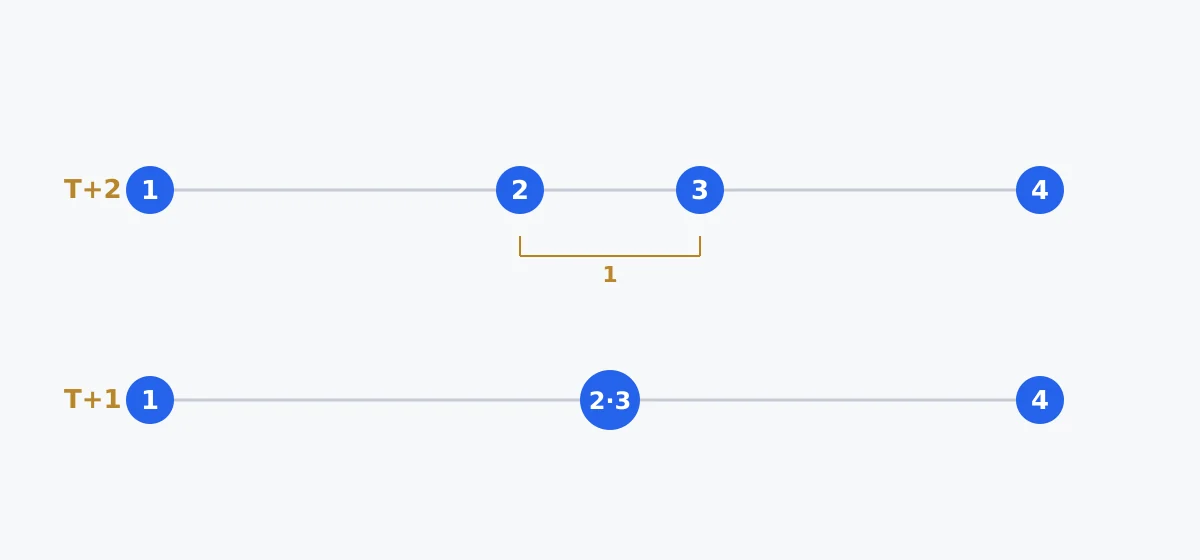 The order is always the same: (1) declaration, (2) ex-dividend date, (3) record date, (4) payment. Under T+2 settlement one trading day separates the ex-dividend date from the record date; under T+1 the two coincide.
Why the price falls before the money arrives
The price drops on the ex-dividend date, not on the payment date. The market prices in the departing entitlement at the moment the share loses it, and the payment itself can be weeks away.
In theory the price falls by the gross dividend, not the net one. The market prices the entitlement itself, not the tax position of a particular holder; that differs between retail investors, funds and foreign owners.
In practice it does not line up exactly. The drop tends to be somewhat smaller than the dividend, because different groups of investors are taxed differently, and above all it is easily swamped by ordinary market movement — at a dividend yield of around 3% the expected drop is so small that on a single stock you often cannot tell it apart at all.
Why the dividend matters
Dividends account for a substantial part of the long-term return on shares, and the S&P 500 illustrates this clearly. Since January 1988 the price index alone has risen roughly 30-fold, while its total return version, with dividends reinvested, has risen more than 60-fold. The gap between the two curves is precisely the dividends.
Paying a dividend also says something about a company, though less than is commonly ascribed to it. A regular dividend means the company has something to pay from; it does not mean the company is healthy — a payout can just as well come from the savings of past years or from debt. Checking that is simple: look at whether the payout matches what the company actually earns.
The third thing is reinvestment. A dividend left sitting in the account stops working. Accumulating funds return it to the portfolio automatically; with individual shares the investor has to do it.
Dividend yield and payout ratio
Two numbers by which dividend stocks are compared.
Dividend yield is the dividend per share divided by the price. For a share at 1,000 with a dividend of 40, that is 4%. Watch whether the figure is quoted before tax or after it — sources often fail to say.
The yield also rises when the price falls. A high dividend yield is therefore not good news in itself; sometimes it is merely a consequence of the market doubting the company.
Payout ratio is the dividend divided by earnings per share and says how much of what was earned the company handed out. The spread is wide — from a few percent at companies saving up for an acquisition to 100% at those distributing the entire profit. A ratio permanently above 100% means the company pays out more than it earns, and it has to take the difference from somewhere.
What to watch out for on tax
Taxation of a dividend has two layers, and they get mixed up.
The first is the tax withheld in the country where the company is domiciled. It leaves before the money reaches the account, and double taxation treaties reduce its rate. With US shares this is most visible: the basic withholding for foreigners is 30%, but the treaty usually cuts it to 15% for a retail investor. The entitlement has to be claimed on the W-8BEN form, which you sign with your broker. Without it the full thirty percent is withheld and the difference is hard to claw back.
The second layer is tax in your own country. That differs from state to state and follows where you are a tax resident — how much you pay, whether the income goes on a return and what you can credit from the tax already withheld are things to check against your own rules.
One thing holds generally: an exemption after a certain holding period usually applies to the profit from selling the share, not to the dividend. The dividend is taxed every time, whether you hold the share for a month or for twenty years.