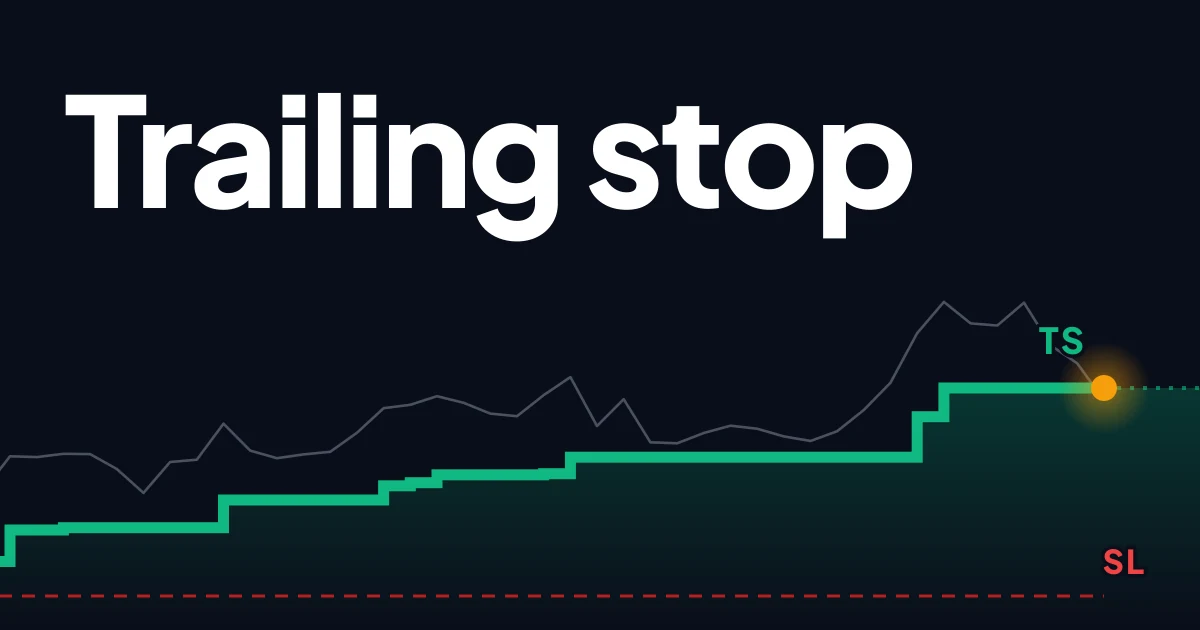
A trailing stop, also known as a trailing stop loss, is a function that automatically optimises the level of your stop loss order. It updates that level whenever the price moves in the direction you predicted. To see how a trailing stop behaves while you trade, you first need to understand what it is there for.
Say you open a position and attach a stop loss that closes it automatically once the loss reaches a certain level. When the market then moves in your favour, wouldn’t it be useful if the stop loss level moved along with it? That is precisely the job the trailing stop order was designed to do.
The basic use of a trailing stop
A trailing stop works as moving protection for profit — a stop loss that follows the trade. It is usually set in points. While the position runs your way, the stop travels behind it into profit. As soon as the market turns, the stop freezes, and once the price falls back by the number of points you set, it closes your position automatically.
- A trailing stop is a dynamic order. It limits the loss from a sharp move against you and at the same time lets the position keep running for as long as the market develops in your direction.
- A trailing stop adjusts itself. It moves up or down behind the position so that profit is locked in as long as the price develops according to plan. It is, in other words, a moving stop loss order.
Before we go on, one caveat. The feature is not available on every platform. One of the platforms that does offer it is eToro. The trailing stop is only one of several order types a platform can put at your disposal, and it pays to know the rest of the list before you use it.
Where it helps and where it hurts
The main benefit of a trailing stop is that it minds the position at the moments when you are not sitting at the chart. Overnight, during your working day or when a headline moves the market, a fixed stop loss will not shift on its own, and the profit already sitting on the trade can hand itself straight back.
That does not make it the better choice every time. In a market without a trend it throws you out of the position too early. The price ticks up, the stop follows it, the price drops back into the range it has been drifting in all day, and the stop is taken out. A fixed stop loss placed below a support level would have left the trade running.
As with an ordinary stop loss order, the selling level of a trailing stop sits below the current market price. The difference is that the trailing stop keeps that level a set distance away from the current price of the instrument. It therefore tracks every move the market makes in your favour, even when the currency pair travels no more than 1/10 of a pip.
When the rate moves against you, the trailing stop stays exactly where it is. The detail is described below.
How it behaves on a long and on a short position
- On a long position (you have bought and expect a rise) the stop moves up every time the price makes a new high. When the price falls or stands still, the stop remains at the highest level it has reached.
- On a short position (you have sold and expect a fall) the stop moves down with every new low. When the price rises or stands still, the stop does not move.
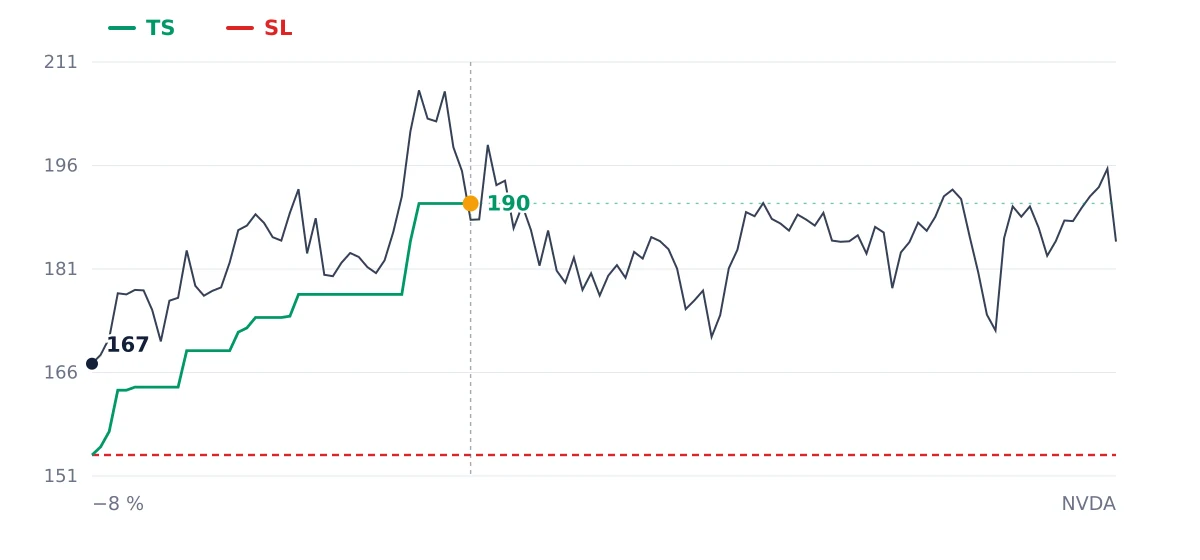
Two stretches of the same stock, with an 8% distance in both. On the left a trending market. Entry at 167, the green trailing stop steps up behind the rising price and closes the trade at 190 after 44 days. On the right a choppy one. Entry at 176, the stop is taken out on day 12 at 167, below the entry, and the price then climbs to 207 without you. The red SL line is the fixed stop, which does not move in either case. Source: Yahoo Finance.
Trading with a trailing stop
When the price of the instrument rises, the trailing stop moves up automatically and proportionally. When the price of the instrument falls, the stop level does not change. With an ordinary stop loss on the chart you have to do all of that by hand, and that is where the trouble starts. Overnight, and often during the day as well, nobody can watch continuously and keep dragging an out-of-date stop loss along. Profit already earned on previous trading days is what gets given away.
In MetaTrader the trailing stop only protects the position while your computer is running and the terminal is open. Unlike a standard stop loss, it is not registered on the broker’s server and is calculated inside the application instead. Switch the machine off and the stop stops moving. It stays at the last level it managed to reach, and that level remains valid on the server.
There are two ways round it. Either run the platform on a virtual server (VPS), or pick a broker that calculates the trailing stop on its own side. Not every broker can, so it pays to check in advance.
A worked example
You buy a share at $100 and set a trailing stop with a distance of $5. The stop therefore starts at $95.
- The price rises to $110. The stop moves to $105.
- The price rises to $120. The stop moves to $115.
- The price falls to $118. The stop stays at $115, because it never travels backwards.
- The price falls to $115. The position closes with a profit of $15 per share.
With a fixed stop loss at $95 the trade would still have been open at that moment, and the profit you had built up could have slipped away.
How to choose the distance
There is no universally correct distance. It follows from how much the instrument normally swings and how long you intend to hold the trade.
A sensible guide is to derive it from real volatility rather than from a round number. That is what the ATR indicator, the average daily range, is for. The best-known rule of that kind is the Chandelier Exit by Charles Le Beau, which on a long position places the stop at the highest high of the last 22 days minus three times the ATR over the same period. The smaller the multiple you choose, the more often ordinary daily movement tears the stop out. The larger it is, the bigger the share of the profit you hand back when the market turns.
The Parabolic SAR indicator rests on a similar principle and works as a trailing stop in its own right, derived from price and time.
What a trailing stop cannot do
A trailing stop is no guarantee of price. The moment your level is touched, it turns into an instruction to sell at once at the nearest available price. When the market opens with a gap below that level, the sale goes through below it, not at it. Overnight, over a weekend or after an earnings release, that is no rarity.
The stop also draws no distinction as to why the price is falling. It behaves the same way in a brief wobble as it does in a reversal of the trend.
What is the difference between a stop loss and a trailing stop?
A trailing stop updates itself automatically, whereas a stop loss stays fixed where you put it.
How does a trailing stop work?
It is a stop that updates itself automatically and optimises the stop loss applied to a position that keeps going up.
Which brokers offer a trailing stop?
Not every broker provides the trailing stop order on MT4 or in its own trading app. Check with the broker before you start trading.