Imagine trading the financial markets with someone else’s money, without putting your own savings on the line. That is what proprietary trading firms sell through funded accounts. So what does a funded account actually mean, and how does the whole arrangement work?
A proprietary trading firm, prop firm for short, looks for capable traders. It then lends them its own capital to trade with. That makes it a different animal from a broker or a fund manager. Both of those look after client money instead.
For the trader the appeal is simple. On a funded account you are not risking your own capital, because the prop firm carries the market risk. In return the firm takes a cut of anything you make. At the bigger firms a trader now keeps 80 percent, and often 90 percent once further conditions are met. The model is aimed at people who have little capital but can trade and can stay inside a rulebook.
How a funded account works
The sequence is clear enough. First you buy a challenge, which is the paid test the firm sets, and prove yourself during the evaluation. The evaluation is a trial period on a simulated account. Only after you pass it do you get a funded account. From then on you share the profits with the firm on agreed terms. The trader usually keeps 80 to 90 percent.
It runs on a simple principle:
- The trader first proves their ability during the evaluation phase
- Once the set criteria are met, they get access to a funded account
- From then on they split the profit with the prop firm
The trader is not risking their own capital. The most they can lose is the evaluation fee. In exchange for the capital, the firm claims a share of the profit, these days usually 10 to 20 percent.
The range is wider than most write-ups suggest. Some programmes drop the trader’s share to 50 or 60 percent. Others push it up to 100 percent, normally for an extra fee or after a longer spell with the firm. Check the exact figure in the terms of the firm you are applying to.
What the evaluation looks like
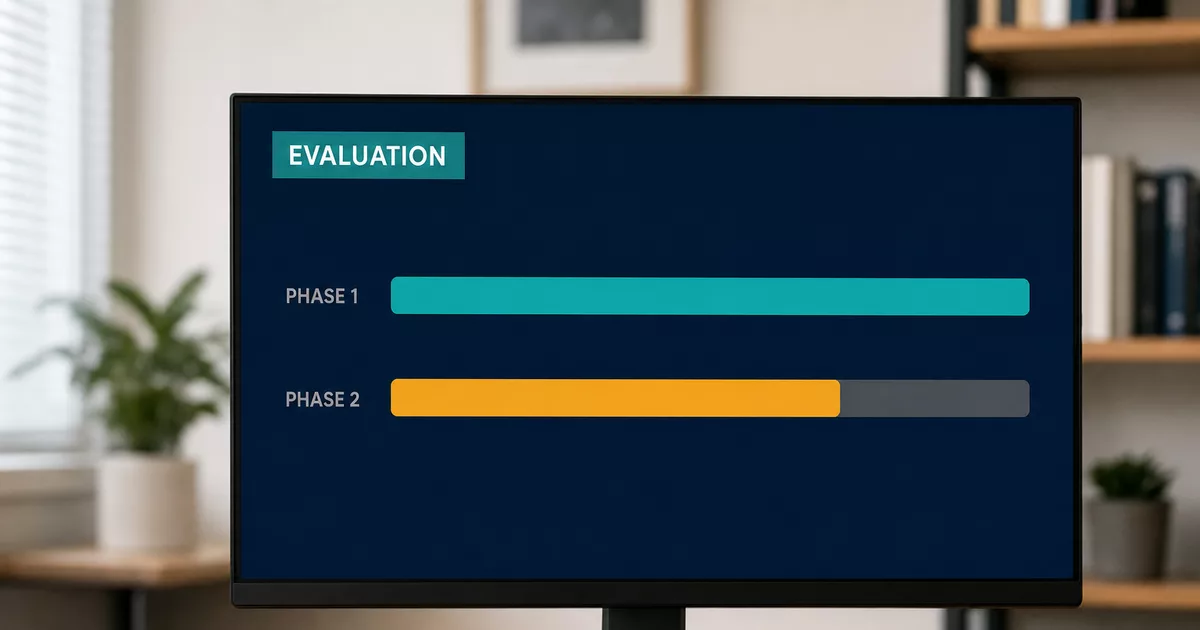
Before a prop firm hands over its capital, you have to get through two rounds of testing. It works rather like applying for a job. First the interview, then the probation period. The entry fee for these rounds starts at around 50 USD and can run into the high hundreds of dollars.
In the first phase you have to show that you can trade profitably while respecting the risk rules. The firm watches your trading closely and checks that you stay inside the limits set for daily and total losses. Each phase also sets a profit target, meaning the amount you have to earn to pass. Fail here and you lose your entry fee. Pass and a second round follows.
The second phase is less about the money and more about consistency. It has to confirm that your trading system keeps working. Think of an athlete defending a title. One good result can be luck, but sustained performance shows real ability.
Step 1
Choosing a firm
A payout record, rules you can understand and a clear contractual counterparty.
Step 2
First phase
Reach the profit target without breaching the loss limits.
Step 3
Second phase
Confirm the result was not luck and the strategy holds up.
The rules it all rests on
- Maximum daily loss — how much you may lose in a single day
- Total drawdown — the lowest the account is allowed to fall overall
- Profit target — how much you must earn to pass the phase
- Position size — a cap on any single trade
- Minimum trading days — one lucky trade is not enough
- Banned practices — typically trading through news releases or at weekends
Only once both phases are behind you do you get access to a live trading account. There you are no longer trading practice money but real capital belonging to the prop firm. The profit is then divided with the firm on the terms agreed beforehand.
So on a live account you work with a large pot of money without putting up your own savings. You share the gains with the firm. The only thing you ever risked was the evaluation fee.
Who it suits:
- You have a strategy that more or less works, but little capital
- You are disciplined and can stick to rules
- You want to take trading seriously
- You have the time
Who it does not suit:
- You have no tested strategy
- You do not really know what trading involves
- You do not want to pay for an evaluation
- Charts bore you
A funded account is not a shortcut to getting rich. It is a way of reaching someone else’s capital, in exchange for a fee and a share of the profit. The outcome is uncertain and the workload is heavy.
What to watch when choosing a firm
You cannot lean on a licence here. Selling evaluations and funded accounts is not an activity the FCA licenses. The vast majority of prop firms hold no permission and do not need one. The picture across the EU is the same. No licensing regime for retail prop trading exists there either.
That has direct consequences. Prop firms, funded accounts and trading challenges sit outside the FCA rulebook, so buying a challenge leaves you unprotected. You cannot take a dispute to the Financial Ombudsman Service, and the Financial Services Compensation Scheme does not cover your money. What the FCA does publish is its Warning List, which names individual unauthorised operators. One entry covers Funded Trader, at funded-trader.net.
Regulators elsewhere in Europe have been more vocal. Belgium’s FSMA issued a warning about the practices of prop firms in March 2024. Italy’s CONSOB followed in a press release of 8 July 2024 and described these offers as a kind of finance video game. It cited complaints about tests pitched to make people try again, and about promised profits that were never shared.
So when a firm waves a licence at you, check the FCA register. Find out which company in the group it covers, and for which activity. It is usually a broker inside the group rather than the entity you pay for the challenge. FTMO is the clearest example. After buying OANDA it owns an FCA-authorised broker, but that permission covers the broker’s business, not the sale of evaluations. A Companies House registration is not a permission to provide financial services either.
Instead of a licence, weigh the things you can verify. A documented payout history. Rules on loss limits and withdrawals that you can actually read. Who your contractual counterparty is. Which platform you will be trading on. Assume that with an unlicensed firm there is nobody to appeal to. The evaluation fee is not a protected deposit.
That the risk is real became obvious in 2024. Roughly 80 to 100 prop firms shut down that year. The trigger was not a regulator but MetaQuotes, the trading platform supplier, which withdrew their MetaTrader licences. A firm with no traceable registered office and no track record is a bet with nothing to enforce.
How much capital a firm hands over
Pass the evaluation and you get access to an account that can range from a few thousand dollars to several hundred thousand. It depends on the plan you buy and on the firm behind it. The size can be raised step by step if you keep to the rules and stay profitable. Some firms run scaling plans that push the ceiling into the millions.
How long before the first results
A month or more can pass between the start of the evaluation and the first real profit. With a solid strategy and tight risk control, the evaluation can be done in a few weeks. Trading on the live account begins as soon as you pass it.
What happens if you break the limits
Breach the maximum loss limit, daily or total, and trading stops automatically. The trader does not lose their own money. The loss is the original evaluation fee. Firms often offer a discount on repeat attempts.