Anyone who leaves a CFD position open overnight for the first time finds an entry in the statement next morning that they never counted on when entering the trade. Brokers call it a swap, an overnight charge or a financing fee — and on positions held for weeks it can turn a decent trade into a losing one.
Two terms get mixed up around this entry. A swap is the interest you pay for the broker financing your leveraged position overnight. A rollover is something else: the switch from an expiring futures contract to the next one on commodity and index CFDs. The first is a running cost, the second a technical operation that should not cost you anything.
Swap: interest on a position held overnight
A CFD is a leveraged product. You put up only a fraction of the position’s value and the broker effectively finances the rest — and borrowed money carries interest.
On currency pairs the cost comes from the interest rate differential between the two currencies. Buy EURUSD and you hold euros while you “owe” dollars: in theory you receive the euro rate and pay the dollar rate. The reference rates today are overnight benchmarks such as ESTR for the euro, SOFR for the dollar or SONIA for sterling.
In practice the broker adds its own markup on top of the differential. That is why both the long and the short side of the same pair routinely pay a negative swap — the rate differential is smaller than the markup applied to each side.
On share and index CFDs the logic is simpler: the long position pays the reference rate plus a markup, the short can in theory earn interest, but the markup usually swallows it. On crypto CFDs expect markedly higher rates.
When it is charged and why Wednesday counts three times
The cut-off is the end of the trading day in New York, 5 p.m. local time, which is 10 p.m. in London. That holds in winter and summer alike, because both sides of the Atlantic move their clocks — the shift cancels out. It is an hour earlier only in the few weeks when the changeover dates diverge: roughly three weeks in March and one week around the turn of October and November. Close the position before that hour and you pay no swap at all. Open it a minute before and you pay for the whole night.
That is the interbank FX convention. Each broker sets its own charging time, and on indices, shares or crypto it is often different from currency pairs, so look it up in the instrument specification.
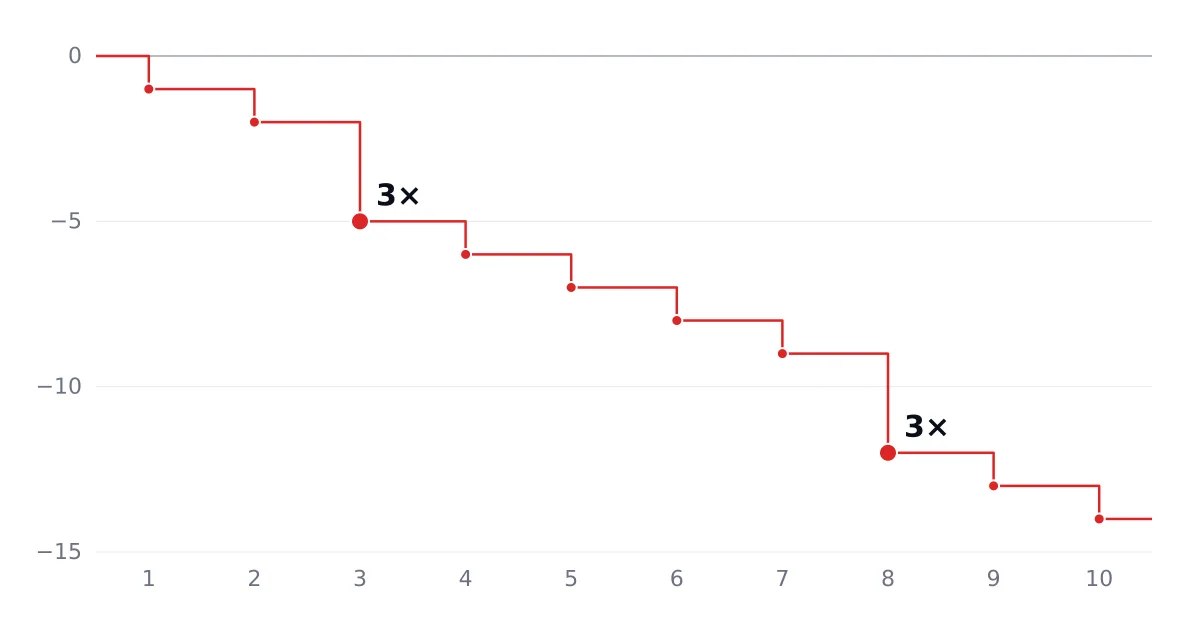
The spot FX market settles two business days after the trade. At the Wednesday rollover the value date therefore jumps from Friday straight to Monday and three days of interest are booked at once: Friday, Saturday and Sunday. Wednesday into Thursday is charged at triple the usual rate, and nothing more is added on Friday or over the weekend on currencies. The weekend is not free, then — it is paid for in advance.
The chart above shows ten such nights over two weeks.
Wednesday is no law, though. On pairs that settle a day earlier the same shift happens a day earlier and the triple charge falls on Thursday night. On share and index CFDs the triple night is usually Friday — there it is not about settlement, simply about adding Saturday and Sunday. And above all: which day it falls on is the broker’s setting, not a rule of the market. Some apply no multiple at all and debit financing on every calendar day including the weekend, while others charge triple on Friday across every instrument, currencies included. Public holidays in the country of either currency shift the date as well. So check the charging day in the instrument specification before you leave a position open over the weekend.
A worked example of how the cost adds up
The numbers below are made up for illustration; they are not any particular broker’s rates. Say that on one lot of EURUSD (100,000 EUR) the swap on a long position is −6.5 USD per night.
You hold the position for two weeks, so ten trading nights. Two of them are Wednesday triples, so the equivalent of fourteen nights is charged: 14 × 6.5 = 91 USD in cost — regardless of whether the trade ended in profit.
The cost grows with position size and time, not with leverage — the swap is calculated on the full notional, so more leverage does not make it cheaper. And 91 USD on a position backed by, say, 2,000 USD of margin is over 4 % of your own capital in two weeks. That is precisely why CFDs do not suit long-term holding.
Rollover: switching the futures contract
Commodity and index CFDs often track the price of a futures contract — and futures expire. As the contract nears its end, the broker moves the whole position to the next contract month. That is the rollover.
The new contract trades at a different price from the old one, so a gap appears on the chart. The broker offsets it with a correcting entry on the account: however far the price jumped up, the account is adjusted the other way by the same amount. The switch itself should therefore create neither profit nor loss.
What to watch for: pending orders, stop losses and take profits set at prices of the old contract. After the rollover they can sit absurdly far from the market — or dangerously close. Brokers publish a rollover calendar with the dates for individual instruments. Check your order levels before the switch date.
On CFDs without expiry (currency pairs, shares, cryptocurrencies) there is no rollover in this sense. Only the swap applies.
How overnight costs differ by market
| Market | Where the cost comes from | What to watch for |
|---|---|---|
| Currency pairs | difference in reference rates ± markup | triple Wednesday night |
| Share CFDs | reference rate + markup | dividend adjustment on a position held over the record date |
| Index CFDs | as with shares, rollover on futures-based versions | rollover calendar, shifted pending orders |
| Commodity CFDs | the futures curve, swap depends on construction | further-out contracts are dearer or cheaper, over a long hold it shows up in the result |
| Crypto CFDs | daily financing rate | the weekend is always paid for, one broker debits it nightly, another in a single go |
One more note on shares: if a CFD is held over the dividend record date, the broker credits the long position an adjustment matching the dividend and debits it from the short. It is neither a bonus nor a penalty, just an offset for the price falling by the dividend.
Where to find the rates and how to tame the cost
You will find the swap in the instrument specification — look for “swap long” and “swap short”, quoted in points per lot per night or as a percentage per year. Convert the points into money using the point value for your position size. Only then does the number mean anything.
A day trader ignores the swap entirely. On a position running for weeks, work it out in advance and build it into the trade plan; it can outweigh even a decent price move. For a hold of several months, consider whether buying the underlying outright makes more sense than a CFD: real shares and ETFs carry no swap.
There are also swap-free accounts. The interest is replaced by a fixed holding fee, which the broker typically starts charging only after a few free nights, commonly three to five. The spread stays the same, and swap-free usually covers selected instruments only: on exotic pairs, energy and cryptocurrencies the swap keeps running. The broker is not giving up the financing, only renaming it.